Question
Can static friction do nonzero work on an object? If yes, give an example. If no, give reason.

Answer

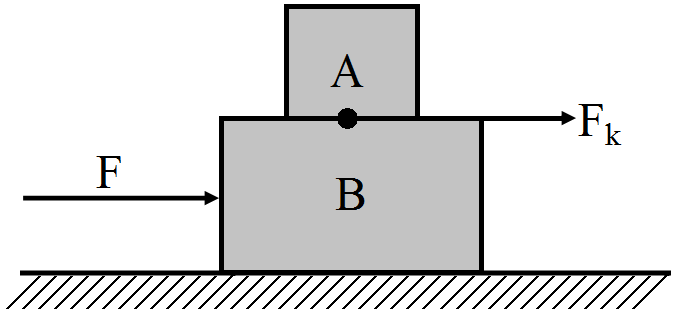
Yes. Let us consider a block A which is resting on another block B. Block B is resting on a smooth horizontal surface. Let the coefficient of kinetic friction between the blocks be $\mu\text{k}.$
When a force F is applied on block B in the forward direction as shown in the above figure, block A moves with block B in the direction of the applied force. The friction force on block A and the displacement will be in the forward direction. Therefore, work done by the friction force is positive. In this case, block A will remain in contact with block B. This shows that static friction is doing a nonzero work on an object.

Need a full question paper?

Generate a complete, print-ready paper with questions like this in minutes — across 16+ boards, with answer keys.
Start Generating Free

Similar questions

Find the increase in surface energy when a large drop of water is sprayed into small droplets.
Separation of Motion of a system of particles into motion of the centre of mass and motion about the centre of mass: Show $\frac{\text{dL}}{\text{dt}}=\sum\text{r}'_\text{i}\times\frac{\text{dp}'}{\text{dt}}$ Further, show that $\frac{\text{dL}'}{\text{dt}}=\tau'_\text{ext}$ where $\tau'_\text{ext}$ is the sum of all external torques acting on the system about the centre of mass. (Hint: Use the definition of centre of mass and third law of motion. Assume the internal forces between any two particles act along the line joining the particles)
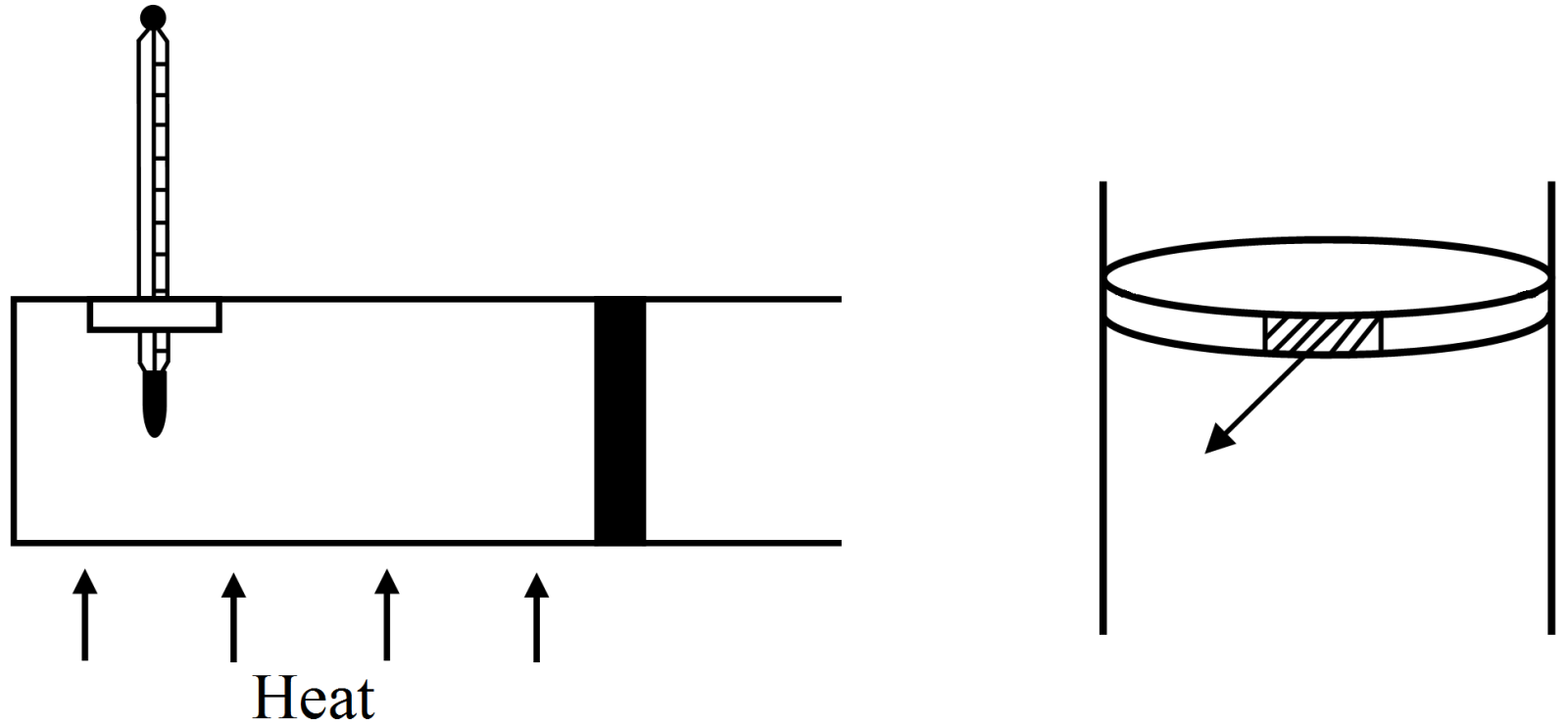
Figure. shows a cylindrical tube of radius 5cm and length 20cm. It is closed by a tight-fitting cork. The friction coefficient between the cork and the tube is 0.20. The tube contains an ideal gas at a pressure of 1 atm and a temperature of 300K. The tube is slowly heated and it is found that the cork pops out when the temperature reaches 600K Let dN denote the magnitude of the normal contact force exerted by a small length dl of the cork along the periphery (see the figure). Assuming that the temperature of the gas is uniform at any instant, calculate $\frac{\text{dN}}{\text{dl}}.$
The ceiling of a long hall is $25m$ high. What is the maximum horizontal distance that a ball thrown with a speed of $40ms^{-1}$ can go without hitting the ceiling of the hall?
A truck is pulling a car out of a ditch by means of a steel cable that is $9.1m$ long and has a radius of $5mm$. When the car just begins to move, the tension in the cable is $800N$. How much has the cable stretched? (Young’s modulus for steel is $2 \times 10^{11}N m^{–2}.)$
A cylinder with a movable piston contains $3$ moles of hydrogen at standard temperature and pressure. The walls of the cylinder are made of a heat insulator, and the piston is insulated by having a pile of sand on it. By what factor does the pressure of the gas increase if the gas is compressed to half its original volume?
Two trains A and B of length $400m$ each are moving on two parallel tracks with a uniform speed of $72km h^{–1}$ in the same direction, with A ahead of B. The driver of B decides to overtake A and accelerates by $1m s^{–2}$. If after $50s$, the guard of B just brushes past the driver of A, what was the original distance between them?
A convex lens has a focal length of 10cm. Find the location and nature of the image if a point object is placed on the principal axis at a distance of:
  1. 9.8cm
  2. 10.2cm from the lens.
Find at what temperature the velocity of sound is air will be $1\frac{1}{2}$ times the velocity at 11°C.
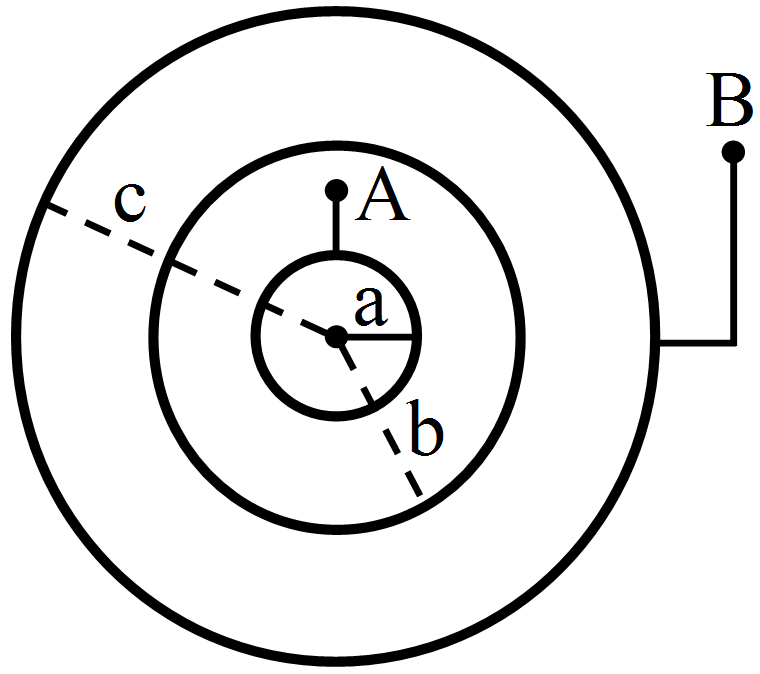
Consider an assembly of three conducting concentric spherical shells of radii a, b and c as shown in figure. Find the capecitance of the assembly between the poima A and B