Question
Can the work by kinetic friction on an object be positive? Zero?

Answer

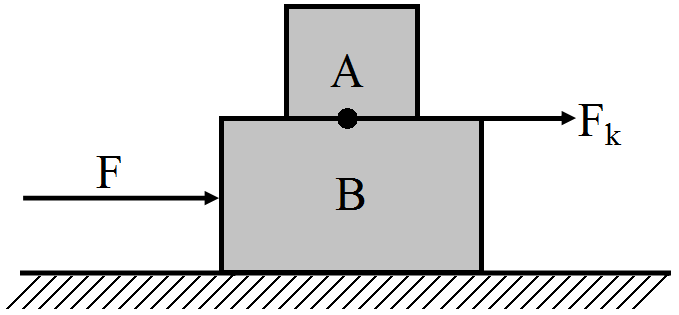
Yes. Let us consider a block A which is resting on another block B. Block B is resting on a smooth horizontal surface. Let the coefficient of friction between the blocks be $\mu.$

When a force is applied on block B in the forward direction as shown in the above figure, block A moves with block B in the direction of the applied force. The frictional force on block A and the displacement will be in the forward direction. Therefore, work done by the frictional force is positive.

If we consider the reference frame of block B, then displacement of block A will be zero. Therefore, work done by the frictional force is zero.

Need a full question paper?

Generate a complete, print-ready paper with questions like this in minutes — across 16+ boards, with answer keys.
Start Generating Free

Similar questions

What do you understand by a solenoid? Obtain an expression for magnetic field of a solenoid of infinite length.###Establish a formula for magnetic field on the axis inside of a straight and long solenoid. Show the direction of magnetic field inside it and what is the magnitude of magnetic field outside the solenoid.###Establish a formula for magnetic field inside a long solenoid. Represent produced force lines by diagram.###Write Ampere's circuital law. Obtain an expression for magnetic field on the axis of a very long current carrying solenoid. Draw necessary diagram also.
Can $\text{L}_\alpha$ X-ray of one material have shorter wavelength than $\text{K}_\alpha$ X-ray of another?
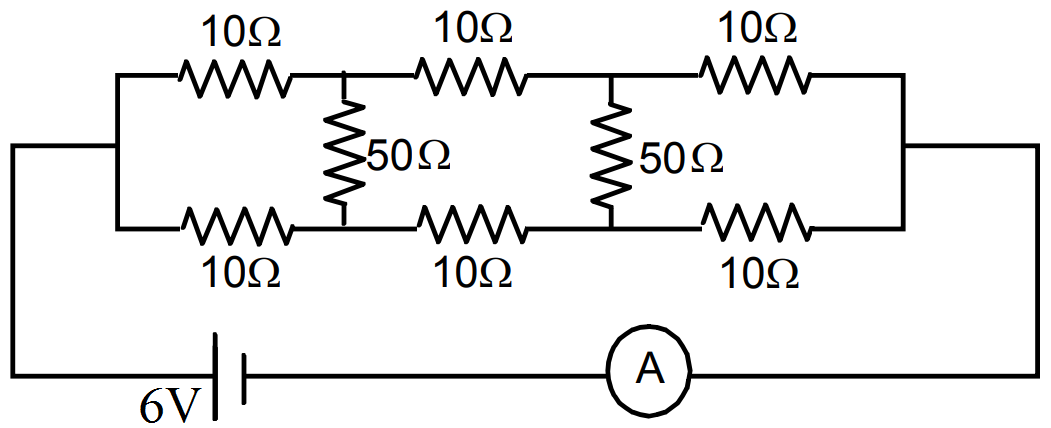
Find the current measured by the ammeter in the circuit shown in the figure.

Do the same exercise as above with the replacement of the earlier transformer by a 40, 000-220V step-down transformer (Neglect, as before, leakage losses though this may not be a good assumption any longer because of the very high voltage transmission involved). Hence, explain why high voltage transmission is preferred?
Oxygen is filled in a closed metal jar of volume 1.0 × 10⁻³m3 at a pressure of 1.5 × 10⁵Pa and temperature 400K. The jar has a small leak in it. The atmospheric pressure is 1.0 × 10⁵Pa and the atmospheric temperature is 300K Find the mass of the gas that leaks out by the time the pressure and the temperature inside the jar equalise with the surrounding.
A long straight horizontal cable carries a current of 2.5 A in the direction 10° south of west to 10° north of east. The magnetic meridian of the place happens to be 10° west of the geographic meridian. The earth’s magnetic field at the location is 0.33 G, and the angle of dip is zero. Locate the line of neutral points (ignore the thickness of the cable). (At neutral points, magnetic field due to a current-carrying cable is equal and opposite to the horizontal component of earth’s magnetic field.)
A ball is kept at a height h above the surface of a heavy transparent sphere made of a material of refractive index $\mu.$ The radius of the sphere is R. At t = 0, the ball is dropped to fall normally on the sphere. Find the speed of the image formed as a function of time for $\text{t}<\sqrt{\frac{2\text{h}}{\text{g}}}.$ Consider only the image by a single refraction.
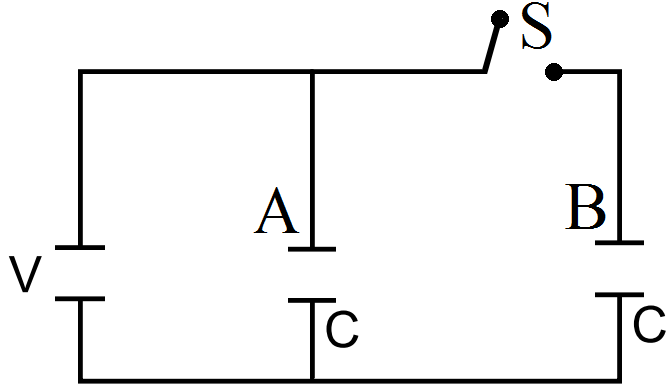
Figure shows two identical parallel plate capacitors connected to a battery through a switch S. Initially, the switch is closed so that the capacitors are completely charged. The switch is now opened and the free space between the plates of the capacitors is filled with a dielectric of dielectric constant 3. Find the ratio of the initial total energy stored in the capacitors to the final total energy stored.

A motorcycle has to move with a constant speed on an overbridge which is in the form of a circular arc of radius R and has a total length L. Suppose the motorcycle starts from the highest point.
  1. What can its maximum velocity be for which the contact with the road is not broken at the highest point?
  2. If the motorcycle goes at speed $\frac{1}{\sqrt2}$ times the maximum found in part (a), where will it lose the contact with the road?
  3. What maximum uniform speed can it maintain on the bridge if it does not lose contact anywhere on the bridge?
Suppose the ends of the coil in the previous problem are connected to a resistance of $100\Omega.$ Neglecting the reaiatance of the coil, find the heat produced in the circuit in one minute.