Question
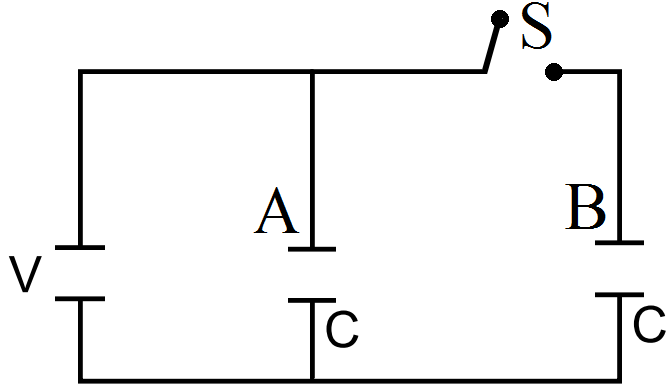
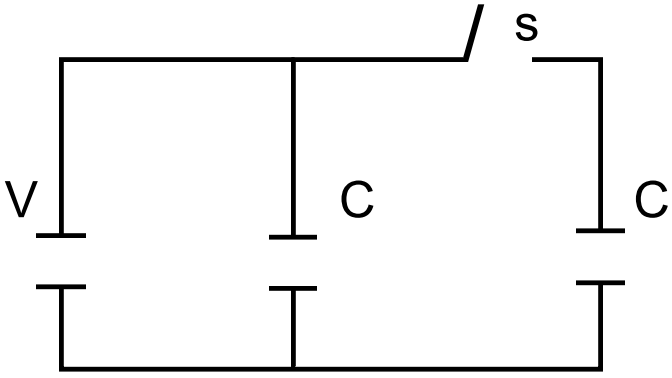
Figure shows two identical parallel plate capacitors connected to a battery through a switch S. Initially, the switch is closed so that the capacitors are completely charged. The switch is now opened and the free space between the plates of the capacitors is filled with a dielectric of dielectric constant 3. Find the ratio of the initial total energy stored in the capacitors to the final total energy stored.
Answer


Initially when switch ‘s’ is closed

Total Initial Energy $=\Big(\frac{1}{2}\Big)\text{CV}^2+\Big(\frac{1}{2}\Big)\text{CV}^2=\text{CV}^2\ \dots(1)$

When switch is open the capacitance in each of capacitors varies, hence the energy also varies.

i.e. in case of ‘B’, the charge remains.

Same i.e. cv

$\text{C}_{\text{eff}}=3\text{C}$

$\text{E}=\frac{1}{2}\times\frac{\text{q}^2}{\text{c}}$

$=\frac{1}{2}\times\frac{\text{c}^2\text{v}^2}{3\text{c}}=\frac{\text{cv}^2}{6}$

In case of 'A'

$\text{C}_{\text{eff}}=3\text{c}$

$\text{E}=\frac{1}{2}\times\text{C}_{\text{eff}}\text{v}^2$

$=\frac{1}{2}\times\text{3c}\times\text{v}^2=\frac{3}{2}\text{cv}^2$

Total final energy $=\frac{\text{cv}^2}{6}+\frac{3\text{cv}^2}{2}=\frac{10\text{cv}^2}{6}$

Now, $\frac{\text{Initial Energy}}{\text{Final Energy}}=\frac{\text{cv}^2}{\frac{10\text{cv}^2}{6}}=3$

Need a full question paper?

Generate a complete, print-ready paper with questions like this in minutes — across 16+ boards, with answer keys.

Start Generating Free

Similar questions

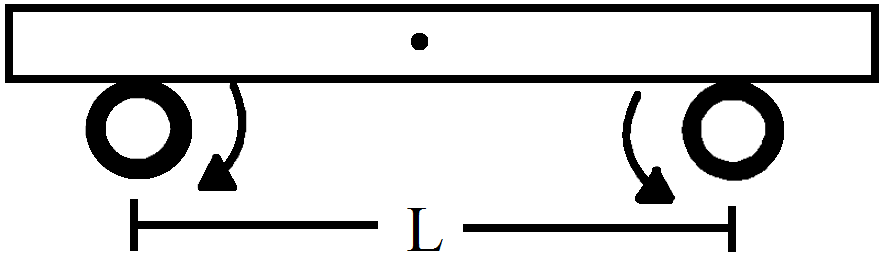
A uniform plate of mass M stays horizontally and symmetrically on two wheels rotating in opposite directions figure The separation between the wheels is L. The friction coefficient between each wheel and the plate is N. Find the time period of oscillation of the plate if it is slightly displayed along its length and released.

Two particles A and B, having opposite charges 2.0 × 10-6C and 2.0 × 10-6C, are placed at a separation of 1.0cm.
  1. Write down the electric dipole moment of this pair.
  2. Calculate the electric field at a point on the axis of the dipole 1.0m awa.y from the centre.
  3. Calculate the electric field at a point on the perpendicular bisector of the dipole and 1.0m away from the centre.
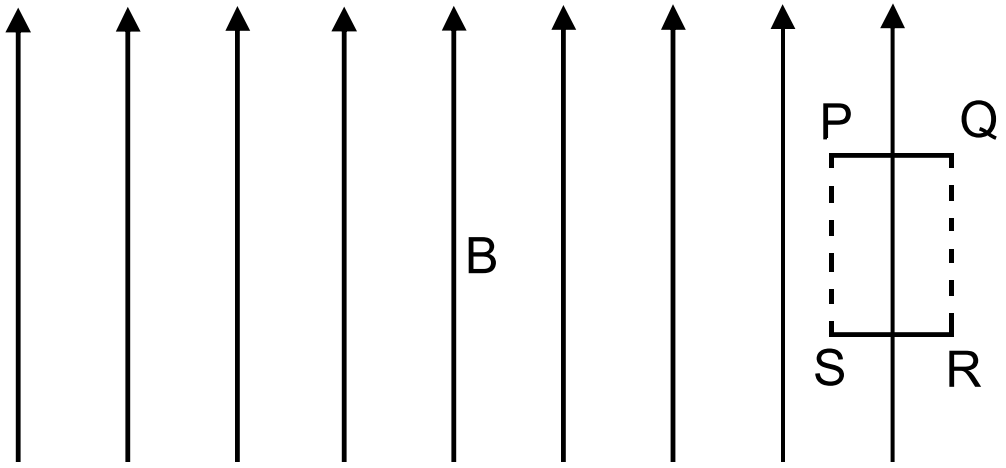
Sometimes we show an idealised magnetic field which is uniform in a given region and falls to zero abruptly. One such field is represented in figure. Using Ampere's law over the path PQRS, show that such a field is not possible.

In a gamma decay process, the internal energy of a nucleus of mass M decreases, a gamma photon of energy E and linear momentum $\frac{\text{E}}{\text{c}}$ is emitted and the nucleus recoils. Find the decrease in internal energy.
The wavelength of sodium light in air is 589nm.
  1. Find its frequency in air.
  2. Find its wavelength in water (refractive index = 1.33).
  3. Find its frequency in water.
  4. Find its speed in water.
The heavier block in an Atwood machine has a mass twice that of the lighter one. The tension in the string is 16.0N when the system is set into motion. Find the decrease in the gravitational potential energy during the first second after the system is released from rest.
A car moving at a speed of 36 km/hr is taking a turn on a circular road of radius 50m. A small wooden plate is kept on the seat with its plane perpendicular to the radius of the circular road (figure In). A small block of mass 100g is kept on the seat which rests against the plate. The friction coefficient between the block and the plate is $\mu=0.58.$
  1. Find the normal contact force exerted by the plate on the block.
  2. The plate is slowly turned so that the angle between the normal to the plate and the radius of the road slowly increases. Find the angle at which the block will just start sliding on the plate.

A conducting square loop having edges of length 2.0cm is rotated through 180° about a diagonal in 0.20s. A magnetic field B exists in the region which is perpendicular to the loop in its initial position. If the average induced emf during the rotation is 20mV, find the magnitude of the magnetic field.
An electron is projected horizontally with a kinetic energy of 10keV. A magnetic field of strength 1.0 × 10⁻⁷T exists in the vertically upward direction.
  1. Will the electron deflect towards the right or left of its motion?
  2. Calculate the sideways deflection of the electron while travelling through 1m. Make appropriate approximations.
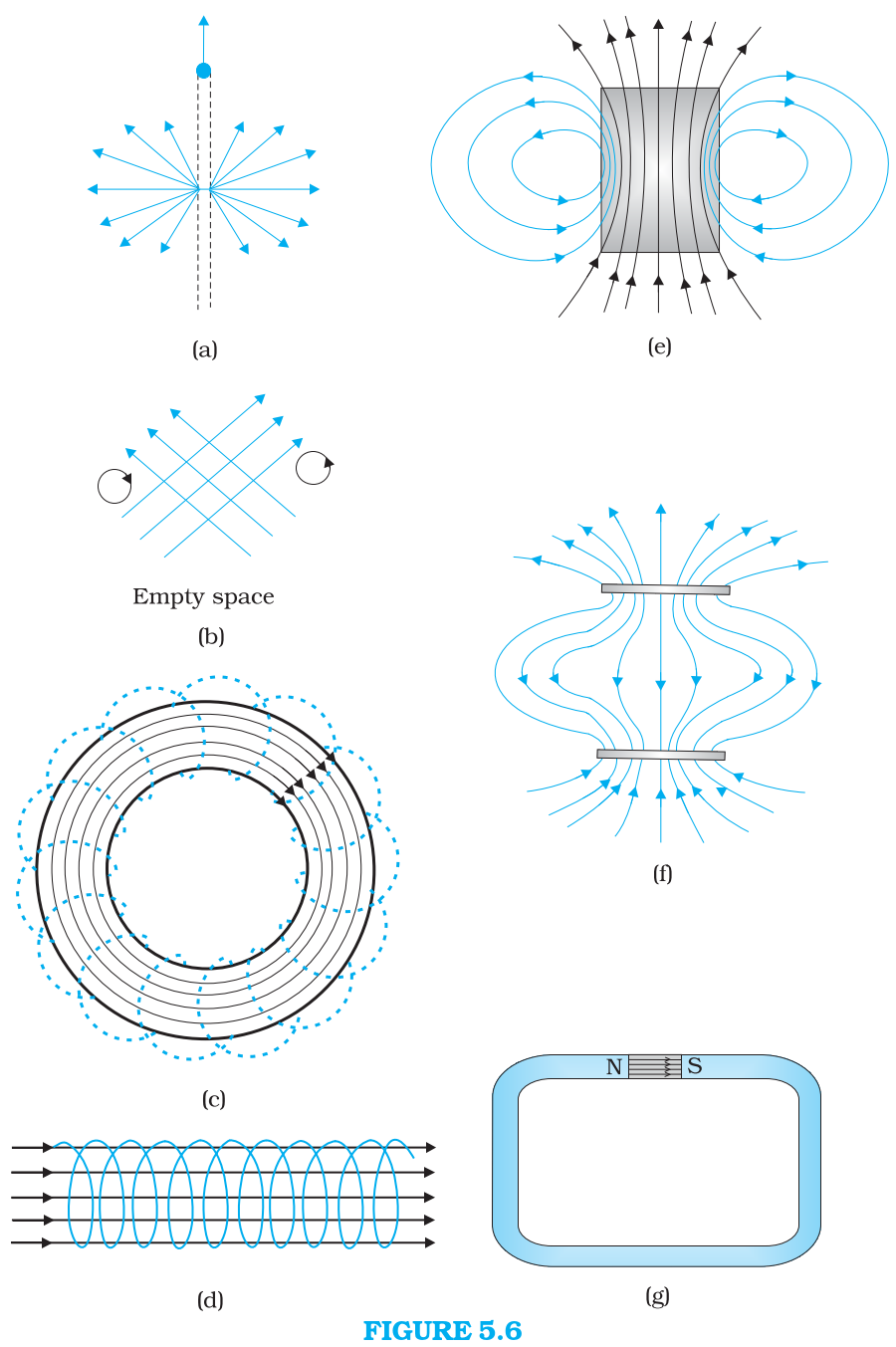
Many of the diagrams given in Fig. 5.7 show magnetic field lines (thick lines in the figure) wrongly. Point out what is wrong with them. Some of them may describe electrostatic field lines correctly. Point out which ones.
Image