Question
Can two equipotential surfaces cut each other?

Answer

At the point of intersection, two normals can be drawn. Also, we know that electric field lines are perpendicular to the equipotential surface. This implies that at that point two different directions of the electric field are possible, which is not possible physically.
Hence, two equipotential surfaces cannot cut each other.

Need a full question paper?

Generate a complete, print-ready paper with questions like this in minutes — across 16+ boards, with answer keys.
Start Generating Free

Similar questions

Consider the circular motion of the earth around the sun. Which of the following statements is more appropriate?
  1. Gravitational attraction of the sun on the earth is equal to the centripetal force.
  2. Gravitational attraction of the sun on the earth is the centripetal force.
Draw the circuit diagram showing how a p-n junction diode is
i. forward biased
ii. reverse biased
How is the width of depletion layer affected in the two cases?
A particle moves in a circle of diameter $1.0\ cm$ under the action of a magnetic field of $0.40T.$ An electric field of $200 Vm^{-1}$ makes the path straight. Find the charge/ mass ratio of the particle.
Explain electric potential energy difference and discuss its important points.
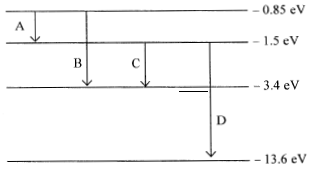
The energy level diagram of an element is given below. Identify, by doing necessary calculations, which transition corresponds to the emission of a spectral line of wavelength $102.7 \ nm$.
 
The density of water at $0^\circ C$ is $0.998g \ cm^{-3}$ and at $4^\circ C$ is $1000g \ cm^{-3}.$Calculate the average coefficient of volume expansion of water in the temperature range $0$ to $4^\circ C.$
In a Young’s double$-$slit experiment, the slits are separated by $0.28\ mm$ and the screen is placed $1.4 m$ away. The distance between the central bright fringe and the fourth bright fringe is measured to be $1.2 \ cm.$ Determine the wavelength of light used in the experiment.
Water is boiled in a container having a bottom of surface area $25\ cm^2,$ thickness $1.0\ mm$ and thermal conductivity $50\text{wm}^{-1}{^{\circ}}\text{C}^{-1}. 100g$ of water is converted into steam per minute in the steady state after the boiling starts. Assuming that no heat is lost to the atmosphere, calculate the temperature of the lower surface of the bottom. Latent heat of vaporization of water $=0.26\times10^6\text{Jkg}^{-1}.$
The electric field associated with a monochromatic beam becomes zero $1.2 \times 10^{15}$ times per second. Find the maximum kinetic energy of the photoelectrons when this light falls on a metal surface whose work function is $2.0\ eV.$
A 3.0 cm wire carrying of 10 A is placed inside a solenoid perpendicular to its axis. The magnetic field inside the solenoid is given to be 0.27 T. What is the magnetic force on the wire?