Question
Can two equipotential surfaces cut each other?

Answer

At the point of intersection, two normals can be drawn. Also, we know that electric field lines are perpendicular to the equipotential surface. This implies that at that point two different directions of the electric field are possible, which is not possible physically.
Hence, two equipotential surfaces cannot cut each other.

Need a full question paper?

Generate a complete, print-ready paper with questions like this in minutes — across 16+ boards, with answer keys.
Start Generating Free

Similar questions

The earth-moon distance is about $60$ earth radius. What will be the diameter of the earth (approximately in degrees) as seen from the moon?
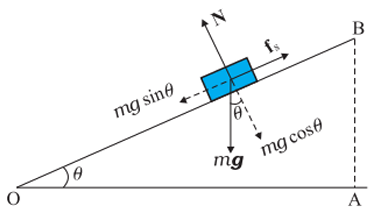
A mass of 4 kg rests on a horizontal plane. The plane is gradually inclined until at an angle $\theta=15^{\circ}$ with the horizontal, the mass just begins to slide. What is the coefficient of static friction between the block and the surface?
Image
Find the potential energy of a system of four particles placed at the vertices of a square of side $l$. Also obtain the potential at the centre of the square.
What is the pressure inside the drop of mercury of radius $3.00mm$ at room temperature? Surface tension of mercury at that temperature $(20^\circ C) is 4.65 \times 10^{–1}N m^{–1}$. The atmospheric pressure is $1.01 × 10⁵Pa$. Also give the excess pressure inside the drop.
Consider a sunlike star at a distance of 2 parsecs. When it is seen through a telescope with 100 magnification, what should be the angular size of the star? Sun appears to be $\Big(\frac{1}{2}\Big)^0$ from the earth. Due to atmospheric fluctuations, eye can’t resolve objects smaller than 1 arc minute.
An electric field of $20NC^{-1}$ exists along the $x-$axis in space. Calculate the potential difference $V_B - V_A$ where the points $A$ and $B$ are given by,
  1. $A = (0, 0); B = (4m, 2m)$
  2. $A = (4m, 2m); B = (6m, 5m)$
  3. $A = (0, 0); B = (6m, 5m)$
Do you find any relation between the answers of parts $(a), (b)$ and $(c)\ ?$
Define 'Radius of Gyration'. Derive an expression for it.
A body is released at a distance r from the centre of the earth. Prove that the velocity v of the body when it strikes the surface of the earth is given by, $\text{v}=\text{R}\Big[2\text{g}\Big(\frac{1}{\text{R}}-\frac{1}{\text{r}}\Big)\Big]^{\frac{1}{2}}$ where R is the radius of the earth r > R.
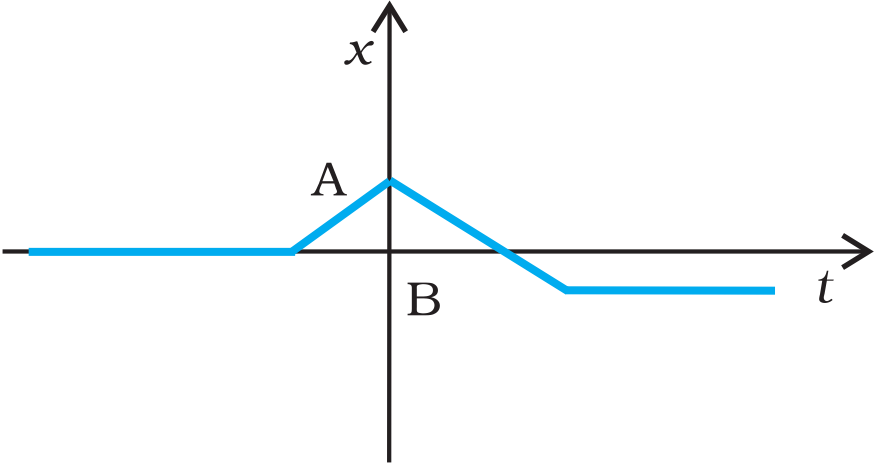
Suggest a suitable physical situation for of the following graphs.
To simulate car accidents, auto manufacturers study the collisions of moving cars with mounted springs of different spring constants. Consider a typical simulation with a car of mass $1000 \ kg$ moving with a speed $18.0 \ km / h$ on a smooth road and colliding with a horizontally mounted spring of spring constant $5.25 \times 10^3 N m ^{-1}$. What is the maximum compression of the spring?