MCQ
Can two isothermal curves cut each other
  • Never
  • B
    Yes
  • C
    They will cut when temperature is $0°C$
  • D
    Yes, when the pressure is critical pressure

Answer

Correct option: A.
Never
a
(a) If isothermal curves cut each other then at equilibrium two temperature will be there which is impossible.

Need a full question paper?

Generate a complete, print-ready paper with questions like this in minutes — across 16+ boards, with answer keys.
Start Generating Free

Similar questions

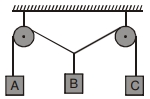
Three blocks $A, B$ and $C$ are suspended as shown in the figure. Mass of each blocks $A$ and $C$ is $m$. If system is in equilibrium and mass of $B$ is $M$, then :
Two factories are sounding their sirens at $800\, Hz$ . A man goes from one factory to other at a speed of $2\,m/s$. The velocity of sound is $320\, m/s$. The number of beats heard by the person in one second will be
A ball is dropped from height $5\,\,m$. The time after which ball stops rebounding if coefficient of restitution between ball and ground $e = 1/2$, is ............. $\mathrm{sec}$
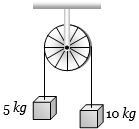
Two masses as shown are suspended from a massless pulley. Calculate the acceleration of the system when masses are left free
A body is projected from ground obliquely. During downward motion, power delivered by gravity to it
Select wrong statement about simple,harmonic motion
In the following problems, indicate the correct direction of friction force acting on the cylinder, which is pulled on a rough surface by a constant force $F$. $A$ spool is pulled vertically by a constant force $F ( < Mg)$ as shown in figure The friction force canbe given by which of the following diagrams
A bomb travelling in a parabolic path explodes in mid air. The centre of mass of fragments will:
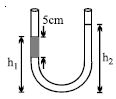
An open-ended $U$-tube of uniform cross-sectional area contains water (density $1.0 $ gram/centimeter$^3$) standing initially $20$ centimeters from the bottom in each arm. An immiscible liquid of density $4.0$ grams/ centimeter $^3$ is added to one arm until a layer $5$ centimeters high forms, as shown in the figure above. What is the ratio $h_2/h_1$ of the heights of the liquid in the two arms?
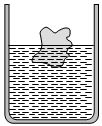
A body floats in a liquid contained in a beaker. If the whole system as shown in figure falls freely under gravity, then the upthrust on the body due to liquid is