MCQ
Can we boil water inside the earth satellite by convection
  • A
    Yes
  • No
  • C
    Nothing can be said
  • D
    In complete information is given

Answer

Correct option: B.
No
b
(b) No, In convection the hot liquid at the bottom becomes lighter and hence it rises up. In this way the base of the convection is the difference in weight and upthrust. In the state of weightlessness this difference does not occur, so convection is not possible.

Need a full question paper?

Generate a complete, print-ready paper with questions like this in minutes — across 16+ boards, with answer keys.

Start Generating Free

Similar questions

$T$ is the time period of simple pendulum on the earth's surface. Its time period becomes $x T$ when taken to a height $R$ (equal to earth's radius) above the earth's surface. Then, the value of $x$ will be:
During a blood transfusion a needle is inserted in a vein where the gauge pressure is $2000\,Pa$. At what height must the blood container be placed so that blood may just enter the vein ?

[Density of blood $= 1.06 \times 10^3\,kgm^{-3}$ ].
The angular momentum of a particle performing uniform circular motion is $L$. If the kinetic energy of partical is doubled and frequency is halved, then angular momentum becomes
If a unit vector is represented by $0.5\hat{\text{i}}+0.8\hat{\text{j}}+\text{c}\hat{\text{k}},$ then the value of 'c' is:
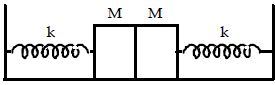
An assembly of identical spring-mass systems is placed on a smooth horizontal surface as shown. Initially the springs are relaxed. The left mass is displaced to the left while the right mass is displaced to the right and released. The resulting collision is elastic. The time period of the oscillations of the system is :-
In the wave equation $y =0.5 \sin \frac{2 \pi}{\lambda}(400 t - x )\,m$  the velocity of the wave will be ......... $m / s$
A particle performs simple harmonic oscillation of period $T$ and the equation of motion is given by; 

$x = a\,\sin \,\left( {\omega t + \pi /6} \right)$

After the elapse of what fraction of the time period the velocity of the particle will be equal to half of its maximum velocity?
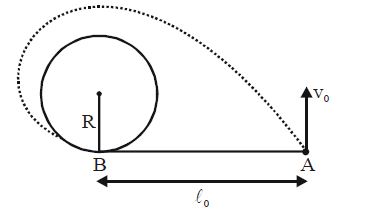
A horizontal plane supports a stationary vertical cylinder of radius $R = 1\ m$ and a disc $A$ attached to the cylinder by a horizontal thread $AB$ of length $l_0 = 2\ m$ (seen in figure, top view). An intial velocity ($v_0 = 1\ m/s$) is imparted $AB$ to the disc as shown in figure. .......... $\sec$ long will it move along the plane until it strikes against the cylinder ? (All surface are assumed to be smooth)
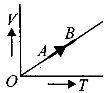
The volume $( V)$ of a monatomic gas varies with its temperature $(T)$ , as shown in the graph. The ratio of work done by the gas , to the heat absorbed by it, when it undergoes a change from state $A$ to state $B$ , is
An object of mass $m$ is suspended at the end of a massless wire of length $L$ and area of cross$-$section, $A$. Young modulus of the material of the wire is $Y$. If the mass is pulled down slightly its frequency of oscillation along the vertical direction is