MCQ
If a unit vector is represented by $0.5\hat{\text{i}}+0.8\hat{\text{j}}+\text{c}\hat{\text{k}},$ then the value of 'c' is:
  • A
    $1$
  • B
    $\sqrt{0.11}$
  • C
    $\sqrt{0.01}$
  • D
    $\sqrt{0.39}$

Answer

  1. $\sqrt{0.11}$

Explanation:

Here, (0.5)2 + (0.8)2 + (c)2 = 1

or $\text{c}=\sqrt{0.11}$

Need a full question paper?

Generate a complete, print-ready paper with questions like this in minutes — across 16+ boards, with answer keys.
Start Generating Free

Similar questions

Choose the correct alternative $(s)$
The equation of an $S.H.M.$ with amplitude $A$ and angular frequency $\omega$ in which all the distances are measured from one extreme position and time is taken to be zero at the other extreme position is ...
Plane angle and solid angle have :
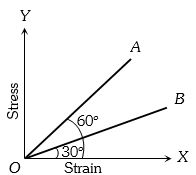
The stress versus strain graphs for wires of two materials $A$ and $B$ are as shown in the figure. If ${Y_A}$ and ${Y_B}$ are the Young ‘s modulii of the materials, then
A pendulum suspended from the ceiling of a train oscillates with a time period $2\,second$, when the train is accelerating at $10\,ms^{-2}$. What will be its time period when the train retards at $10\,ms^{-2}$ ? ..... $\sec$
The quantities $\quad x=\frac{1}{\sqrt{\mu_{0} \in_{0}}}, y=\frac{E}{B}$ and $z=\frac{l}{C R}$ are defined where $C-$ capacitance $R-$Resistance, $l-$length, $E-$Electric field, $B-$magnetic field and $\varepsilon_{0}, \mu_{0},$ -free space permittivity and permeability respectively. Then....
Aball of mass $m$ is thrown vertically upwards.Assume the force of air resistance has magnitude proportional to the velocity, and direction opposite to the velocity's. At the highest point, the ball's acceleration is
A ball of mass $50 \,g$ is dropped from a height of $20 \,m$. A boy on the ground hits the ball vertically upwards with a bat with an average force of $200 \,N$, so that it attains a vertical height of $45 \,m$. The time for which the ball remains in contact with the bat is ........... of a second [Take $g=10 \,m / s ^2$ ]
A uniform rope of mass $6\,kg$ hangs vertically from a rigid support. A block of mass $2\,kg$ is attached to the free end of the rope. A transverse pulse of wavelength $0.06\,m$ is produced at the lower end of the rope. The wavelength of the pulse when it reaches the top is (in $m$ )
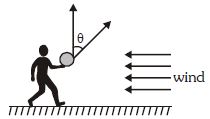
A body throws a ball upwards with velocity $v_0 = 20\, m/s$ . The wind imparts a horizontal acceleration of $4\, m/s^2$ to the ball. The angle $\theta $ from vertical at which the ball must be thrown so that the ball returns to the boy's hand is $(g = 10\, m/s^2)$