Question
Can work be done by a system without changing its volume?

Answer

If the system goes through a cyclic process, then initial volume gets equal to the final volume after one cycle. But work done by the gas is non-zero. So, work can be done by a system without changing its volume.

Need a full question paper?

Generate a complete, print-ready paper with questions like this in minutes — across 16+ boards, with answer keys.
Start Generating Free

Similar questions

A block of mass 5.0kg slides down an incline of inclination 30° and length 10m. Find the work done by the force of gravity.
Find the acceleration due to gravity in a mine of depth 640m if the value at the surface is 9.800m/s2. The radius of the earth is 6400km.
Explain how current is formed in conductors.
The force with which the earth attracts an object is called the weight of the object. Calculate the weight of the moon from the following data: The universal constant of gravitation G = 6.67 × 10⁻¹¹N-m2/kg2, mass of the moon = 7.36 × 10²²kg, mass of the earth = 6 × 1024kg and the distance between the earth and the moon = 3.8 × 10⁵km.
N small conducting liquid droplets, each of radius r, are charged to a potential V each. These droplets coalesce to form a single large drop without any charge leakage. Find the potential of the large drop.
An electronically driven loudspeaker is placed near the open end of a resonance column apparatus. The length of air column in the tube is 80cm. The frequency of the loudspeaker can be varied between 20Hz-2kHz. Find the frequencies at which the column will resonate. Speed of sound in air = 320m/s.
By looking at the construction of a compound microscope and a telescope, how will you distinguish which type of optical instrument is which?
The output of an OR gate is connected to both the inputs of a NAND gate. Draw the logic circuit of this combination of getes and write its truth table.
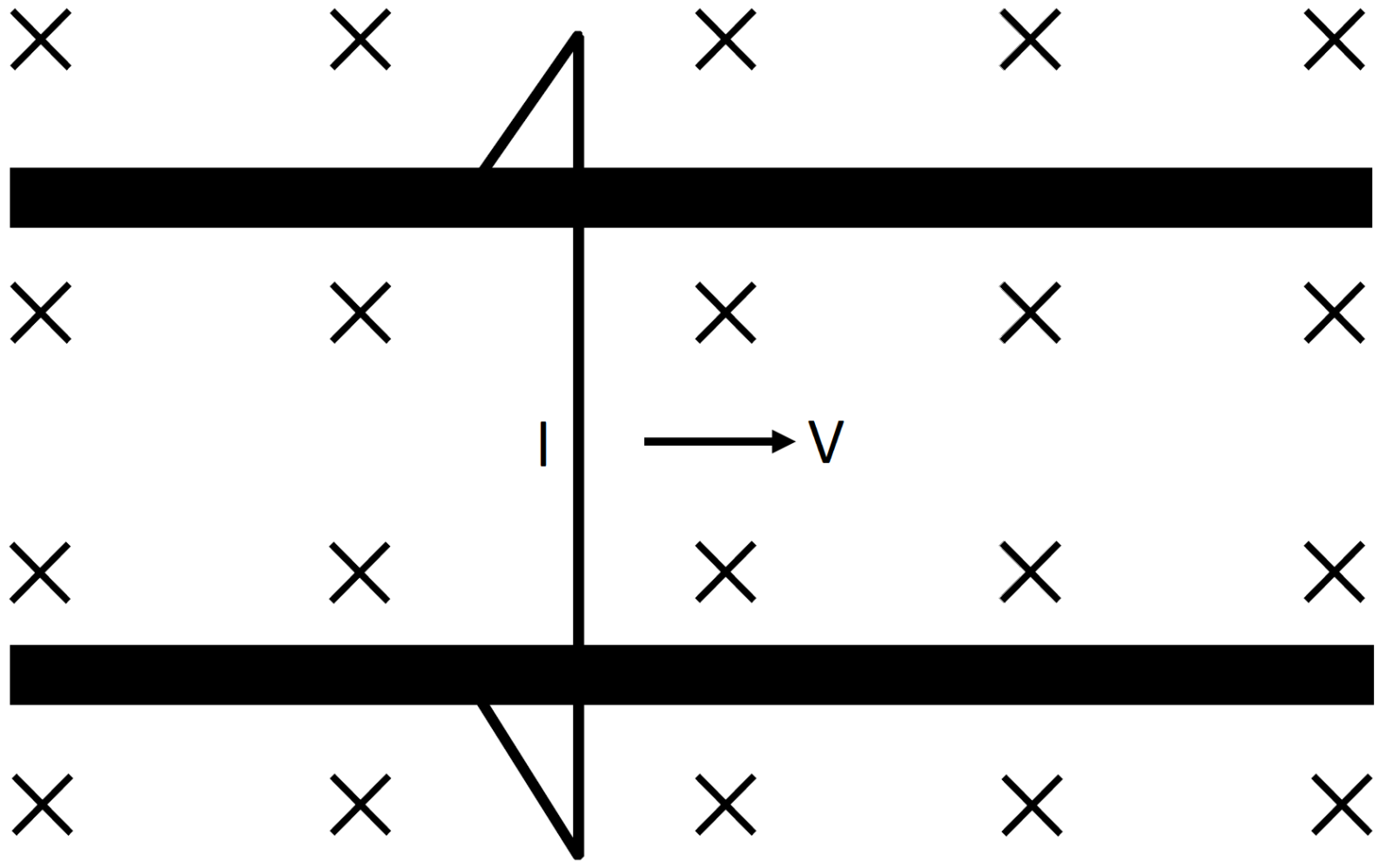
Figure shows a wire sliding on two parallel, conducting rails placed at a separation l. A magnetic field B exists in a direction perpendicular to the plane of the rails. What force is necessary to keep the wire moving at a constant velocity v?

The equation $\omega=\frac{\mu_\text{v}-\mu_\text{r}}{\mu-1}$ asderived for a prism having small refracting angle. Is it also valid for a prism of large refracting angle? Is it also valid for a glass slab or a glass sphere?