Question types

Laws of Thermodynamics question types

51 questions across 6 question groups — pick any mix to generate a Physics paper with step-by-step answer keys.

51
Questions
6
Question groups
5
Question types
Sample Questions

Laws of Thermodynamics questions

One sample from each question group in this chapter. Select any group above to see the full set with answer keys.

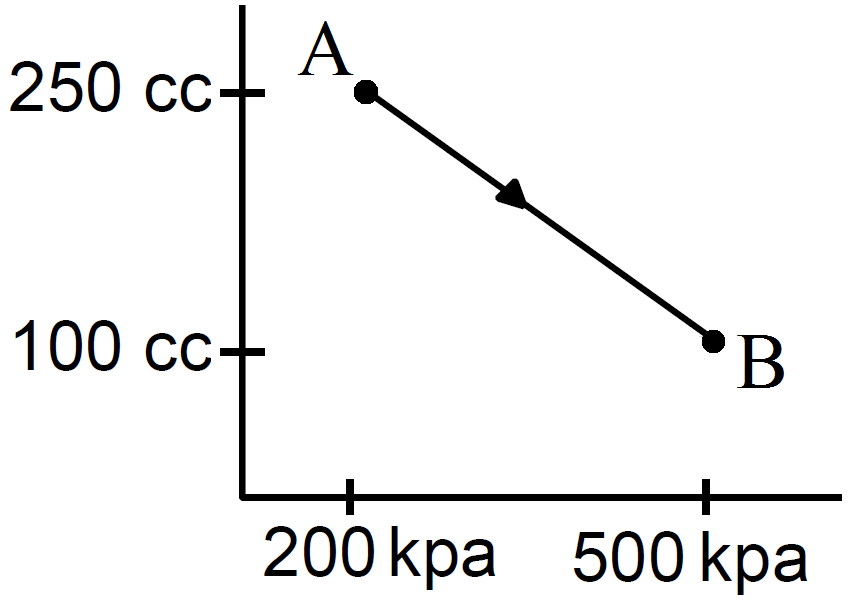
The pressure of a gas changes linearly with volume from 10kPa, 200cc to 50kPa, 50cc.
  1. Calculate the work done by the gas.
  2. If no heat is supplied or extracted from the gas, what is the change in the internal energy of the gas?
View full solution
A gas is enclosed in a cylindrical vessel fitted with a frictionless piston. The gas is slowly heated for some time. During the process, 10J of heat is supplied and the piston is found to move out 10cm. Find the increase in the internal energy of the gas. The area of cross section of the cylinder = 4cm2 and the atmospheric pressure = 100kPa.
View full solution
An ideal gas is taken from an initial state i to a final state f in such a way that the ratio of the pressure to the absolute temperature remains constant. What will be the work done by the gas?
View full solution
A force F is applied on a block of mass M. The block is displaced through a distance d in the direction of the force. What is the work done by the force on the block? Does the internal energy change because of this work?
View full solution
When we heat an object, it expands. Is work done by the object in this process ? Is heat given to the object equal to the increase in its internal energy?
View full solution
Q 103 Marks Question3 Marks
A cylinder containing a gas is lifted from the first floor to the second floor. What is the amount of work done on the gas? What is the amount of work done by the gas? Is the internal energy of the gas increased? Is the temperature of the gas increased?
View full solution
A closed bottle contains some liquid. The bottle is shaken vigorously for 5 minutes. It is found that the temperature of the liquid is increased. Is heat transferred to the liquid? Is work done on the liquid? Neglect expansion on heating.
View full solution
An ideal gas is pumped into a rigid container having diathermic walls so that the temperature remains constant. In a certain time interval, the pressure in the container is doubled. Is the internal energy of the contents of the container also doubled in the interval?
View full solution
Q 16M.C.Q (1 Marks)1 Mark
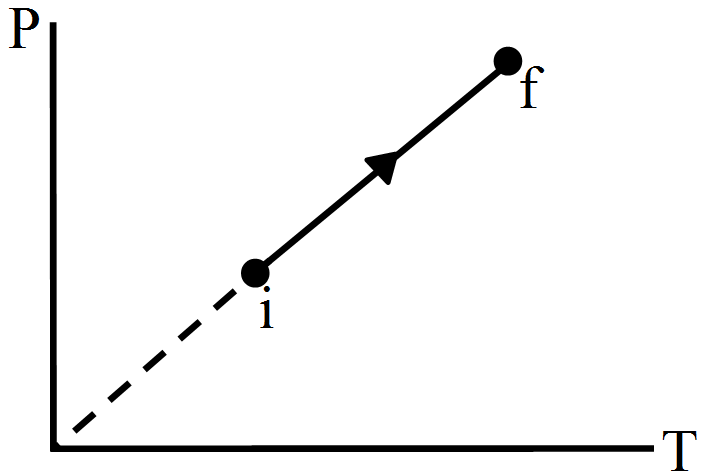
An ideal gas goes from the state i to the state fas shown in figure. The work done by the gas during the process:
  1. Is positive.
  2. Is negative.
  3. Is zero.
  4. Cannot be obtained from this information.

View full solution
Q 17M.C.Q (1 Marks)1 Mark
The internal energy of an ideal gas decreases by the same amount as the work done by the system:
  1. The process must be adiabatic.
  2. The process must be isothermal.
  3. The process must be isobaric.
  4. The temperature must decrease.
View full solution
Q 18M.C.Q (1 Marks)1 Mark
In a process on a system, the initial pressure and volume are equal to the final pressure and volume.
  1. The initial temperature must be equal to the final temperature.
  2. The initial internal energy must be equal to the final internal energy.
  3. The net heat given to the system in the process must be zero.
  4. The net work done by the system in the process must be zero.
View full solution
Q 19M.C.Q (1 Marks)1 Mark
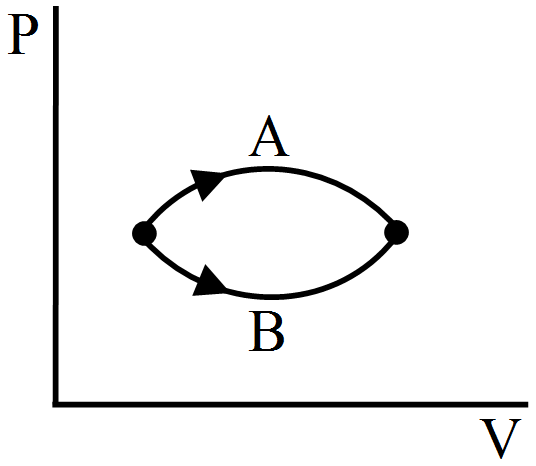
Figure. shows two processes A and B on a system. Let $\Delta\text{Q}_1$ and $\Delta\text{Q}_2$ be the heat given to the system in processes A and B respectively. Then,
  1. $\Delta\text{Q}_1>\Delta\text{Q}_2$
  2. $\Delta\text{Q}_1=\Delta\text{Q}_2$
  3. $\Delta\text{Q}_1<\Delta\text{Q}_2$
  4. $\Delta\text{Q}_1\le\Delta\text{Q}_2$

View full solution
Q 20M.C.Q (1 Marks)1 Mark
The first law of thermodynamics is a statement of:
  1. Conservation of heat.
  2. Conservation of work.
  3. Conservation of momentum.
  4. Conservation of energy.
View full solution
A 100kg block is started with a speed of 2.0ms-1 on a long, rough belt kept fixed in a horizontal position. The coefficient of kinetic friction between the block and the belt is 0.20.
  1. Calculate the change in the internal energy of the block-belt system as the block comes to a stop on the belt.
  2. Consider the situation from a frame of reference moving at 2.0ms-1 along the initial velocity of the block. As seen from this frame, the block is gently put on a moving belt and in due time the block starts moving with the belt at 2.0ms-1 Calculate the increase in the kinetic energy of the block as it stops slipping past the belt.
  3. Find the work done in this frame by the external force holding the belt.
View full solution
A thermally insulated, closed copper vessel contains water at 15°C. When the vessel is shaken vigorously for 15 minutes, the temperature rises to l 7°C. The .mass of the vessel is 100g and that of the water is 200g. The specific heat capacities of copper and water are 420Jkg-1 K-1 and 4200Jkg-1 K-1 respectively. Neglect any thermal expansion.
  1. How much heat is transferred to the liquid-vessel system?
  2. How much work has been done on this system?
  3. How much is the increase in internal energy of the system?
View full solution
A gas is taken along the path AB as shown in figure. If 70cal of heat is extracted from the gas in the process, calculate the change in the internal energy of the system.

View full solution
The internal energy of a gas is given by U = 1.5PV. It expands from 100cm3 to 200cm3 against a constant pressure of 1.0 x 10⁵Pa. Calculate the heat absorbed by the gas in the process.
View full solution
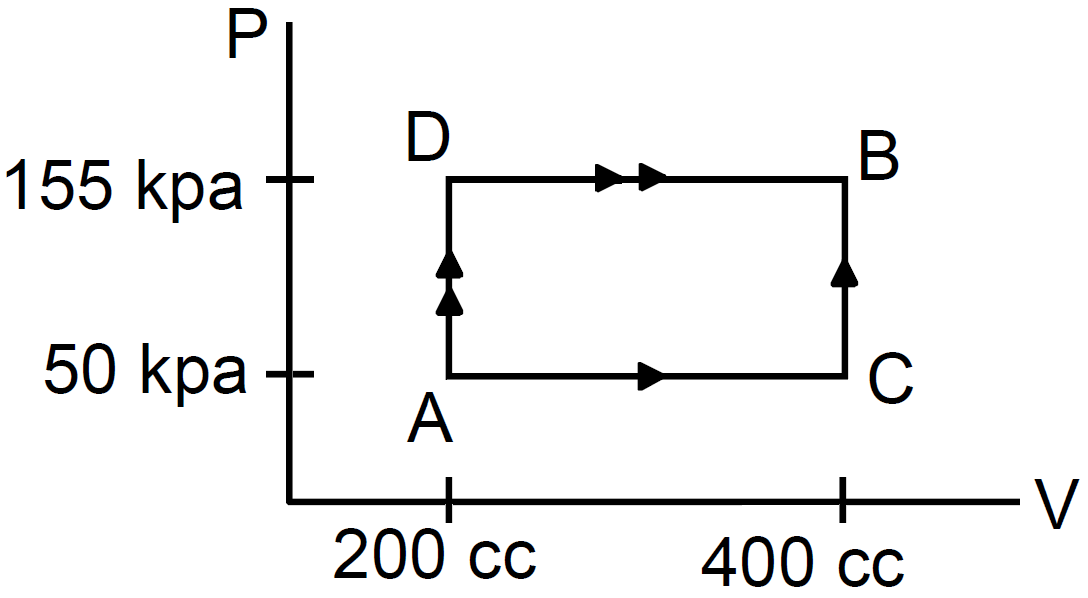
50cal of heat should be supplied to take a system from the state A to the state B through the path ACB as shown in figure. Find the quantity of heat to be supplied to take it from A to B via ADB.

View full solution

Generate a Laws of Thermodynamics paper free

Pick question groups from the list above, set marks and difficulty, and export a branded PDF with step-by-step answer keys. First 3 chapters free — no signup.

Download App