Question
Can you add three unit vectors to get a unit vector? Does your answer change if two unit vectors are along the coordinate axes?

Answer

Of course we can add three unit vectors to give a unit vector. An example of this is i, i, -i even If any two unit vectors are along the axes the third vector can so be aligned so that they give a vector of unit magnitude. I will give you an example: i, j, –i.

Need a full question paper?

Generate a complete, print-ready paper with questions like this in minutes — across 16+ boards, with answer keys.
Start Generating Free

Similar questions

Describe experiment of two stationary coil which explains clectromagnetic induction.
Explain controlled thermonuclear fusion.
A conducting circular loop having a radius of 5.0cm, is placed perpendicular to a magnetic field of 0.50T. It is removed from the field in 0.50s. Find the average emf produced in the loop during this time.
Verify that the cyclotron frequency $ω = eB/m$ has the correct dimensions of $[T]^{–1}.$
Plot a graph showing variation of de Broglie wavelength $(\lambda)$ associated with a charged particle of mass m, versus $\frac{1}{\sqrt{\text{V}}},$ where V is the potential difference through which the particle is accelerated. How does this graph give us the information regarding the magnitude of the charge of the particle?
On the basis of electric field lines, in space, how does the intensity ( $\vec{E}$ ) of electric field of a point charge depend on distance $r$ ? - explain.
###
How do electric field lines depend on area or the solid angle subtended by area element?
Explain the process of thermonuclear fusion as a source of energy in the Sun.
A calorimeter is kept in a wooden box to insulate it thermally from the surroundings. Why is it necesaary?
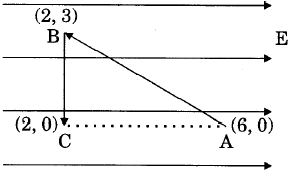
A test charge $'q\ '$ is moved without acceleration from $A$ to $C$ along the path from $A$ to $B$ and then from $B$ to $C$ in electric field $E$ as shown in the figure. $(i)$ Calculate the potential difference between $A$ and $C. (ii)$ At which point $($of the two$)$ is the electric potentialmore and why?
Find the number of molecules of an ideal gas in a volume of $1.000\ cm^3$ at $\text{STP}.$