Question
Can you add two vectors representing physical quantities having different dimensions? Can you multiply two vectors representing physical quantities having different dimensions?

Answer

Two quantities cannot be added or subtracted if they have different dimensions be it a vector or a scalar quantity. But they can be multiplied or divided, or only multiplied in the case of vectors.

Need a full question paper?

Generate a complete, print-ready paper with questions like this in minutes — across 16+ boards, with answer keys.
Start Generating Free

Similar questions

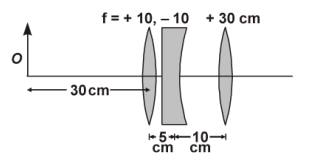
Find the position of the image formed by the lens combination given in the figure.
Image
Discuss sign convention of distance for reflection by spherical mirror and refraction by spherical lens.
A point charge produces an electric field of magnitude $5.0NC^{-1}$ at a distance of $40\ cm$ from it. What is the magnitude of the charge?
The maximum value of electric field vector $\overrightarrow{ E }$ in a electromagnetic wave is 0.3 mV metre$^{-1}$. Calculate the maximum value of magnetic field vector $\overrightarrow{ B }$.
Write uses of X-rays.
A circular wire-loop of radius a carries a total charge Q distributed uniformly over its length. A small length dL of the wire is cut off. Find the electric field at the centre due to the remaining wire.
Define electric field strength. Is it a vector or a scalar quantity?
An electric dipole is held in a uniform electric field:
  1. Show that the net force acting on it is zero.
  2. The dipole is aligned parallel to the field. Find the work done in rotating it through the angle of $180^\circ.$
A uranium$-238$ nucleus, initially at rest, emits an alpha particle with a speed of $1.4 \times 10^7m/s.$ Calculate the recoil speed of the residual nucleus thorium$-234.$ Assume that the mass of a nucleus is proportional to the mass number.
(a) Calculate the potential at a point $P$ due to a charge of $4 \times 10^{-7} C$ located $9 cm$ away.
(b) Hence obtain the work done in bringing a charge of $2 \times 10^{-9} C$ from infinity to the point P. Does the answer depend on the path along which the charge is brought?