MCQ
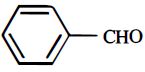
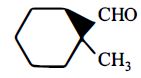
Cannizaro' s reaction is not given by
  • A

  • B

  • $CH_3CHO$
  • D
    $HCHO$

Answer

Correct option: C.
$CH_3CHO$
c
Only those aldehydes which do not have $\alpha  - H$ atom undergo Cannizaro's reaction. Hence $CH_3CHO$ will not undergo Cannizaro's reaction as it has $3\,\alpha $ $H$ atoms.

Need a full question paper?

Generate a complete, print-ready paper with questions like this in minutes — across 16+ boards, with answer keys.
Start Generating Free

Similar questions

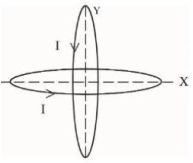
Two identical circular wires of radius $20\,cm$ and carrying current $\sqrt{2}\,A$ are placed in perpendicular planes as shown in figure. The net magnetic field at the centre of the circular wire is $.............\times 10^{-8}\,T$. (Take $\pi=3.14$ )
Which of the following most closely depicts the correct variation of the gravitational potential $V(r)$ due to a large planet of radius $R$ and uniform mass density ? (figures are not drawn to scale)
A ping-pong ball of mass $m$ is floating in air by a jet of water emerging out of a nozzle. If the water strikes the ping-pong ball with a speed $v$ and just after collision water falls dead, the rate of flow (in $kg/s$) of water in the nozzle is equal to
A uniform thermometre scale is at steady state with its $0 \,cm$ mark at $20^{\circ} C$ and $100 \,cm$ mark at $100^{\circ} C$. Temperature of the $60 \,cm$ mark is ............. $^{\circ} C$
Fan is based on
Which of the following is correct statement for the given reaction

$C{H_3} - CH = O + {C_6}{H_5} - CH =O \xrightarrow[\Delta ]{{\mathop O\limits^\Theta  H\,\left( {aq} \right)}}\mathop X\limits_{{\text{(}}{{\text{C}}_4}{{\text{H}}_6}{\text{O)}}}  + \mathop Y\limits_{{\text{(}}{{\text{C}}_9}{{\text{H}}_8}{\text{O)}}} $
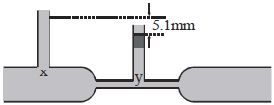
The diagram (figure) shows a venturimeter, through which water is flowing. The speed of water at $X$ is $2\,cm/s.$ The speed of water at $Y$ (taking $g = 1000 \,cm/s^2$ ) is ........ $cm/s$
Mark the wrong statement :-
For the given vector $\vec A =3\hat i -4\hat j+10\hat k$ , the ratio of magnitude of its component on the $x-y$ plane and the component on $z-$ axis is
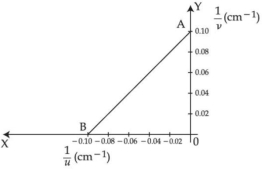
The graph between $\frac{1}{ u }$ and $\frac{1}{ v }$ for a thin convex lens in order to determine its focal length is plotted as shown in the figure. The refractive index of length is $1.5$ and its both the surfaces have same radius of curvatures $R$. The value of $R$ will be $cm$

(Where $u =$ object distance, $v =$ image distance)