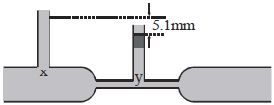
The diagram (figure) shows a venturimeter, through which water is flowing. The speed of water at $X$ is $2\,cm/s.$ The speed of water at $Y$ (taking $g = 1000 \,cm/s^2$ ) is ........ $cm/s$
Medium
Download our app for free and get started
$V_2^2 = V_1^2+2gh=(2)^2 + 2 \times 1000 \times 5.1 \times 10^{-1}=1024$
$V_2 = 32\,cm/s$

Download our appand get started for free
Experience the future of education. Simply download our apps or reach out to us for more information. Let's shape the future of learning together!No signup needed.*
Similar Questions
- 1Two identical cylindrical vessels are kept on the ground and each contain the same liquid of density $d.$ The area of the base of both vessels is $S$ but the height of liquid in one vessel is $x_{1}$ and in the other, $x_{2}$. When both cylinders are connected through a pipe of negligible volume very close to the bottom, the liquid flows from one vessel to the other until it comes to equilibrium at a new height. The change in energy of the system in the process isView Solution
- 2A hemispherical bowl just floats without sinking in a liquid of density $1.2 × 10^3kg/m^3$. If outer diameter and the density of the bowl are $1 m$ and $2 × 10^4 kg/m^3$ respectively, then the inner diameter of the bowl will be........ $m$View Solution
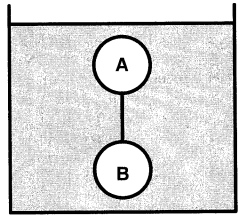
- 3Two solid spheres $A$ and $B$ of equal volumes but of different densities $d_A$ and $d_B$ are connected by a string. They are fully immersed in a fluid of density $d_F$. They get arranged into an equilibrium state as shown in the figure with a tension in the string. The arrangement is possible only ifView Solution
$(A)$ $d_Ad_F$ $(B)$ $d_B > d_F$ $(C)$ $d_A>d_F$ $(D)$ $d_A+d_B=2 d_F$
- 4Some liquid is filled in a cylindrical vessel of radius $R$. Let $ F_1 $ be the force applied by the liquid on the bottom of the cylinder. Now the same liquid is poured into a vessel of uniform square crss-section of side $R$. Let $F_2$ be the force applied by the liquid on the bottom of this new vessel. Then:View Solution
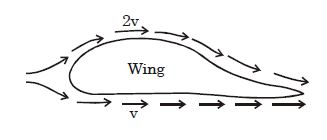
- 5The flow speeds of air on the lower and upper surfaces of the wing of an aeroplane are $v$ and $2v$ respectively. The density of air is $\rho $ and surface area of wing is $A$ . The dynamic lift on the wing isView Solution
- 6View SolutionWater flows out of the hole on the side of a bucket and follows a parabolic path. If the bucket falls freely under gravity, ignoring air resistance, the water flow
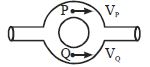
- 7In the figure shown, a liquid is flowing through a tube at the rate of $0.1\, m^3/sec$. The tube is branched into two semicircular tubes of cross-sectional area $A/3$ and $2A/3$. The velocity of liquid at $Q$ is ......... $ m/sec$ (The cross-section of the main tube $= A =10^{-2}\, m^2$ and $v_p = 20\, m/sec$)View Solution
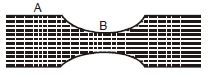
- 8Water flows in a horizontal tube as shown in figure. The pressure of water changes by $600\, N/ m^2$ between $A$ and $B$ where the area of crosssection are $30\, cm^2$ and $15\, cm^2$ respectively. Find the rate of flow of water through the tube.View Solution
- 9View SolutionThe Reynolds number of a flow is the ratio of
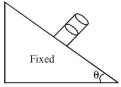
- 10A cylindrical vessel filled with water is released on an inclined surface of angle $\theta$ as shown in figure.The friction coefficient of surface with vessel is $\mu( < \tan \theta)$.Then the contact angle made by the surface of water with the incline will beView Solution