MCQ
car moves on a circular road. It describes equal angles about the centre in equal intervals of time. Which of the following statement about the velocity of the car is true
  • A
    Magnitude of velocity is not constant
  • B
    Both magnitude and direction of velocity change
  • C
    Velocity is directed towards the centre of the circle
  • Magnitude of velocity is constant but direction changes
Answer

Correct option: D.
Magnitude of velocity is constant but direction changes
d
(d)As body covers equal angle in equal time intervals. its angular velocity and hence magnitude of linear velocity is constant.

Need a full question paper?

Generate a complete, print-ready paper with questions like this in minutes — across 16+ boards, with answer keys.

Start Generating Free

Similar questions

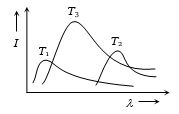
A black body is at a temperature $300 K$ . It emits energy at a rate, which is proportional to
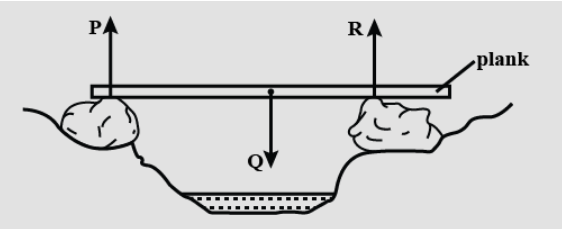
A wooden plank rests in equilibrium on two rocks on opposite sides of a narrow stream. Three forces P, Q and R act on the plank. How are the sizes of the forces related?

A tube-well pumps out $2400\; kg$ of water per minute. If water is coming out with a velocity of $3 \;ms ^{-1}$. How much work is done, if the pump runs for $10\; hours$?
A body of mass 'M' collides against a wall with a velocity v and retraces its path with the same speed. the change in momentum is ............. (take initial direction of velocity as positive)
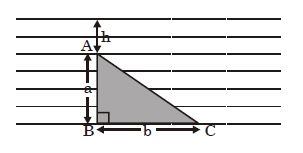
A vertical triangular plate $ABC$ is placed inside water with side $BC$ parallel to water surface as shown. The force on one surface of plate by water is (density of water is $\rho $ and atmospheric pressure $P_0$ ) 
Mercury has an angle of contact equal to $140^{\circ}$ with soda lime glass. A narrow tube of radius $1.00 \;mm$ made of this glass is dipped in a trough containing mercury. By what amount does the mercury dip down (in $mm$) in the tube relative to the liquid surface outside? Surface tension of mercury at the temperature of the experiment is $0.465\; N m ^{-1} .$ Density of mercury $=13.6 \times 10^{3} \;kg m ^{-3}$
A clock has $75 \mathrm{~cm}, 60 \mathrm{~cm}$ long second hand and minute hand respectively. In $30$ minutes duration the tip of second hand will travel $x$ distance more than the tip of minute hand. The value of $x$ in meter is nearly (Take $\pi=3.14$ ) :
The power (P) of an engine lifting a mass of 100kg upto a height of 10m in 1 min is:
The plots of intensity versus wavelength for three black bodies at temperatures $T_1, T_2$ and $T_3$ respectively are as shown. Their temperature are such that
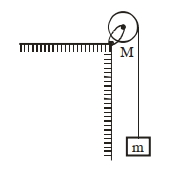
A uniform disc with mass $M=4\,kg$ and radius $R=$ $10\,cm$ is mounted on a fixed horizontal axle as shown in figure. A block with mass $m =2\,kg$ hangs from a massless cord that is wrapped around the rim of the disc. During the fall of the block, the cord does not slip and there is no friction at the axle. The tension in the cord is_______ $N$

$\left(\right.$ Take $\left.g =10\,ms ^{-2}\right)$