MCQ
Carbon dioxide is a  __________.
  • A
    Weak electrophile.
  • B
    Weak nucleophile.
  • C
    Ambident species.
  • D
    None of these.

Answer

  1. Weak electrophile.

Explanation:

Carbon dioxide is a weak electrophile. It possess very less partial positive charge which are attracted towards electrons.

Need a full question paper?

Generate a complete, print-ready paper with questions like this in minutes — across 16+ boards, with answer keys.

Start Generating Free

Similar questions

Biuret test is not given by
The number of geometrical isomers of the complex $\left[ {Co{{(N{O_2})}_2}{{(N{H_3})}_2}} \right]$ is
How much chlorine will be liberated on passing one ampere current for $30 $ minutes through $ NaCl $ solution
In which of the following, tendency towards formation of coloured ions is maximum
In a cell, the following reactions take place

$Fe ^{2+} \rightarrow Fe ^{3+} + e ^{-} \quad E _{ Fe ^{3+} / Fe ^{2+}}=0.77 \,V$

$2 I ^{-} \rightarrow I _{2}+2 e ^{-} \quad E _{ I _{2} / I ^{-}}^{0}=0.54 \,V$

The standard electrode potential for the spontaneous reaction in the cell is $x \times 10^{-2} \,V 298$ $K$. The value of $x$ is .... (Nearest Integer)

Out of the following which gives blue colour on reaction with

$\xrightarrow{{P + {I_2}}}\,\xrightarrow{{AgN{O_2}}}\,\xrightarrow{{HN{O_2}}}\,\,\xrightarrow{{NaOH}}$

Which of the following reactant in reactions can reduced by $SO_2$

$(I)\,\, O_3 \to $ product

$(II)\,\,C{r_2}O_7^{ - 2}\xrightarrow{{{H^ + }}}$ product

$(III)\,\,MnO_4^\Theta \xrightarrow{{{H^ + }}}$ product

$(IV)\,\, H_2S \to $ product

Identify the one which will NOT produce as a major product ?
Corrosion can not be prevented by which of the following method?
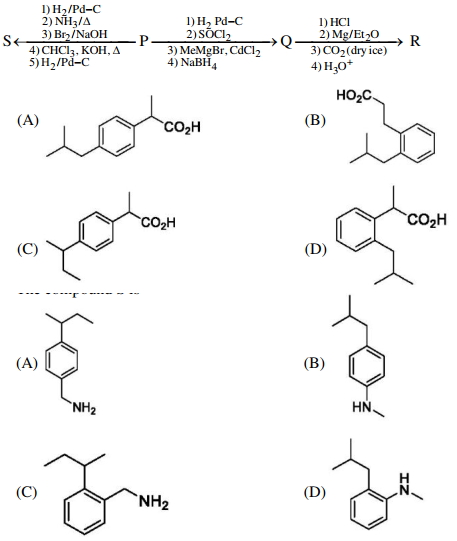
An organic acid $P \left( C _{11} H _{12} O _2\right)$ can easily be oxidized to a dibasic acid which reacts with ethyleneglycol to produce a polymer dacron. Upon ozonolysis, $P$ gives an aliphatic ketone as one of the products. $P$ undergoes the following reaction sequences to furnish $R$ via $Q$. The compound $P$ also undergoes another set of reactions to produce $S$.

(image)   

($1$) The compound $R$ is

(image) 

($2$) The compound $S$ is

(image) 

Give the answer or quetion ($1$) and ($2$)