MCQ
Corrosion can not be prevented by which of the following method?
  • A
    Galvanisation.
  • B
    Create a barrier between the object being corroded and oxygen.
  • C
    Painting.
  • D
    Exposing it to sunlight.

Answer

  1. Exposing it to sunlight.

Explanation:

Corrosion can be prevented by creating a barrier between the object and oxygen. Galvanisation is a process to prevent corrosion and so is painting. However, exposing to sunlight is not a method to prevent corrosion.

Need a full question paper?

Generate a complete, print-ready paper with questions like this in minutes — across 16+ boards, with answer keys.

Start Generating Free

Similar questions

Following is a confirmatory test for aromatic primary amines. Identify reagent $(A)$ and $(B)$
Catalyst $A$ reduces the activation energy for a reaction by $10\, k\,J\, mol ^{-1}$ at $300\, K$. The ratio of rate $\frac{ k _{ T }, \text { Catalysed }}{ k _{ T }, \text { Uncatalysed }}$ is $e ^{ x }$ [nearest integer $]$

[Assume theat the pre-exponential factor is same in both the cases.

Given $R =8.31 \,J\, K ^{-1} \,mol ^{-1}$ ]

Lanthanides and actinides resemble in:
When a certain conductivity cell was filled with $0.1\ M\  KCl$, it had a resistance of $85\  \Omega$ at $25\,^o\ C$. When the same cell was filled with an aqueous solution of $0.052\  M$ unknown electrolyte, the resistance was $96\  \Omega$. Calculate the molar conductivity of the unknown electrolyte at this concentration ............ ${\Omega ^{ - 1}}{\rm{c}}{{\rm{m}}^2}{\rm{mo}}{{\rm{l}}^{ - 1}}$ (Given : Specific conductivity of $0.1\ M\  KCl = 1.29 × 10^{-2}\ \Omega ^{-1} \ \ cm^{-1}$)
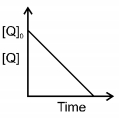
In the reaction, $P+Q \longrightarrow R+S$

the time taken for $75 \%$ reaction of $P$ is twice the time taken for $50 \%$ reaction of $P$. The concentration of $Q$ varies with reaction time as shown in the figure. The overall order of the reaction is
For a chemical reaction, $2A + 2B \to C + D$, the order of reaction is one with respect to $A$ and one with respect to $B$. The initial rate of the reaction is $4 \times 10^{-2}\ mol\,L^{-1}\, s^{-1}$. When $50\%$ of the reactants are converted into products, the rate of the reaction would become
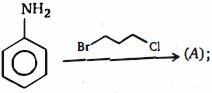
Product $(A)$ of this reaction is
How fast the reaction is at $25\,^oC$ as compared to $0\,^oC$. If the activation energy is $65\, KJ$ ......  times
Which of following can be prepared effectively by Williamson ether synthesis
Which metal does not give the following reaction $M +$  water or steam $ \to $oxide $ + H$ $\downarrow$