MCQ
Carbon has __________ isotopes.
- A1 (one)
- B2 (two)
- C3 (three)
- D4 (four)
Explanation:
Carbon has three isotopes $12\text{C}\\ \ 6$, $13\text{C}\\ \ 6$ and $14\text{C}\\ \ 6$
Generate a complete, print-ready paper with questions like this in minutes — across 16+ boards, with answer keys.
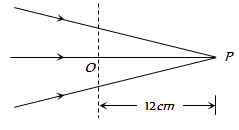
Figure given below shows a beam of light converging at point P. When a convex lens of focal length 16 cm is introduced in the path of the beam at a place O shown by dotted line such that OP becomes the axis of the lens, the beam converges at a distance x from the lens. The value x will be equal to
|
(a) 12 cm |
(b) 24 cm |
(c) 36 cm |
(d) 48 cm |
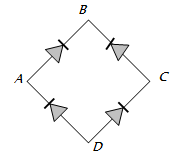
In the diagram, the input is across the terminals A and C and the output is across the terminals B and D, then the output is
|
(a) Zero |
(b) Same as input |
(c) Full wave rectifier |
(d) Half wave rectifier |
In the circuit, the potential difference across PQ will be nearest to

|
(a) 9.6 V |
(b) 6.6 V |
(c) 4.8 V |
(d) 3.2 V |
In the given figure, when galvanometer shows no deflection, the current (in ampere) flowing through 5Ω resistance will be

|
(a) 0.5 |
(b) 0.6 |
(c) 0.9 |
(d) 1.5 |