MCQ
Which theory is confirmed by the Davisson – Germer experiment?
- Ade – Broglie theory
- BNewton’s theory
- CEinstein’s theory
- DPlanck’s theory
Explanation:
Davisson and Germer experiment proves the concept of wave nature of matter particles. The Davisson–Germer experiment provides a critically important confirmation of the de-Broglie hypothesis, which said that particles, such as electrons, are of dual nature.
Generate a complete, print-ready paper with questions like this in minutes — across 16+ boards, with answer keys.
Radius of central zone of circular zone plate is 2.3 mm. Wavelength of incident light is 5893 . Source is at a distance of 6m Then the distance of first image will be
|
(a) 9 m |
(b) 12 m
|
(c) 24 m |
(d) 36 m |
Two point charges placed at a certain distance r in air exert a force F on each other. Then the distance r' at which these charges will exert the same force in a medium of dielectric constant k is given by
|
(a) r |
(b) r/k |
(c) r/ |
(d) r |
Assertion : In high latitude one sees colourful curtains of light hanging down from high altitudes.
Reason : The high energy charged particles from the sun are deflected to polar regions by the magnetic field of the earth.
|
(a) If both assertion and reason are true and the reason is the correct explanation of the assertion. |
|
(b) If both assertion and reason are true but reason is not the correct explanation of the assertion. |
|
(c) If assertion is true but reason is false. |
|
(d) If the assertion and reason both are false. |
Resistance as shown in figure is negative at
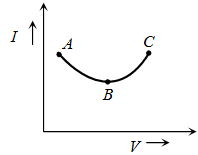
|
(a) A |
(b) B |
(c) C |
(d) None of these |
The instrument that is based on the principle that when an object is placed between first principal focus and the optic centre of convex lens, an upright, virtual and enlarged image on the same side of the object is formed, is:
Equal charges are given to two spheres of different radii. The potential will
|
(a) Be more on the smaller sphere |
|
(b) Be more on the bigger sphere |
|
(c) Be equal on both the spheres |
|
(d) Depend on the nature of the materials of the spheres |
The magnetic moment of a magnet of length 10 cm and pole strength 4.0 Am will be
|
(a) |
(b) 1.6 |
(c) 20 |
(d) 8.0 |
The capacity of a parallel plate condenser is C. Its capacity when the separation between the plates is halved will be
|
(a) 4 C |
(b) 2C |
(c) |
(d) |


