MCQ
Carbon resistor has resistance specified by three bands having colour red, yellow and black. If this resistor is cut into two pieces of equal length then the new colour code of each one will be (Neglect tolerance of $4^{th}$ band)
  • Brown, Red, Black
  • B
    Red, Orange, Black
  • C
    White, Blue, Black
  • D
    Black, Blue, Black

Answer

Correct option: A.
Brown, Red, Black
a
$\mathrm{R}_{\mathrm{L}}=24 \times 10^{\circ}\, \Omega$

$\mathrm{R}_{\mathrm{f}}=\frac{\mathrm{R}_{\mathrm{i}}}{2}=12 \times 10^{\circ}\, \Omega$

Need a full question paper?

Generate a complete, print-ready paper with questions like this in minutes — across 16+ boards, with answer keys.

Start Generating Free

Similar questions

Calculate the wavelength of light used in an interference experiment from the following data : Fringe width $=0.03\,cm$. Distance between the slits and eyepiece through which the interference pattern is observed is $1\,m$. Distance between the images of the virtual source when a convex lens of focal length $16\,cm$ is used at a distance of $80\,cm$ from the eyepiece is $0.8\,cm$.
The energy of $He ^{+}$ion in its first excited state is $......eV$ (The ground state energy for the Hydrogen atom is $-13.6\,eV )$
Two magnets A and B are identical in mass, length and breadth but have different magnetic moments. In a vibration magnetometer, if the time period of B is twice the time period of A. The ratio of the magnetic moments $\mathrm{M}_{\mathrm{A}} / \mathrm{M}_{\mathrm{B}}$ of the magnets will be
Three resistances of magnitude 2, 3 and 5 ohm are connected in parallel to a battery of 10 volts and of negligible resistance. The potential difference across 3 Ω resistance will be
A thin rectangular magnet suspended freely has a period of oscillation equal to $T$. Now it is broken into two equal halves (each having half of the original length) and one piece is made to oscillate freely in the same field. If its period of oscillation is $T'$, the ratio $T'/T$ is :-
The resistance of a wire is $5\,ohm$  at $50\,^o C$ and $6\,ohm $ at $100\,^o C$. The resistance of the wire at $0\,^o C$ will be .............. $\Omega$
If an object is placed 10 cm infront of a concave mirror of focal length 20 cm, the image will be
In Bohr's model of hydrogen atom, let PE represents potential energy and TE the total energy. In going to a higher level
Wave front formed by the collimator of a spectrometer:
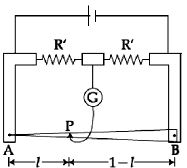
In a meter bridge, the wire of length $1\, m$ has a nonuniform cross-section such that, the variation $\frac{{dR}}{{d\ell }}$ of its resistance $R$ with length $\ell $ is $\frac{{dR}}{{d\ell }} \propto \frac{1}{{\sqrt \ell  }}$ Two equal resistances are connected as shown in the figure. The galvanometer has zero deflection when the jockey is at point $P$. What is the length $AP$ ? ................ $m$