MCQ
Carbon resistors are of two types:
- AComposition type resistor and film type resistor.
- BRheostat and film type resistor.
- CRheostat and variable resistor.
- DComposition type resistor and rheostat.
Explanation:
Carbon resistors are of two types composition type resistor and film type resistor.
There are a number of different types of fixed resistor:
Carbon composition: These types were once very common, but are now seldom used.
Carbon film: This resistor type is formed by "cracking" a hydrocarbon onto a ceramic former.
Generate a complete, print-ready paper with questions like this in minutes — across 16+ boards, with answer keys.
The decay constant of a radioactive element is 1.5  per second. Its mean life in seconds will be
|
(a) 1.5 |
(b) 4.62 |
(c) 6.67 |
(d) 10.35 |
Einstein's photoelectric equation states that  . In this equation
  refers to
|
(a) Kinetic energy of all the emitted electrons |
|
(b) Mean kinetic energy of the emitted electrons |
|
(c) Maximum kinetic energy of the emitted electrons |
|
(d) Minimum kinetic energy of the emitted electrons |
A point object is placed at the center of a glass sphere of radius 6 cm and refractive index 1.5. The distance of the virtual image from the surface of the sphere is
|
(a) 2 cm |
(b) 4 cm |
(c) 6 cm |
(d) 12 cm |
Faraday's laws are consequence of conservation of
|
(a) Energy |
(b) Energy and magnetic field |
|
(c) Charge |
(d) Magnetic field |
A current carrying circular loop is freely suspended by a long thread. The plane of the loop will point in the direction
|
(a) Wherever left free |
(b) North-south |
|
(c) East-west |
(d) At 45° with the east-west direction |
A cell of internal resistance 1.5Ω and of e.m.f. 1.5 volt balances 500 cm on a potentiometer wire. If a wire of 15 Ω is connected between the balance point and the cell, then the balance point will shift
|
(a) To zero |
(b) By 500 cm |
(c) By 750 cm |
(d) None of the above |
The stopping potential as a function of the frequency of the incident radiation is plotted for two different photoelectric surfaces A and B. The graphs show that work function of A is
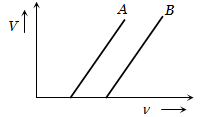
|
(a) Greater than that of B |
|
(b) Smaller than that of B |
|
(c) Equal to that of B |
|
(d) No inference can be drawn about their work functions from the given graphs |

