MCQ
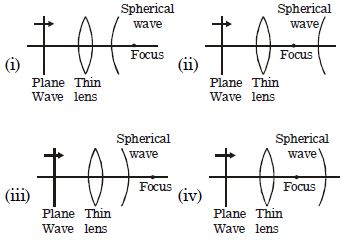
Carefully analyses the diagram and choose the correct option :
  • A
    $i$ and $ii$ are true
  • B
    $i$ and $iii$ are true
  • $i$ and $iv$ are true
  • D
    $ii$ and $ii$ are true

Answer

Correct option: C.
$i$ and $iv$ are true
c
The rays of light first converge and then diverges.

Need a full question paper?

Generate a complete, print-ready paper with questions like this in minutes — across 16+ boards, with answer keys.
Start Generating Free

Similar questions

If the maximum velocity and maximum acceleration of a particle executing $SHM$ are equal in magnitude, the time period will be .... $\sec$
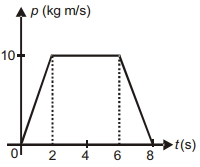
The momentum $p$ of an object varies with time $(t)$ as shown in figure. The corresponding force $(F)$-time $(t)$ graph is
A compass needle whose magnetic moment is $60 \,amp × m^2$ pointing geographical north at a certain place, where the horizontal component of earth's magnetic field is $40\, \mu Wb/m^2$, experiences a torque $1.2 \times {10^{ - 3}}\,N \times m.$ What is the declination at this place......$^o$
According to Bohr's theory, the moment of momentum of an electron revolving in $4^{\text {th }}$ orbit of hydrogen atom is :
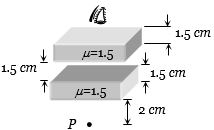
The image of point $P$ when viewed from top of the slabs will be
A second's pendulum is mounted in a rocket. Its period of oscillation decreases when the rocket
The gravitational potential at a point above the surface of earth is $-5.12 \times 10^7 \mathrm{~J} / \mathrm{kg}$ and the acceleration due to gravity at that point is $6.4 \mathrm{~m} / \mathrm{s}^2$. Assume that the mean radius of earth to be $6400 \mathrm{~km}$. The height of this point above the earth's surface is :
${U^{238}}$ decays into $T{h^{234}}$ by the emission of an $\alpha - $ particle. There follows a chain of further radioactive decays, either by $\alpha - $ decay or by $\beta $ - decay. Eventually a stable nuclide is reached and after that, no further radioactive decay is possible. Which of the following stable nuclides is the and product of the ${U^{238}}$ radioactive decay chain
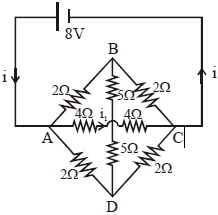
The value of current $i_{1}$ flowing from $A$ to $C$ in the circuit diagram is$.......A$
A $12\,V,60\,W$ lamp is connected to the secondary of a step down transformer, whose primary is connected to ac mains of $220\,V$. Assuming the transformer to be ideal, $..........\,A$ is the current in the primary winding.