MCQ
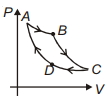
Carnot cycle is plotted in $P-V$ graph. Which portion represents an isothermal expansion?
  • $A B$
  • B
    $B C$
  • C
    $C D$
  • D
    $D A$

Answer

Correct option: A.
$A B$
a
(a)

$A B$ is isothermal expansion. $B C$ is adiabatic expansion $C D$ is isothermal compression $\Delta A=$ adiabatic compression.

Need a full question paper?

Generate a complete, print-ready paper with questions like this in minutes — across 16+ boards, with answer keys.
Start Generating Free

Similar questions

A thermally insulated vessel contains an ideal gas of molecular mass $M$ and ratio of specific heats $1.4$. Vessel is moving with speed $v$ and is suddenly brought to rest. Assuming no heat is lost to the surrounding and vessel temperature of the gas increases by ... ( $R =$ universal gas constant )
Dimensions of kinetic energy are
Two bodies $A$and $B$ have thermal emissivities of $0.01$ and $0.81$ respectively. The outer surface areas of the two bodies are the same. The two bodies emit total radiant power at the same rate. The wavelength ${\lambda _B}$ corresponding to maximum spectral radiancy in the radiation from $B$ is shifted from the wavelength corresponding to maximum spectral radiancy in the radiation from $A$, by $1.00\mu m$. If the temperature of $A$ is $5802\;K$
Two boys are standing at the ends $A$ and $B$ of a ground where $AB = a$. The boy at $B$ starts running in a direction perpendicular to $AB$ with velocity ${v_1}.$ The boy at $A$ starts running simultaneously with velocity $v$ and catches the other boy in a time $t$, where $t$ is
A body performing unifom circular motion completed $140$ revolution in a second. Its angular speed is .......... $rad / s$
Which of the following has the maximum momentum?
A passenger sitting in a train A moving at $90\,km / h$ observes another train $B$ moving in the opposite direction for $8\,s$. If the velocity of the train $B$ is $54\,km / h$, then length of train $B$ is $..........\,m$
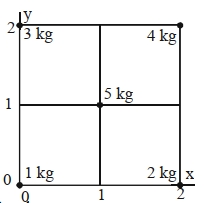
Five masses are placed in a plane as shown in figure. The coordinates of the centre of mass are nearest to.
A brass rod of length $2\,m$ and cross-sectional area $2.0\,cm^2$ is attached end to end to a steel rod of length $L$ and cross-sectional area $1.0\,cm^2$ . The compound rod is subjected to equal and opposite pulls of magnitude $5 \times 10^4\,N$ at its ends. If the elongations of the two rods are equal, then length of the steel rod $(L)$ is ........... $m$ $(Y_{Brass}=1.0\times 10^{11}\,N/m^2$ and $Y_{Steel} = 2.0 \times 10^{11}\,N/m^2)$
If e is the electronic charge, $c$ is the speed of light in free space and $h$ is Planck's constant, the quantity $\frac{1}{4 \pi \varepsilon_{0}} \frac{| e |^{2}}{h c}$ has dimensions of .......