Question
Case Based Question
A digital wallet is an electronic alternative to a traditional wallet, enabling you to make payments for a wide range of products and services. Whether shopping or dining out, many people now prefer using digital wallets over other payment methods.
Kritika and Ajay are friends, and they use digital wallets. Kritika had ₹ 256.45 in her wallet, Ajay wallet’s had ₹ 1121.77. On Sunday, they went a mall for shopping.–
Based on the above information, answer the following questions :
Q.1. Kritika bought a toothpaste for ₹ 71.75, soap for ₹ 41.25, and shoe polish for ₹ 52. Find the money left in her wallet.
Q.2. Ajay bought 3 notebooks for ₹ 106.50 and 4 bottles of juice for ₹ 873.00. Find the money left in his wallet.
Q.3. After shopping, find the sum of the money left in their wallets.

Answer

(1) Kritika’s total expense = ₹ 71.75 + ₹ 41.25 + ₹ 52 = ₹ 165.00
Money left = ₹ 256.45 – ₹ 165.00 = ₹ 91.45
(2) Ajay’s total expense = ₹ 106.50 + ₹ 873.00 = ₹ 979.50
Money left = ₹ 1121.77 – ₹ 979.50 = ₹ 142.27
(3) Sum of the money left = ₹ 91.45 + ₹ 142.27 = ₹233.72

Need a full question paper?

Generate a complete, print-ready paper with questions like this in minutes — across 16+ boards, with answer keys.

Start Generating Free

Similar questions

Salima was very happy because it was Eid. Everyone in her family put a few coins in her bag. She now had 30 one-rupee coins, 25 two-rupee coins, 15 five-rupee coins and 5 ten-rupee coins in her bag.
Q.1. The number of five-rupee coins is what per cent of the total number of coins in the bag?
(a) 5%$\quad$(b) 10%$\quad$(c) 15%$\quad$(d) 20%
Q.2. The value of two-rupee coins is what per cent of the total value of coins in the bag?
(a) $16 \frac{11}{36} \%$$\quad$(b) $24 \frac{16}{41} \%$$\quad$(c) $17 \frac{12}{37} \%$$\quad$(d) $21 \frac{9}{17} \%$
Q.3. The number of five-rupee coins is what per cent less than that of two-rupee coins?
(a) 60%$\quad$(b) 40%$\quad$(c) 50%$\quad$(d) 75%
Q.4. The value of five-rupee coins is what per cent more than that of two-rupee coins?
(a) 50%$\quad$(b) 40%$\quad$(c) $33 \frac{1}{3} \%$$\quad$(d) $66 \frac{2}{3} \%$
A shelf with a triangular frame is ixed on a wall as shown below.
Image

The lengths of the rods used in the shaded triangular frame are $48\ cm, 55\ cm$ and $73\ cm.$
$1.$ What is the type of the shaded triangle$?$
$A.$ Obtuse triangle
$B.$ Isosceles triangle
$C.$ Equilateral triangle
$D. $ Right-angled triangle
$2.$ What can be the height of the shelf$?$
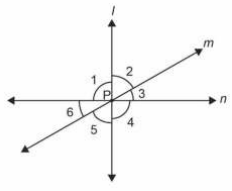
Three lines shown in the igure intersect each other at point $P.$
Image

Line lis perpendicular to line n.
The measure of $\angle 2$ is $65^\circ .$
$1.$ What is the measure of $\angle 6?$
$2.$ What is the sum of the measure of $\angle 3$ and $\angle 4?$
$A. 95^\circ $
$B. 115^\circ $
$C. 120^\circ $
$D. 155^\circ $
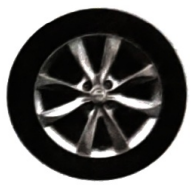
Here is a picture of a car wheel.
Image
What is the order of rotational symmetry for this wheel?
The costs of entry tickets to an amusement park are different for adults and children. An adult
ticket costs $Rs.800$ and a child ticket costs $Rs.500.$
$1.$ On Sunday, $x$ adult tickets and $y$ child tickets were sold. Which of the following expressions show the money collected through the ticket sale?
$A. 1300x$
$B. 800x+ 500x$
$C. 800x+ 500 y$
$D. (800 + 500) ( x + y)$
$2.$ A car parking ticket at the amusement park costs $Rs.150$ on Saturdays and Sundays and $Rs.100$ on weekdays. In a month with $5$ Saturdays and $4$ Sundays, the total parking ticket sale was worth $Rs.250,000.$ Write an equation to represent the situation algebraically.
$3.$ On Monday, the number of adults who visited the amusement park was the square of the number of children who visited. How much money was collected by selling entry tickets on Monday$?$
$A. x^2$
$B. 800x^2+ 500x$
$C. 800x + 500x^2$
$D.1300 (x+ x^2)$
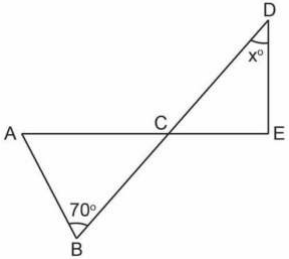
In the triangle $ABC$ below, $AC = BC.$ In the triangle $DCE, \angle CED = 90^\circ .$
Image
$1$.What is the value of $'x\ ’?$
Here is a picture of a car wheel.Image
1. Awhat is the order of rotational symmetry for this wheel?
Sunder is a fruit seller. Today he bought plums to sell. He purchased them at the rate of 9 for 100 from the wholesale market.
Q.1. How many plums should he sell for ₹40 if he wishes to gain 20%?
(a) 3$\quad$ (b) 4$\quad$(c) 5$\quad$(d) 8
Q.2.  He found that another fruit seller Kishan was selling plums at the rate of 6 for ₹90. Find the gain per cent of Kishan. (Assume that the wholesale rate is the same for all fruit sellers.
(a) 15%$\quad$(b) 20%$\quad$(c) 25%$\quad$(d) 35%
Q.3. Sunder decided to sell his plums at the rate of 7 for₹ 100. Find his gain per cent.
(a) $15 \frac{5}{9} \%$$\quad$(b) $17 \frac{7}{9} \%$$\quad$(c) $21 \frac{1}{9} \%$$\quad$(d) $22 \frac{2}{9} \%$
Q.4. In a box of 180 plums, he found that 28 were rotten and he had to throw them away. He sold the remaining plums at the rate of 8 for 100. Find his gain or loss per cent on this box.
(a) 2% gain$\quad$(b) 5% gain$\quad$(c) 2% loss$\quad$(d) 5% loss