MCQ
Cathode rays are
  • A
    Positive rays
  • B
    Neutral rays
  • C
    He rays
  • Electron waves

Answer

Correct option: D.
Electron waves
  Electron waves

Need a full question paper?

Generate a complete, print-ready paper with questions like this in minutes — across 16+ boards, with answer keys.
Start Generating Free

Similar questions

An electron and a proton enter a magnetic field perpendicularly. Both have same kinetic energy. Which of the following is true
Zener breakdown occurs in a $p-n$ junction having $p$ and $n$ both :
The plates of parallel plate capacitor are charged upto $100\;V$. A $2\,mm$ thick plate is inserted between the plates. Then to maintain the same potential difference, the distance between the plates is increased by $1.6\;mm$. The dielectric constant of the plate is
The inductance of a solenoid $0.5 \,m$ long of cross-sectional area $20\, cm^2$ and with $500$ turns is......$mH$
A convex lens A of focal length 20 cm and a concave lens B of focal length 5 cm are kept along the same axis with the distance d between them. If a parallel beam of light falling on A leaves B as a parallel beam, then distance d in cm will be
Smallest particle in a chemical element or compound that has the chemical properties of that element or compound is:
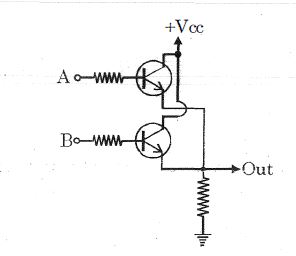
The circuit shown here can be used as a  logic gate. The logic gate is 
In the Young's double slit experiment using a monochromatic light of wavelength $\lambda$, the path difference (in terms of an integer $n$ ) corresponding to any point having half the peak intensity is :
Of the diodes shown in the following diagrams, which one is reverse biased
In a conductor, if the number of conduction electrons per unit volume is $8.5 \times 10^{28}\, m^{-3}$ and mean free time is $25\,fs$ (femto second), its approximate resistivity is $\left( {{m_e} = 9.1 \times {{10}^{ - 31}}\,kg} \right)$