Question
$\ce{He_2^3}$ and $\ce{He_1^3}$ nuclei have the same mass number. Do they have the same binding energy?a

Answer

The nuclei $\ce{He_2^3}$ and $\ce{He_1^3}$​​​​​​​ have the same mass number.
$\ce{He_2^3}$​​​​​​​ has two protons and one neutron.
​​​​​​​$\ce{He_2^3}$​​​​​​​ has one proton and two neutrons.
As $\ce{He3}$ has only one proton hence the repulsive force between protons is missing in $\ce{1He^3},$
so the binding energy of $\ce{1He^3}$​​​​​​​ is greater than that of $\ce{2He^3}$.

Need a full question paper?

Generate a complete, print-ready paper with questions like this in minutes — across 16+ boards, with answer keys.
Start Generating Free

Similar questions

If current flowing in a circular coil is doubled and radius is halved, then what would be the change in the produced magnetic field at the center of the coil?
An electric dipole with dipole moment $4 \times 10^{-9}$ Cm is aligned at $30^{\circ}$ with the direction of a uniform electric field of magnitude $5 \times 10^4 N C ^{-1}$. Calculate the magnitude of the torque acting on the dipole.
In some old texts it is mentioned that $4\pi$ lines of force originate from each unit positive charge. Comment on the statement in view of the fact that $4\pi$ is not an integer.
In a Young's double slit experiment $\lambda=500\ \text{nm}, d = 1.0\ mm$ and $D = 1.0m$. Find the minimum distance from the central maximum for which the intensity is half of the maximum intensity.
Find the dimensions of:
  1. Electric dipole moment p.
  2. Magnetic dipole moment M.
The defining equations are p = q.d and M = IA, where d is distance, A is area, q is charge and I is current.
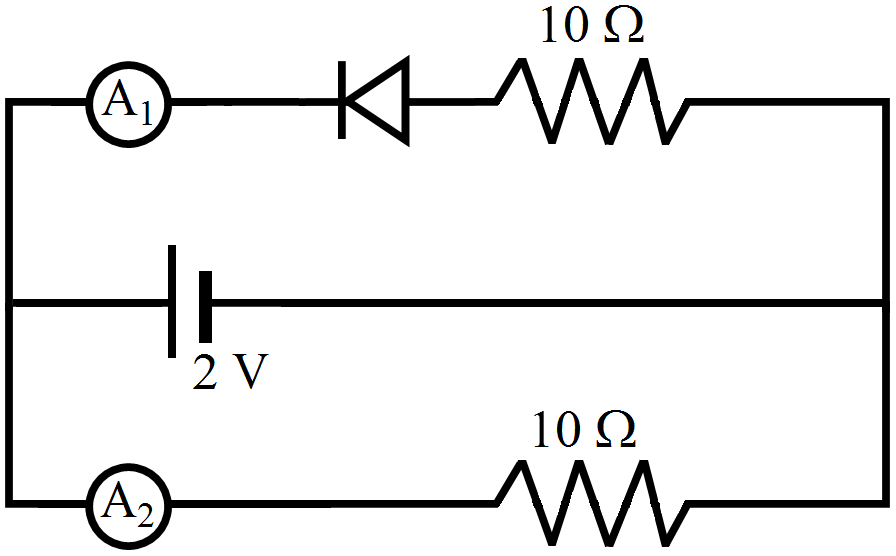
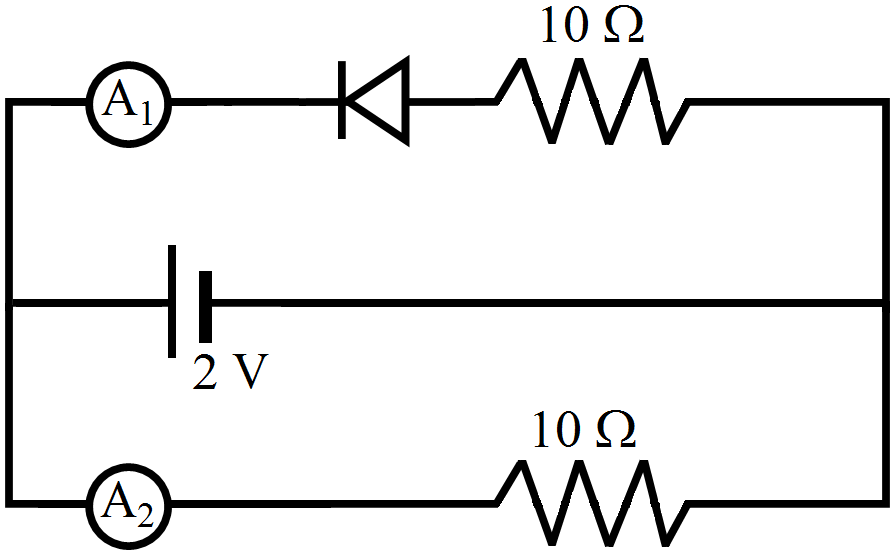
What are the readings of the ammeters $A_1$ and $A_2$ shown in figure. Neglect the resistance of the meters.​​​​​​​
A solenoid of length $0.5 m$ has a radius of $1 cm$ and is made up of 500 turns. It carries a current of $5 A$. What is the magnitude of the magnetic field inside the solenoid?
Answer the following question:
Magnifying power of a simple microscope is inversely proportional to the focal length of the lens. What then stops us from using a convex lens of smaller and smaller focal length and achieving greater and greater magnifying power?
It is said that the separation between the two charges forming an electric dipole should be small. Small compared to what?
A 44 m H inductor is connected to 220 V, 50 Hz ac supply. Determine the rms value of the current in the circuit.