Question
In a Young's double slit experiment $\lambda=500\ \text{nm}, d = 1.0\ mm$ and $D = 1.0m$. Find the minimum distance from the central maximum for which the intensity is half of the maximum intensity.

Answer

Given that$, D = 1m, d = 1\ mm = 10^{-3}m, \lambda=500\ \text{nm}=5\times10^{-7}\text{m}$
For intensity to be half the maximum intensity.
$\text{y}=\frac{\lambda\text{D}}{4\text{d}}$
$\Rightarrow\text{y}=\frac{5\times10^{-7}\times1}{4\times10^{-3}}$
$\Rightarrow\text{y}=1.25\times10^{-4}\text{m}.$

Need a full question paper?

Generate a complete, print-ready paper with questions like this in minutes — across 16+ boards, with answer keys.
Start Generating Free

Similar questions

An extended object is placed at a distance of 5.0cm from a convex lens of focal length 8.0cm.
  1. Draw the ray diagram (to the scale) to locate the image and from this, measure the distance of the image from the lens.
  2. Find the position of the image from the lens formula and see how close the drawing is to the correct result.
The total energy of electron is negative. What do you mean by this fact? It is positive then what is the indication?
Is it necessary to have two waves of equal intensity to study interference pattern? Will there be an effect on clarity if the waves have unequal intensity?
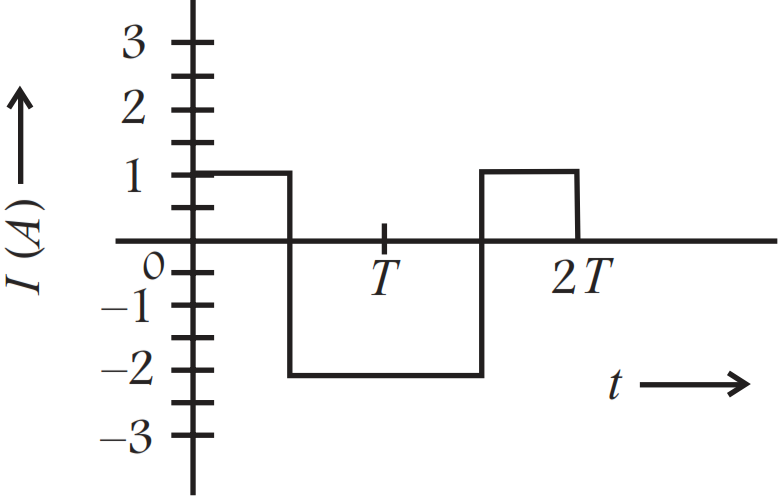
The alternating current in a circuit is described by the graph shown in Fig. Show rms current in this graph.
Discuss induced emf produced in a conducting rod during its motion in direction perpendicular to uniform magnetic field with reference to Lorentz force and obtain its expression.
Obtain the equation of electric potential energy of a system of two electric charges in external electric field.
A monochromatic light source of frequency $ 6\times10^{14} $ Hz emitts $ 2\times10^{-3} $ Joule energy per second. Calculate the number of photons emitted by the source per second.
  1. Find the first excitation potential of $He^+ \text{ion}.$
  2. Find the ionization potential of $Li^{++ } \text{ion}.$
A single lens is mounted in a tube. A parallel beam enters the tube and emerges out of the tube as a divergent beam. Can you say with certainty that there is a diverging lens in the tube?
Taking force, length and time to be the fundamental quantities find the dimensions of:
  1. Density.
  2. Pressure.
  3. Momentum.
  4. Energy.