MCQ
Centre of mass is a point:
  • A
    Which is geometric centre of a body.
  • B
    From which distance of particles are same.
  • Where the whole mass of the body is supposed the.
  • D
    None of these.

Answer

Correct option: C.
Where the whole mass of the body is supposed the.
Center of mass of a body is a point where we can assume all mass is concentrated.

Need a full question paper?

Generate a complete, print-ready paper with questions like this in minutes — across 16+ boards, with answer keys.
Start Generating Free

Similar questions

The temperature of an object is observed to rise in a period. In this period:
  1. Heat is certainly supplied to it.
  2. Heat is certainly not supplied to it.
  3. Heat may have been supplied to it.
  4. Work may have been done on it.
A body of mass $m= 10^{-2}$ $kg$ is moving in a medium and experiences a frictional force $F= -kv^2$. Its initial speed is $v_0= 10$ $ms^{-1}$. If, after $10\; s$, its energy is $\frac{1}{8}$ $mv_0^2$ the value of $k$ will be
In an experiment four quantities $a, b, c$ and $d $ are measured with percentage error $1\%, 2\%, 3\%$ and $4\%$ respectively. Quantity $P$ is calculated as follows $P = \frac{{{a^3}{b^2}}}{{cd}}$. $ \%$ error in $P$ is ........ $\%$
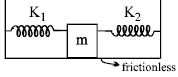
Two springs with negligible masses and force constant of $K_1 = 200\, Nm^{-1}$ and $K_2 = 160\, Nm^{-1}$ are attached to the block of mass $m = 10\, kg$ as shown in the figure. Initially the block is at rest, at the equilibrium position in which both springs are neither stretched nor compressed. At time $t = 0,$ a sharp impulse of $50\, Ns$ is given to the block with a hammer.
If the acceleration due to gravity at earth is $'g'$ and mass of earth is $80\,times$ that of moon and radius of earth is $4\,times$ that of moon, the value of acceleration due to gravity at the surface of moon will be
The volume of a gas at $20°C$ is $200\, ml$. If the temperature is reduced to $-20°C$ at constant pressure, its volume will be ...... $ml$
A steam engine intakes $50\, g$ of steam at $100^{\circ} C$ per minute and cools it down to $20^{\circ} C$. If latent heat of vaporization of steam is $540 \,cal g ^{-1}$, then the heat rejected by the steam engine per minute is .........$\times 10^{3}$$cal.$
In $1913,$ Niels Bohr gave theory on the basis of:
By properly combining two prisms made of different materials, it is possible to:
A wire is stretched by $0.01$ $m$ by a certain force $F.$ Another wire of same material whose diameter and length are double to the original wire is stretched by the same force. Then its elongation will be