{C{H_3} - CH - C{H_3}} \\
{|\,\,\,\,} \\
{\,\,C{H_3}}
\end{array}$
Above reaction is an example of
- ✓isomerization
- Bpolymerization
- Ccracking
- Dde-hydrogenation
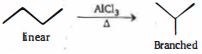
Above reaction is an example of

Generate a complete, print-ready paper with questions like this in minutes — across 16+ boards, with answer keys.
$\Psi_{2 s}=\frac{1}{2 \sqrt{2 \pi}}\left(\frac{1}{a_0}\right)^{1 / 2}\left(2-\frac{ r }{ a _0}\right) e ^{- r / 2 a _0}$
At $r=r_0$, radial node is formed. Thus, $r_0$ in terms of $a_0$
$\mathrm{H}_2 \mathrm{O}_2, \mathrm{ClO}_3^{-}, \mathrm{P}_4, \mathrm{Cl}_2, \mathrm{Ag}, \mathrm{Cu}^{+1}, \mathrm{~F}_2, \mathrm{NO}_2, \mathrm{~K}^{+}$
Assertion $A:$ $5 f$ electrons can participate in bonding to a far greater extent than $4 f$ electrons
Reason $R:$ $5 f$ orbitals are not as buried as $4 f$ orbitals
In the light of the above statements, choose the correct answer from the options given below

$Cr/Cr^{3+} (1.0\ M)\ ||\ Co^{+2} (1.0\ M)/Co$
$[E^o$ for $Cr^{3+}/Cr =\ -0.74\ V$ and $Co^{+2}/Co=\ -0.28\ V]$