MCQ
Characteristic $X-$ rays are produced due to
  • A
    Transfer of momentum in collision of electrons with target atoms
  • Transition of electrons from higher to lower electronic orbits in an atom
  • C
    Heating of the target
  • D
    Transfer of energy in collision of electrons with atoms in the target
Answer

Correct option: B.
Transition of electrons from higher to lower electronic orbits in an atom
b
(b) Characteristics $\mathrm{X}$ -ray are produced when an element is bombarded with high energy particles which can be photons, electrons or ions. When the incident particle stikes a bound electron in an atom, the bound electron is ejected from the inner shell of the atom. After the electron has been ejected, the atom is left with vacant energy level, also known as core hole. outer shell electrons then fall into the innershell, emitting quantized photons with an energy equivalent to the energy difference between the higher and lower states. Each element has a unique set of energy levels, and thus the transmission form the higher to lower energy level so produce $\mathrm{x}$ -rays with frequencies that are characteristics to each element.

Need a full question paper?

Generate a complete, print-ready paper with questions like this in minutes — across 16+ boards, with answer keys.

Start Generating Free

Similar questions

Alpha particles are
A glass flask of volume $200 \,cm ^3$ is just filled with mercury at $20^{\circ} C$. The amount of mercury that will overflow when the temperature of the system is raised to $100^{\circ} C$ is ........ $cm ^3$ $\left(\gamma_{\text {glase }}=1.2 \times 10^{-5} / C ^{\circ}, \gamma_{\text {mercury }}=1.8 \times 10^{-4} / C^{\circ}\right)$
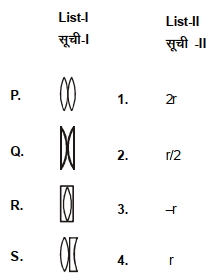
Four combinations of two thin lenses are given in List-$I$. The radius of curvature of all curved surface is r and the refractive index of all lenses is $1.5.$ Match lens combinations in List-$I$ with their focal length in List-$II$ and select the correct answer using the code given below the lists.
By what factor the $r.m.s.$ velocity will change, if the temperature is raised from $27^\circ C$ to  $327^\circ C$
A tuning fork of frequency $340\, Hz$ is sounded above an organ pipe of length $120\, cm$. Water is now slowly poured in it. The minimum height of water column required for resonance is .... $cm$ (speed of sound in air $= 340 \,m/s$)
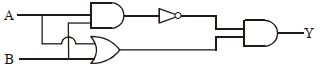
Which one of the following will be the output of the given circuit?
Which of the following will not give Cannizzaro reaction?
An inductor of inductance $2\,\mu\,H$ is connected in series with a resistance, a variable capacitor and an $AC$ source of frequency $7\,kHz$. The value of capacitance for which maximum current is drawn into the circuit is $\frac{1}{x} F$, where the value of $x$ is $.........$. $\left(\right.$ Take $\left.\pi=\frac{22}{7}\right)$
An electron is projected with velocity $v_0$ in a uniform electric field $E$ perpendicular to the field. Again it is projetced with velocity $v_0$ perpendicular to a uniform magnetic field $B/$ If $r_1$ is initial radius of curvature just after entering in the electric field and $r_2$ is initial radius of curvature just after entering in magnetic field then the ratio $r_1:r_2$ is equal to 
A body revolved around the sun $27$ times faster then the earth what is the ratio of their radii