charge $Q$ is uniformly distributed over a long rod $AB$ of length $L$ as shown in the figure. The electric potential at the point $O$ lying at distance $L$ from the end $A$ is

JEE MAIN 2013, Medium
Download our app for free and get started
Electric potential is given by,
$V=\int_{L}^{2 L} \frac{k d q}{x}=\int_{L}^{2 L} \frac{1}{4 \pi \varepsilon_{0}} \frac{\left(\frac{q}{L}\right) d x}{x}=\frac{q}{4 \pi \varepsilon_{0} L} \ln (2)$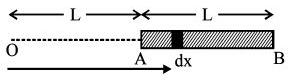

Download our appand get started for free
Experience the future of education. Simply download our apps or reach out to us for more information. Let's shape the future of learning together!No signup needed.*
Similar Questions
- 1The electric field intensity produced by the radiation coming from a $100\, W$ bulb at a distance of $3\, m$ is $E$. The electric field intensity produced by the radiation coming from $60\, W$ at the same distance is $\sqrt{\frac{x}{5}} E$. Where the value of $x=......... .$View Solution
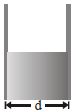
- 2A parallel plate air capacitor has a capacitance $C$. When it is half filled with a dielectric of dielectric constant $5$, the percentage increase in the capacitance will be......$\%$View Solution
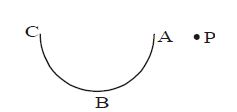
- 3In the following diagram the work done in moving a point charge from point $P$ to point $A, B$ and $C$ is respectively as $W_A,\, W_B$ and $W_C$, then (there is no charge nearby)View Solution
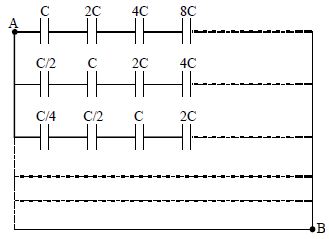
- 4Consider an infinite matrix of capacitors as shown in the figure. The effective capacitance between point $A$ and $B$ will beView Solution
- 5View SolutionWhich of the following figure shows the correct equipotential surfaces of a system of two positive charges?
- 6A particle of charge $q$ and mass $m$ is subjected to an electric field $E = E _{0}\left(1- ax ^{2}\right)$ in the $x-$direction, where $a$ and $E _{0}$ are constants. Initially the particle was at rest at $x=0 .$ Other than the initial position the kinetic energy of the particle becomes zero when the distance of the particle from the origin isView Solution
- 7A $4\,\mu F$ condenser is connected in parallel to another condenser of $8\,\mu F$. Both the condensers are then connected in series with a $12\,\mu F$ condenser and charged to $20\;volts$. The charge on the plate of $4\,\mu F$ condenser is......$\mu C$View Solution
- 8Three concentric metal shells $A, B$ and $C$ of respective radii $a, b$ and $c (a < b < c)$ have surface charge densities $+\sigma,-\sigma$ and $+\sigma$ respectively. The potential of shell $B$ isView Solution
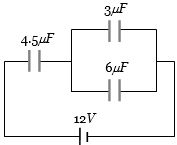
- 9In the circuit shown in the figure, the potential difference across the $4.5\,\mu F$ capacitor is.......$volts$View Solution
- 10View SolutionA parallel plate capacitor is charged fully by using a battery. Then, without disconnecting the battery, the plates are moved further apart. Then,