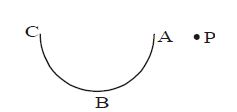
In the following diagram the work done in moving a point charge from point $P$ to point $A, B$ and $C$ is respectively as $W_A,\, W_B$ and $W_C$, then (there is no charge nearby)
Easy
Download our app for free and get started
The work done is moving a charge on equipotential surface is zero.

Download our appand get started for free
Experience the future of education. Simply download our apps or reach out to us for more information. Let's shape the future of learning together!No signup needed.*
Similar Questions
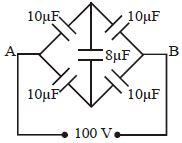
- 1Five capacitors are connected to a $DC$ potential of $100\,V$ as shown in the adjoining figure. Find charge in $10\,μF$ capacitor.......$\mu C$View Solution
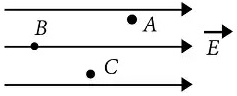
- 2$A, B$ and $C$ are three points in a uniform electric field. The electric potential isView Solution
- 3An alpha particle is accelerated through a potential difference of ${10^6}\,volt$. Its kinetic energy will be......$MeV$View Solution
- 4Three concentric metal shells $A, B$ and $C$ of respective radii $a, b$ and $c (a < b < c)$ have surface charge densities $+\sigma,-\sigma$ and $+\sigma$ respectively. The potential of shell $B$ isView Solution
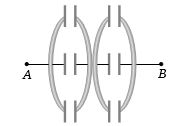
- 5All six capacitors shown are identical, Each can withstand maximum $200\, volts$ between its terminals. The maximum voltage that can be safely applied between $A$ and $B$ is.....$V$View Solution
- 6The capacitor of capacitance $4\,\mu F$ and $6\,\mu F$ are connected in series. A potential difference of $500\;volts$ applied to the outer plates of the two capacitor system. Then the charge on each capacitor is numericallyView Solution
- 7The minimum number of capacitors each of $2$ $\mu F$ required to make a circuit with an equivalent capacitance $5$ $\mu F$ isView Solution
- 8In the circuit shown in figure, four capacitors are connected to a battery. The equivalent capacitance of the circuit is......$ \mu F$View Solution
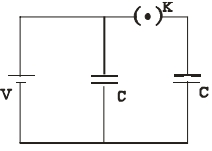
- 9A source of potential difference $V$ is connected to the combination of two identical capacitors as shown in the figure. When key ' $K$ ' is closed, the total energy stored across the combination is $E _{1}$. Now key ' $K$ ' is opened and dielectric of dielectric constant 5 is introduced between the plates of the capacitors. The total energy stored across the combination is now $E _{2}$. The ratio $E _{1} / E _{2}$ will be :View Solution
- 10An electric charge $10^{-3}\ \mu C$ is placed at the origin $(0, 0)$ of $X-Y$ coordinate system. Two points $A$ and $B$ are situated at $(\sqrt 2 ,\sqrt 2 )$ and $(2, 0)$ respectively. The potential difference between the points $A$ and $B$ will be......$V$View Solution