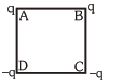
Charges are placed on the vertices of a square as shown. Let $E$ be the electric field and $V$ the potential at the centre. If the charges on $A$ and $B$ are interchanged with those on $D$ and $C$ respectively, then
Easy


Download our appand get started for free
Experience the future of education. Simply download our apps or reach out to us for more information. Let's shape the future of learning together!No signup needed.*
Similar Questions
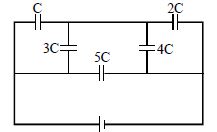
- 1In the given circuit, ratio of charge stored in the capacitors $C, 2C, 3C, 4C, 5C$ isView Solution
- 2Two charged spheres of radii $10\, cm$ and $15\, cm$ are connected by a thin wire. No current will flow, if they haveView Solution
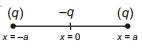
- 3Three charges are placed along $x$-axis at $x=-a, x=0$ and $x=a$ as shown in the figure. The potential energy of the system isView Solution
- 4The electrostatic force between the metal plates of an isolated parallel plate capacitor $C$ having a charge $Q$ and area $A,$ isView Solution
- 5The electrostatic potential due to an electric dipole at a distance ' $r$ ' varies as :View Solution
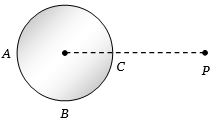
- 6Two identical positive charges are placed at $x =\, -a$ and $x = a$ . The correct variation of potential $V$ along the $x-$ axis is given byView Solution
- 7A parallel plate capacitor of capacitance $C$ is connected to a battery and is charged to a potential difference $V$. Another capacitor of capacitance $2C$ is similarly charged to a potential difference $2V$. The charging battery is now disconnected and the capacitors are connect in parallel to each other in such a way that the positive terminal of one is connected to the negative terminal of the other. The final energy of the configuration isView Solution
- 8Two charged spherical conductors of radius $R_{1}$ and $\mathrm{R}_{2}$ are connected by a wire. Then the ratio of surface charge densities of the spheres $\left(\sigma_{1} / \sigma_{2}\right)$ is :View Solution
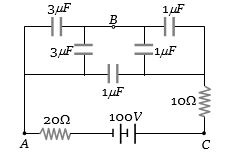
- 9In the figure below, what is the potential difference between the point $A$ and $B$ and between $B$ and $C$ respectively in steady stateView Solution
- 10A hollow conducting sphere is placed in an electric field produced by a point charge placed at $P$ as shown in figure. Let ${V_A},{V_B},{V_C}$ be the potentials at points $A,B$ and $C$ respectively. ThenView Solution