Two identical positive charges are placed at $x =\, -a$ and $x = a$ . The correct variation of potential $V$ along the $x-$ axis is given by
- A
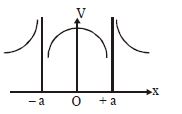
- B
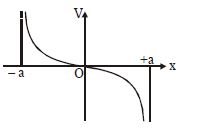
- C
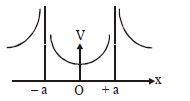
- D
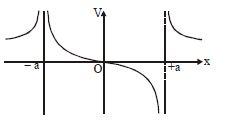
Medium


Download our appand get started for free
Experience the future of education. Simply download our apps or reach out to us for more information. Let's shape the future of learning together!No signup needed.*
Similar Questions
- 1A parallel plate capacitor has plates of area $A$ separated by distance $d$ between them. It is filled with a dielectric which has a dielectric constant that varies as $\mathrm{k}(\mathrm{x})=\mathrm{K}(1+\alpha \mathrm{x})$ where $\mathrm{x}$ is the distance measured from one of the plates. If $(\alpha \text {d)}<<1,$ the total capacitance of the system is best given by the expressionView Solution
- 2Choose the $CORRECT$ optionView Solution
- 3A parallel plate capacitor has plate area $A$ and separation $d$. It is charged to a potential difference $V_o$. The charging battery is disconnected and the plates are pulled apart to three times the initial separation. The work required to separate the plates isView Solution
- 4Determine the electric field strength vector if the potential of this field depends on $x, y$ coordinates as $V=10$ axyView Solution
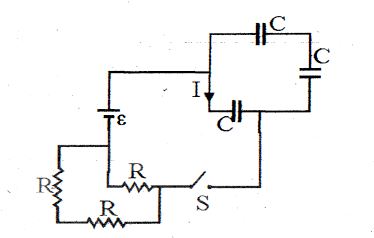
- 5In the given circuit switch $S$ is closed at $t = 0$ . The current $I$ in the figure at time $t$ isView Solution
- 6Three concentric spherical metallic shells $X , Y$ and $Z$ of radius $a , b$ and c respectively $[ a < b < c ]$ have surface charge densities $\sigma,-\sigma$ and $\sigma$, respectively. The shells $X$ and $Z$ are at same potential. If the radii of $X$ and $Y$ are $2\,cm$ and $3\,cm$, respectively.The radius of shell $Z$ is $......cm$.View Solution
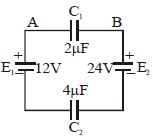
- 7Two capacitors $C_1$ and $C_2$ are connected in a circuit as shown in figure. The potential difference $(V_A -V_B)$ is....$V$View Solution
- 8The electric potential $V$ is given as a function of distance $x$ (metre) by $V = (5{x^2} + 10x - 9)\,volt$. Value of electric field at $x = 1$ is......$V/m$View Solution
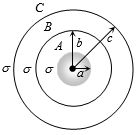
- 9Three concentric metallic shells $A, B$ and $C$ of radii $a, b$ and $c (a < b < c)$ have surface charge densities $\sigma ,\, - \sigma $ and $\sigma $ respectively. then ${V_A}$ and ${V_B}$View Solution
- 10A capacitor stores $60\ \mu C$ charge when connected across a battery. When the gap between the plates is filled with a dielectric , a charge of $120\ \mu C$ flows through the battery , if the initial capacitance of the capacitor was $2\ \mu F$, the amount of heat produced when the dielectric is inserted.......$\mu J$View Solution