Question
Check if the following functions have an inverse function. If yes, find the inverse function.

$f(x)=$

Answer

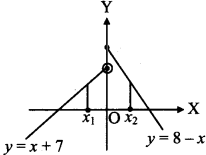
$f(x)=x+7, x<0$
$
=8-x, x \geq 0
$
Image
We observe from the graph that for two values of $x_1$ say $x_1, x_2$ the values of the function are equal.
i.e. $f\left(x_1\right)=f\left(x_2\right)$
$\therefore \mathrm{f}$ is not one-one (i.e. many-one) function.
$\therefore \mathrm{f}$ does not have inverse.

Need a full question paper?

Generate a complete, print-ready paper with questions like this in minutes — across 16+ boards, with answer keys.

Start Generating Free

Similar questions

All the letters of the word 'EAMCOT' are arranged in different possible ways. Find the number of arrangements in which no two vowels are adjacent to each other:
If $\sec \theta=\sqrt{2}$ and $\frac{3 \pi}{2}<\theta<2 \pi$, then evaluate $\frac{1+\tan \theta+\operatorname{cosec} \theta}{1+\cot \theta-\operatorname{cosec} \theta}$
Find the values of $\theta$ and p, if the equation $\text{x} \cos θ + \text{y} \sin \theta = \text{p}$ is the normal form of the line $\sqrt{3}\text{x}+\text{y}+2=0.$
Prove that: $\frac{\tan^22\text{x}-\tan^2\text{x}}{1-\tan^22\text{x}\tan^2\text{x}}=\tan3\text{x}\tan\text{x}$
Find the sum of the following series to infinit:$\frac{1}{3}+\frac{1}{5^2}+\frac{1}{3^3}+\frac{1}{5^4}+\frac{1}{3^5}+\frac{1}{5^6}+\ ...\infty$
Find the length of the transverse axis, length of the conjugate axis, the eccentricity, the co-ordinates of foci, equations of directrices, and the length of the latus rectum of the hyperbolae.: $x=2 \sec \theta, y=2 \sqrt{3} \tan \theta$
Find the middle terms in the expansion of

$\left(x^2+\frac{1}{x}\right)^7$

Let $A = {1, 2, 4, 5}, B = {2, 3, 5, 6}, C = {4, 5, 6, 7}$.
Verify the following identities:
$\text{A}\cap(\text{B}\cup\text{C})=(\text{A}\cap\text{B})\cup(\text{A}\cap\text{C})$
Find the equation of the parabola whose focus is $(5, 2)$ and having vertex at $( 3, 2)$.
Prove the following : $\frac{(1+\cot \theta+\tan \theta)(\sin \theta-\cos \theta)}{\sec ^3 \theta-\operatorname{cosec}^3 \theta}=\sin ^2 \theta \cos ^2 \theta$