Question 13 Marks
Find (fof) ( $x$ ) if : $f(x)=\frac{2 x+1}{3 x-2}$
Answer$\mathrm{f}(x)=\frac{2 x+1}{3 x-2}$
$
\begin{aligned}
f(f(x)) & =f\left(\frac{2 x+1}{3 x-2}\right)=\frac{2\left(\frac{2 x+1}{3 x-2}\right)+1}{3\left(\frac{2 x+1}{3 x-2}\right)-2} \\
& =\frac{4 x+2+3 x-2}{6 x+3-6 x+4}=\frac{7 x}{7} \\
& =x
\end{aligned}
$
View full question & answer→Question 23 Marks
Find (fof) ( $x$ ) if : $f(x)=\frac{x}{\sqrt{1+x^2}}$
Answer$ f(x)=\frac{x}{\sqrt{1+x^2}}$
$\mathrm{f}(\mathrm{f}(x))=\mathrm{f}\left(\frac{x}{\sqrt{1+x^2}}\right)=\frac{\frac{x}{\sqrt{1+x^2}}}{\sqrt{1+\left(\frac{x}{\sqrt{1+x^2}}\right)^2}} $
$=\frac{\frac{x}{\sqrt{1+x^2}}}{\sqrt{\frac{1+2 x^2}{1+x^2}}}=\frac{x}{\sqrt{1+2 x^2}}$
View full question & answer→Question 33 Marks
Find the domain of the following functions.$f(x)=\sqrt{\log \left(x^2-6 x+6\right)}$
Answer$f(x)=\sqrt{\log \left(x^2-6 x+6\right)}$
For $f$ to be defined,
$ \log \left(x^2-6 x+6\right) \geq 0$
$\therefore x^2-6 x+6 \geq 1$
$\therefore x^2-6 x+5 \geq 0$
$\therefore(x-5)(x-1) \geq 0$
$\therefore x \leq 1 \text { or } x \geq 5 \ldots . . \text { (i) } $
[ $\because$ The solution of $(x-a)(x-b) \geq 0$ is $x \leq a$ or $x \geq b$, for $a0$
$\therefore(x-3)^2>-6+9$
$\therefore(x-3)^2>3$
$\therefore x<3-\sqrt{3} \text { or } x>3+\sqrt{3}$
From (i) and (ii), we get
$x \leq 1 \text { or } x \geq 5$
Solution set $=(-\infty, 1] \cup[5, \infty)$
$\therefore$ Domain of $f=(-\infty 11\cup[5 \infty)$
View full question & answer→Question 43 Marks
If $\frac{\log _2 a}{4}=\frac{\log _2 b}{6}=\frac{\log _2 c}{3 k}$ and $a^3 b^2 c=1$, find the value of $k$.
AnswerLet $\frac{\log _2 \mathrm{a}}{4}=\frac{\log _2 \mathrm{~b}}{6}=\frac{\log _2 \mathrm{c}}{3 \mathrm{k}}=x$
$
\begin{array}{ll}
\therefore \quad \log _2 \mathrm{a}=4 x, \log _2 \mathrm{~b}=6 x, \log _2 \mathrm{c}=3 \mathrm{k} x \\
\text { Also, } \mathrm{a}^3 \mathrm{~b}^2 \mathrm{c}=1
\end{array}
$
Taking log to the base 2 throughout, we get $\log _2\left(a^3 b^2 c\right)=\log _2 1$
$
\begin{array}{ll}
\therefore & \log _2 \mathrm{a}^3+\log _2 \mathrm{~b}^2+\log _2 \mathrm{c}=0 \\
\therefore & 3 \log _2 \mathrm{a}+2 \log _2 \mathrm{~b}+\log _2 \mathrm{c}=0 \\
\therefore & 3(4 x)+2(6 x)+3 \mathrm{k} x=0 \\
\therefore & 3kx=-24x \\
\therefore & k=-8
\end{array}
$...[From (i)]
View full question & answer→Question 53 Marks
Show that $7 \log \left(\frac{15}{16}\right)+6 \log \left(\frac{8}{3}\right)+5 \log \left(\frac{2}{5}\right)+\log \left(\frac{32}{25}\right)=\log 3$
Answer$\text { L.H.S. }=7 \log \left(\frac{15}{16}\right)+6 \log \left(\frac{8}{3}\right)+5 \log \left(\frac{2}{5}\right)$
$+\log \left(\frac{32}{25}\right)$
$ =\log \left(\frac{15}{16}\right)^7+\log \left(\frac{8}{3}\right)^6+\log \left(\frac{2}{5}\right)^5+\log \left(\frac{32}{25}\right)$
$=\log \left(\frac{3 \times 5}{2^4}\right)^7+\log \left(\frac{2^3}{3}\right)^6+\log \left(\frac{2}{5}\right)^5+\log \left(\frac{2^5}{5^2}\right)$
$=\log \left(\frac{3^7 \times 5^7}{2^{28}}\right)+\log \left(\frac{2^{18}}{3^6}\right)+\log \left(\frac{2^5}{5^5}\right)+\log \left(\frac{2^5}{5^2}\right)$
$=\log \left[\frac{3^7 \times 5^7}{2^{28}} \times \frac{2^{18}}{3^6} \times \frac{2^5}{5^5} \times \frac{2^5}{5^2}\right]$
$=\log 3=\text { R.H.S. } $
View full question & answer→Question 63 Marks
Without using log tables, prove that $\frac{2}{5}<\log _{10} 3<\frac{1}{2}$.
AnswerWe have to prove that, $\frac{2}{5}<\log _{10} 3<\frac{1}{2}$
i.e., to prove that $\frac{2}{5}<\log _{10} 3$ and $\log _{10} 3<\frac{1}{2}$
i.e., to prove that $2<5 \log _{10} 3$ and $2 \log _{10} 3<1$
i.e., to prove that $2 \log _{10} 10<5 \log _{10} 3$ and $2 \log _{10} 3<\log _{10} 10 \ldots \ldots .\left[\because \log _a\right.$ a $=1]$
i.e., to prove that $\log _{10} 10^2<\log _{10} 3^5$ and $\log _{10} 3^2<\log _{10} 10$
i.e., to prove that $10^2<3^5$ and $3^2<10$
i.e., to prove that $100<243$ and $9<10$ which is true
$
\therefore \frac{2}{5}<\log _{10} 3<\frac{1}{2}
$
View full question & answer→Question 73 Marks
If $f(x)=\log (1-x), 0 \leq x<1$, show that $f\left(\frac{1}{1+x}\right)=f(1-x)-f(-x)$.
Answer$\mathrm{f}(x)=\log (1-x)$
Replacing $x$ by $\left(\frac{1}{1+x}\right)$, we get
$ \mathrm{f}\left(\frac{1}{1+x}\right)=\log \left(1-\frac{1}{1+x}\right)=\log \left(\frac{1+x-1}{1+x}\right)=\log \left(\frac{x}{1+x}\right)$
$\therefore \quad \mathrm{f}\left(\frac{1}{1+x}\right)=\log x-\log (1+x)$
$\therefore \quad \mathrm{f}\left(\frac{1}{1+x}\right)=\log (1-1+x)-\log (1+x)$
$\therefore \quad \mathrm{f}\left(\frac{1}{1+x}\right)=\log [1-(1-x)]-\log [1-(-x)]$
$\therefore \quad \mathrm{f}\left(\frac{1}{1+x}\right)=\mathrm{f}(1-x)-\mathrm{f}(-x)$
View full question & answer→Question 83 Marks
Simplify $\log _{10} \frac{28}{45}-\log _{10} \frac{35}{324}+\log _{10} \frac{325}{432}-\log _{10} \frac{13}{15}$
Answer$ \log _{10}\left(\frac{28}{45}\right)-\log _{10}\left(\frac{35}{324}\right)+\log _{10}\left(\frac{325}{432}\right)-\log _{10}\left(\frac{13}{15}\right)$
$=\log _{10}\left(\frac{28}{45}\right)+\log _{10}\left(\frac{325}{432}\right)$
$-\left[\log _{10}\left(\frac{35}{324}\right)+\log _{10}\left(\frac{13}{15}\right)\right]$
$=\log _{10}\left(\frac{28}{45} \times \frac{325}{432}\right)-\log _{10}\left(\frac{35}{324} \times \frac{13}{15}\right)$
$=\log _{10}\left(\frac{7 \times 65}{9 \times 108}\right)-\log _{10}\left(\frac{7 \times 13}{3 \times 324}\right)$
$=\log _{10}\left(\frac{\frac{7 \times 65}{9 \times 108}}{\frac{7 \times 13}{3 \times 324}}\right)$
$=\log _{10}\left(\frac{7 \times 65}{9 \times 108} \times \frac{3 \times 324}{7 \times 13}\right)=\log _{10} 5$
View full question & answer→Question 93 Marks
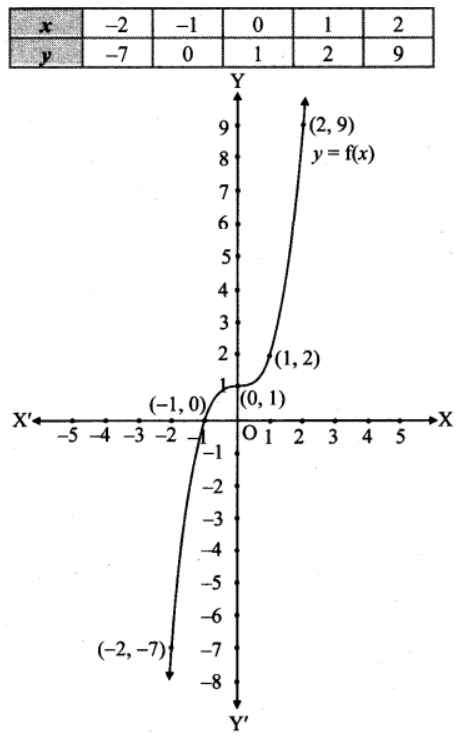
Let $f: R \rightarrow R$ be given by $f(x)=x^3+1$ for all $x \in R$. Draw its graph.
AnswerLet $y=f(x)=x^3+1$
View full question & answer→Question 103 Marks
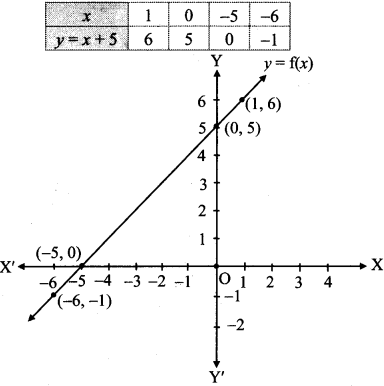
Let $f: R \rightarrow R$ be given by $f(x)=x+5$ for all $x \in R$. Draw its graph.
Answer$
f(x)=x+5
$
View full question & answer→Question 113 Marks
Let $f: R \rightarrow R$ be a function defined by $f(x)=5 x^3-8$ for all $x \in R$. Show that $f$ is one-one and onto. Hence find $\mathrm{f}^{-1}$.
Answer$
\begin{array}{ll}
& \mathrm{f}(x)=5 x^3-8 x \in \mathrm{R} \\
& \text { Let } \mathrm{f}\left(x_1\right)=\mathrm{f}\left(x_2\right) \\
\therefore & 5 x_1{ }^3-8=5 x_2{ }^3-8 \\
\therefore & x_1{ }^3-x_2{ }^3=0 \\
\therefore & \left(x_1-x_2\right) \underbrace{\left(x_1{ }^2+x_1 x_2+x_2{ }^2\right)}_{>0 \text { for all } \mathrm{\eta}, x_2 \text { a discrinium }<0}=0 \\
\therefore & x_1=x_2\\
\therefore \quad & \mathrm{f} \text { is a one-one function. } \\
& \text { Let } \mathrm{f}(x)=5 x^3-8=y \text { (say), } \quad y \in \mathrm{R} \\
\therefore & x=\sqrt[3]{\frac{y+8}{5}} \\
\therefore & \text { For every } y \in \mathrm{R}, \text { there is some } x \in \mathrm{R} \\
\therefore & \mathrm{f} \text { is an onto function. } \\
& x=\sqrt[3]{\frac{y+8}{5}}=\mathrm{f}^{-1}(y) \\
\therefore & \mathrm{f}^{-1}(x)=\sqrt[3]{\frac{x+8}{5}}
\end{array}
$
View full question & answer→Question 123 Marks
Solve the following for $x$, where $|x|$ is modulus function, $[x]$ is the greatest integer function, $\{x\}$ is a fractional part function.$|x-4|+|x-2|=3$
Answer$|x-4|+|x-2|=3$
Case I: $x<2$
Equation (i) reduces to
$ 4-\mathrm{x}+2-\mathrm{x}=3 \ldots \ldots .[\mathrm{x}<2<4, \mathrm{x}-4<0, \mathrm{x}-2<0]$
$\therefore 6-3=2 \mathrm{x}$
$\therefore \mathrm{x}=\frac{3}{2} $
Case II: $2 \leq \mathrm{x}<4$
Equation (i) reduces to
$ 4-\mathrm{x}+\mathrm{x}-2=3$
$\therefore 2=3 \text { (absurd) } $
There is no solution in $[2,4)$
Case III: $x \geq 4$
Equation (i) reduces to
$ x-4+x-2=3$
$\therefore 2 x=6+3=9$
$\therefore x=\frac{9}{2}$
$\therefore x=\frac{3}{2}, \frac{9}{2} \text { are solutions. } $
The solution set $=\left\{\frac{3}{2}, \frac{9}{2}\right\}$
View full question & answer→Question 133 Marks
Check if the following functions have an inverse function. If yes, find the inverse function.$f(x)=$
Answer$f(x)=x+7, x<0$
$
=8-x, x \geq 0
$
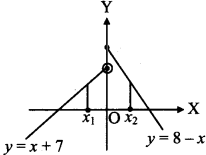
We observe from the graph that for two values of $x_1$ say $x_1, x_2$ the values of the function are equal.
i.e. $f\left(x_1\right)=f\left(x_2\right)$
$\therefore \mathrm{f}$ is not one-one (i.e. many-one) function.
$\therefore \mathrm{f}$ does not have inverse.
View full question & answer→Question 143 Marks
Check if the following functions have an inverse function. If yes, find the inverse function.$f(x)=9 x^3+8$
Answer$f(x) 9 x^3+8$
Let $\mathrm{f}\left(\mathrm{x}_1\right)=\mathrm{f}\left(\mathrm{x}_2\right)$
$
\therefore 9 x_1^3+8=9 x_2^3+8
$
$
\therefore \mathrm{x}_1=\mathrm{x}_2
$
$\therefore \mathrm{f}$ is a one-one function.
$
\therefore \mathrm{f}(\mathrm{x})=9 \mathrm{x}^3+8=\mathrm{y} \text {, (say) }
$
$\therefore \mathrm{x}=\sqrt[3]{\frac{y-8}{9}}$
$\therefore$ For every y we can get $x$.
$\therefore \mathrm{f}$ is an onto function.
$
\therefore \mathrm{x}=\sqrt[3]{\frac{y-8}{9}}=\mathrm{f}^{-1}(\mathrm{y})
$
Replacing y by $x$, we get
$
\mathrm{f}^{-1}(\mathrm{x})=\sqrt[3]{\frac{x-8}{9}}
$
View full question & answer→Question 153 Marks
Check if the following functions have an inverse function. If yes, find the inverse function.$f(x)=\sqrt{4 x+5}$
Answer$\mathrm{f}(\mathrm{x})=\sqrt{4 x+5}, x \geq \frac{-5}{4}$
Let $\mathrm{f}\left(\mathrm{x}_1\right)=\mathrm{f}\left(\mathrm{x}_2\right)$
$\therefore \sqrt{4 x_1+5}=\sqrt{4 x_2+5}$
$\therefore \mathrm{x}_1=\mathrm{x}_2$
$\therefore \mathrm{f}$ is a one-one function.
$\mathrm{f}(\mathrm{x})=\sqrt{4 x+5}=\mathrm{y}$, (say) $\mathrm{y} \geq 0$
Squaring on both sides, we get
$\mathrm{y}^2=4 \mathrm{x}+5$
$\therefore \mathrm{x}=\frac{y^2-5}{4}$
$\therefore$ For every y we can get $\mathrm{x}$.
$\therefore \mathrm{f}$ is an onto function.
$\therefore \mathrm{x}=\frac{y^2-5}{4}=\mathrm{f}^{-1}(\mathrm{y})$
Replacing y by $x$, we get
$f^{-1}(x)=\frac{x^2-5}{4}$
View full question & answer→Question 163 Marks
Check if the following functions have an inverse function. If yes, find the inverse function.$f(x)=\frac{6 x-7}{3}$
Answer$f(x)=\frac{6 x-7}{3}$
Let $\mathrm{f}\left(\mathrm{x}_1\right)=\mathrm{f}\left(\mathrm{x}_2\right)$
$\therefore \frac{6 x_1-7}{3}=\frac{6 x_2-7}{3}$
$\therefore \mathrm{x}_1=\mathrm{x}_2$
$\therefore \mathrm{f}$ is a one-one function.
$\mathrm{f}(\mathrm{x})=\frac{6 x-7}{3}=\mathrm{y}$ (say)
$\therefore \mathrm{x}=\frac{3 y+7}{6}$
$\therefore$ For every $\mathrm{y}$, we can get $\mathrm{x}$
$\therefore \mathrm{f}$ is an onto function.
$\therefore \mathrm{x}=\frac{3 y+7}{6}=\mathrm{f}^{-1}(\mathrm{y})$
Replacing y by $x$, we get
$f-1(x)=\frac{3 x+7}{6}$
View full question & answer→Question 173 Marks
If $x=\log _a b c, y=\log _b c a, z=\log _c a b$, then prove that $\frac{1}{1+x}+\frac{1}{1+y}+\frac{1}{1+z}=1$.
Answer$ x=\log _a(\mathrm{bc}), y=\log _b(\mathrm{ca}), \mathrm{z}=\log _{\mathrm{c}}(\mathrm{ab})$
$\text { L.H.S. }=\frac{1}{1+x}+\frac{1}{1+y}+\frac{1}{1+z}$
$=\frac{1}{1+\log _a(b c)}+\frac{1}{1+\log _b(c a)}+\frac{1}{1+\log _c(a b)}$
$=\frac{1}{\log _a a+\log _a(b c)}+\frac{1}{\log _b b+\log _b(c a)}$
$+\frac{1}{\log _e c+\log _e(a b)}$
$=\frac{1}{\log _a(a b c)}+\frac{1}{\log _b(a b c)}+\frac{1}{\log _c(a b c)}$
$\text {...[ } \left.\log _a a=1\right]$
$\ldots\left[\log _a m+\log _a n=\log _a m n\right]$
$=\frac{\log a}{\log (a b c)}+\frac{\log b}{\log (a b c)}+\frac{\log c}{\log (a b c)}$
$\ldots\left[\log _y x=\frac{\log x}{\log y}\right]$
$=\frac{\log a+\log b+\log c}{\log a b c}$
$=\frac{\log a b c}{\log a b c}$
$= 1$
$=R.H.S $
View full question & answer→Question 183 Marks
If $\log \left(\frac{x+y}{3}\right)=\frac{1}{2} \log x+\frac{1}{2} \log y$, show that $\frac{x}{y}+\frac{y}{x}=7$
Answer$
\log \left(\frac{x+y}{3}\right)=\frac{1}{2} \log x+\frac{1}{2} \log y
$
Multiplying throughout by 2 , we get
$
\begin{array}{ll}
& 2 \log \left(\frac{x+y}{3}\right)=\log x+\log y \\
\therefore \quad & 2 \log \left(\frac{x+y}{3}\right)=\log x y \\
\therefore \quad & \log \left(\frac{x+y}{3}\right)^2=\log x y \quad \ldots\left[\text { nog } \mathrm{m}=\log \mathrm{m}^{\mathrm{n}}\right] \\
\therefore \quad & \frac{(x+y)^2}{9}=x y \\
\therefore \quad & x^2+2 x y+y^2=9 x y \\
\therefore \quad & x^2+y^2=7 x y
\end{array}
$
Dividing throughout by $x y$, we get
$
\frac{x}{y}+\frac{y}{x}=7
$
View full question & answer→Question 193 Marks
Solve for $\mathrm{x}$ :$x+\log _{10}\left(1+2^x\right)=x \log _{10} 5+\log _{10} 6$
Answer$ x+\log _{10}\left(1+2^x\right)=x \log _{10} 5+\log _{10} 6$
$\therefore \quad x \log _{10} 10+\log _{10}\left(1+2^x\right)=x \log _{10} 5+\log _{10} 6$
$.\left[\log _a a=1\right]$
$\therefore \quad \log _{10} 10^x+\log _{10}\left(1+2^x\right)=\log _{10} 5^x+\log _{10} 6$
$\ldots\left[n \log m=\log \mathrm{m}^{\mathrm{n}}\right]$
$\therefore \quad \log _{10}\left[10^x \cdot\left(1+2^x\right)\right]=\log _{10}\left(6 \times 5^x\right)$
$\ldots[\log m+\log n=\log m n]$
$\therefore \quad 10^x\left(1+2^x\right)=6 \times 5^x$
$\therefore \quad 2^x \times 5^x\left(1+2^x\right)=6 \times 5^x$
$\therefore \quad 2^x\left(1+2^x\right)=6$
$\text { Let } 2^x=a$
$\therefore \quad a \cdot(1+a)=6$
$\therefore a+a^2=6$
$\therefore a^2+a-6=0$
$\therefore(a+3)(a-2)=0$
$\therefore a+3=0 \text { or } a-2=0$
$\therefore \mathrm{a}=-3 \text { or } \mathrm{a}=2$
$\text { Since } 2 x=-3 \text { is not possible, }$
$2 x=2=21$
$\therefore x=1$
View full question & answer→Question 203 Marks
Solve for $\mathrm{x}$ :$\log _2 x+\log _4 x+\log _{16} x=\frac{21}{4}$
Answer$\begin{array}{ll}
& \log 2 x+\log x+\log _{16} x=\frac{21}{4} \\
\therefore \quad & \frac{\log x}{\log 2}+\frac{\log x}{\log 4}+\frac{\log x}{\log 16}=\frac{21}{4} \quad \ldots\left[\log x=\frac{\log x}{\log y}\right] \\
\therefore \quad & \frac{\log x}{\log 2}+\frac{\log x}{\log (2)^2}+\frac{\log x}{\log (2)^4}=\frac{21}{4} \\
\therefore \quad & \frac{\log x}{\log 2}+\frac{\log x}{2 \cdot \log 2}+\frac{\log x}{4 \cdot \log 2}=\frac{21}{4} \\
\therefore \quad & \frac{\log x}{\log 2}\left(1+\frac{1}{2}+\frac{1}{4}\right)=\frac{21}{4} \\
\therefore \quad & \frac{\log x}{\log 2} \times\left(\frac{7}{4}\right)=\frac{21}{4} \\
\therefore \quad & \frac{\log x}{\log 2}=3\\
\therefore \quad & \log x=3 \log 2 \\
\therefore \quad & \log x=\log 2^3 \\
\therefore \quad & x=2^3 \\
\therefore \quad & x=8
\end{array}$
View full question & answer→Question 213 Marks
Solve for $\mathrm{x}$ :$2 \log _{10} x=1+\log _{10}\left(x+\frac{11}{10}\right)$
Answer$ 2 \log _{10} x=1+\log _{10}\left(x+\frac{11}{10}\right)$
$\log _{10} x^2-\log _{10}\left(x+\frac{11}{10}\right)=1$
$\ldots\left[\text { log } \mathrm{m}=\log \mathrm{m}^{\mathrm{n}}\right]$
$\therefore \quad \log _{10} x^2-\log _{10}\left(\frac{10 x+11}{10}\right)=1$
$\therefore \quad \log _{10}\left(\frac{x^2}{\frac{10 x+11}{10}}\right)_{}=1 \quad \ldots\left[\log \mathrm{m}-\log \mathrm{n}=\log \frac{\mathrm{m}}{\mathrm{n}}\right]$
$\therefore \quad \log _{10}\left(\frac{10 x^2}{10 x+11}\right)=\log _{10} 10 \quad \ldots\left[\log _{\mathrm{a}} \mathrm{a}=1\right]$
$\therefore \quad \frac{10 x^2}{10 x+11}=10$
$\therefore \quad \frac{x^2}{10 x+11}=1$
$\therefore x^2=10 \mathrm{x}+11$
$\therefore x^2-10 x-11=0$
$\therefore(x-11)(\mathrm{x}+1)=0$
$\therefore x=11 \text { or } \mathrm{x}=-1 $
But $\log$ of a negative numbers does not exist
$ \therefore \mathrm{x} \neq-1$
$\therefore \mathrm{x}=11 $
View full question & answer→Question 223 Marks
Solve for $\mathrm{x}$ :$\log 2+\log (x+3)-\log (3 x-5)=\log 3$
Answer$ \log 2+\log (x+3)-\log (3 x-5)=\log 3$
$\therefore \log 2(x+3)-\log (3 x-5)=\log 3 \ldots . .[\because \log m+\log n=\log m n]$
$\therefore \log \frac{2(x+3)}{3 x-5}=\log 3 \ldots . .\left[\because \log m-\log n=\log \frac{m}{n}\right]$
$\therefore \frac{2(x+3)}{3 x-5}=3$
$\therefore 2 x+6=9 x-15$
$\therefore 7 x=21$
$\therefore x=3 $
Check:
If $x=3$ satisfies the given condition, then our answer is correct.
$ \text { L.H.S. }=\log 2+\log (x+3)-\log (3 x-5)$
$=\log 2+\log (3+3)-\log (9-5)$
$=\log 2+\log 6-\log 4$
$=\log (2 \times 6)-\log 4$
$=\log \frac{12}{4}$
$=\log 3$
$=\text { R.H.S. } $
Thus, our answer is correct.
View full question & answer→Question 233 Marks
If $f(x)=a x^2-b x+6$ and $f(2)=3$ and $f(4)=30$, find $a$ and $b$.
Answer$ f(x)=a x^2-b x+6$
$f(2)=3$
$\therefore a(2)^2-b(2)+6=3$
$\therefore 4 a-2 b+6=3$
$\therefore 4 a-2 b+3=0 \ldots .(i)$
$f(4)=30$
$\therefore a(4)^2-b(4)+6=30$
$\therefore 16 a-4 b+6=30$
$\therefore 16 a-4 b-24=0 . . .(1 $
By (ii) $-2 \times$ (i), we get
$ 8 a-30=0$
$\therefore a=\frac{30}{8}=\frac{15}{4} $
Substiting $a=\frac{15}{4}$ in (i), we get
$ 4\left(\frac{15}{4}\right)-2 b+3=0$
$\therefore 2 b=18$
$\therefore b=9$
$\therefore a=\frac{15}{4}, b=9 $
View full question & answer→Question 243 Marks
An open box is made from a square of cardboard of $30\ cms$ side, by cutting squares of length $x$ centimeters from each corner and folding the sides up.
Express the volume of the box as a function of $x$. Also, find its domain.
Answer
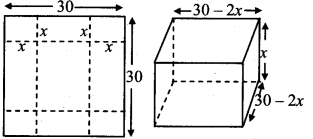
Length of the box $= 30 – 2x$
Breadth of the box $= 30 – 2x$
Height of the box $= x$
Volume $= (30 – 2x)^2 x, x < 15, x \neq 15, x > 0$
$= 4x(15 – x)^2, x \neq 15, x > 0$
Domain $(0, 15)$ View full question & answer→Question 253 Marks
Express the area $\mathrm{A}$ of a circle as a function of its
(i) radius $r$
(ii) diameter d
(iii) circumference $\mathrm{C}$
Answer(i) Area $(A)=\pi r^2$
(ii) Diameter (d) $=2 \mathrm{r}$
$ \therefore r=\frac{\mathrm{d}}{2}$
$\therefore \text { Area }(A)=\pi r^2=\frac{\pi d^2}{4} $
(iii) Circumference $(C)=2 \pi r$
$\therefore \mathrm{r}=\frac{C}{2 \pi}$
Area $(A)=\pi r^2=\pi\left(\frac{C}{2 \pi}\right)^2$
$\therefore \mathrm{A}=\frac{C^2}{4 \pi}$
View full question & answer→