MCQ
Choke coil is used to control
  • $ac$
  • B
    $dc$
  • C
    Both $ ac$  and  $ dc $
  • D
    Neither $ac $ nor $ dc$ 

Answer

Correct option: A.
$ac$
a
(a)The choke coil can be used only in $ac$ circuits, not in $ dc $   circuits, because for $ dc$ $ (\omega = 0)$ the inductive reactance ${X_L} = \omega L$ of the coil is zero, only the resistance of the coil remains effective which too is almost zero.

Need a full question paper?

Generate a complete, print-ready paper with questions like this in minutes — across 16+ boards, with answer keys.
Start Generating Free

Similar questions

Two solids $A$  and $ B$  float in water. It is observed that $A$  floats with $\frac{1}{2}$ of its body immersed in water and $ B$  floats with $\frac{1}{4}$ of its volume above the water level. The ratio of the density of $ A$  to that of $B$  is
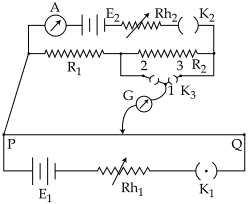
A potentiometer $PQ$ is set up to compare two resistances as shown in the figure. The ameter $A$ in the circuit reads $1.0\, A$ when two way key $K_3$ is open. The balance point is at a length $l_1\, cm$ from $P$ when two way key $K_3$ is plugged in between $2$ and $1$ , while the balance point is at a length $l_2\, cm$ from $P$ when key $K_3$ is plugged in between $3$ and $1$ . The ratio of two resistances $\frac{{{R_1}}}{{{R_2}}}$ is found to be
Two trains move towards each other with the same speed. The speed of sound is $340 \;m / s$. If the height of the tone of the whistle of one of them heard on the other changes $9 / 8$ times, then the speed of each train should be ........... $m/sec$
For an ideal gas of diatomic molecules
Two spherical conductors each of capacity $C$ are charged to potentials $V$ and $ - V$. These are then connected by means of a fine wire. The loss of energy will be
If the measurement errors in all the independent quantities are known, then it is possible to determine the error in any dependent quantity. This is done by the use of series expansion and truncating the expansion at the first power of the error. For example, consider the relation $z=x / y$. If the errors in $x, y$ and $z$ are $\Delta x, \Delta y$ and $\Delta z$, respectively, then

$\mathrm{z} \pm \Delta \mathrm{z}=\frac{\mathrm{x} \pm \Delta \mathrm{x}}{\mathrm{y} \pm \Delta \mathrm{y}}=\frac{\mathrm{x}}{\mathrm{y}}\left(1 \pm \frac{\Delta \mathrm{x}}{\mathrm{x}}\right)\left(1 \pm \frac{\Delta \mathrm{y}}{\mathrm{y}}\right)^{-1} .$

The series expansion for $\left(1 \pm \frac{\Delta y}{y}\right)^{-1}$, to first power in $\Delta y / y$, is $1 \mp(\Delta y / y)$. The relative errors in independent variables are always added. So the error in $\mathrm{z}$ will be $\Delta \mathrm{z}=\mathrm{z}\left(\frac{\Delta \mathrm{x}}{\mathrm{x}}+\frac{\Delta \mathrm{y}}{\mathrm{y}}\right)$.

The above derivation makes the assumption that $\Delta x / x<<1, \Delta \mathrm{y} / \mathrm{y} \ll<1$. Therefore, the higher powers of these quantities are neglected.

($1$) Consider the ratio $\mathrm{r}=\frac{(1-\mathrm{a})}{(1+\mathrm{a})}$ to be determined by measuring a dimensionless quantity a.

If the error in the measurement of $\mathrm{a}$ is $\Delta \mathrm{a}(\Delta \mathrm{a} / \mathrm{a} \ll<1)$, then what is the error $\Delta \mathrm{r}$ in

$(A)$ $\frac{\Delta \mathrm{a}}{(1+\mathrm{a})^2}$ $(B)$ $\frac{2 \Delta \mathrm{a}}{(1+\mathrm{a})^2}$ $(C)$ $\frac{2 \Delta \mathrm{a}}{\left(1-\mathrm{a}^2\right)}$ $(D)$ $\frac{2 \mathrm{a} \Delta \mathrm{a}}{\left(1-\mathrm{a}^2\right)}$

($2$) In an experiment the initial number of radioactive nuclei is $3000$ . It is found that $1000 \pm$ $40$ nuclei decayed in the first $1.0 \mathrm{~s}$. For $|\mathrm{x}| \ll 1$, In $(1+\mathrm{x})=\mathrm{x}$ up to first power in $x$. The error $\Delta \lambda$, in the determination of the decay constant $\lambda$, in $\mathrm{s}^{-1}$, is

$(A) 0.04$    $(B) 0.03$    $(C) 0.02$   $(D) 0.01$

Give the answer quetion ($1$) and ($2$)

A proton and a deuteron are initially at rest and are accelerated through the same potential difference. Which of the following is false concerning the final properties of the two particles ?
A tuning fork whose frequency as given by manufacturer is $512 Hz$ is being tested with an accurate oscillator. It is found that the fork produces a beat of $2 Hz$ when oscillator reads $514 Hz$ but produces a beat of $6 Hz$ when oscillator reads $510 Hz$. The actual frequency of fork is ..... $Hz$
If radius of first orbit of hydrogen atom is $5.29 \times 10^{-11} \,m$, the radius of fourth orbit will be ......... $\mathring A$
Two identical coherent sound sources $R$ and $S$ with frequency $f$ are $5 \,m$ apart. An observer standing equidistant from the source and at a perpendicular distance of $12 \,m$ from the line $R S$ hears maximum sound intensity.When he moves parallel to $R S$, the sound intensity varies and is a minimum when he comes directly in front of one of the two sources. Then, a possible value of $f$ is close to ............ $Hz$ (the speed of sound is $330 \,m / s$ )