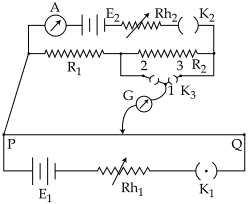
A potentiometer $PQ$ is set up to compare two resistances as shown in the figure. The ameter $A$ in the circuit reads $1.0\, A$ when two way key $K_3$ is open. The balance point is at a length $l_1\, cm$ from $P$ when two way key $K_3$ is plugged in between $2$ and $1$ , while the balance point is at a length $l_2\, cm$ from $P$ when key $K_3$ is plugged in between $3$ and $1$ . The ratio of two resistances $\frac{{{R_1}}}{{{R_2}}}$ is found to be
JEE MAIN 2017, Medium


Download our appand get started for free
Experience the future of education. Simply download our apps or reach out to us for more information. Let's shape the future of learning together!No signup needed.*
Similar Questions
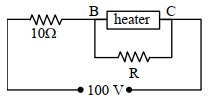
- 1A heater is designed to operate with a power of $1000 \mathrm{~W}$ in a $100 \mathrm{~V}$ line. It is connected in combination with a resistance of $10 \Omega$ and a resistance $R$, to a $100 \mathrm{~V}$ mains as shown in figure. For the heater to operate at $62.5 \mathrm{~W}$, the value of $\mathrm{R}$ should be .................. $\Omega$.View Solution
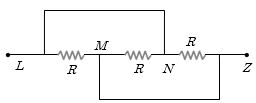
- 2Three equal resistances each of value $R$ are joined as shown in the figure. The equivalent resistance between $M$ and $N$ isView Solution
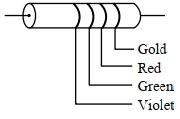
- 3View SolutionThe colour coding on a carbon resistor is shown in the given figure. The resistance value of the given resistor is:
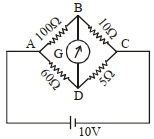
- 4The four arms of a Wheatstone bridge have resistances as shown in the figure. A galvanometer of $15\, \Omega$ resistance is connected across $BD$. Calculate the current through the galvanometer when a potential difference of $10\, V$ is maintained across $AC.$View Solution
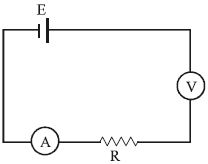
- 5Assertion : All electric devices shown in the circuit are ideal. The reading of each of ammeter $(a)$ and voltmeter $(V)$ is zero.View Solution
Reason : An ideal voltmeter draws almost no current due to very large resistance, and hence $(V)$ and $(a)$ will read zero.
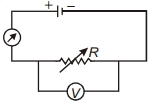
- 6A voltmeter is connected in parallel with a variable resistance $R$ which is in series with an ammeter and a cell as shown in the figure. For one value of $R$, the meters read $0.3 \,A$ and $0.9 \,V$. For another value of $R$ the readings are $0.25 \,A$ and $1.0 \,V$. What is the internal resistance of the cell is ......... $\Omega$View Solution
- 7How many $60 \,W$ bulbs may be safely run on $220 \,V$ using a $5 \,A$ fuse is .........View Solution
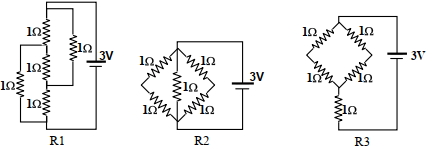
- 8Figure shows three resistor configurations $\mathrm{R} 1, \mathrm{R} 2$ and $\mathrm{R} 3$ connected to $3 \mathrm{~V}$ battery. If the power dissipated by the configuration $\mathrm{R} 1, \mathrm{R} 2$ and $\mathrm{R} 3$ is $\mathrm{P} 1, \mathrm{P} 2$ and $\mathrm{P} 3$, respectively, thenView Solution
Figure:
- 9View SolutionIf in the experiment of Wheatstone's bridge, the positions of cells and galvanometer are interchanged, then balance points will
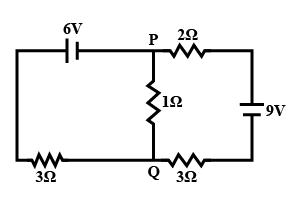
- 10In the circuit shown, the current in the $1\,\Omega$ resistor isView Solution