Question
Choose the correct alternative :
(a) Acceleration due to gravity increases/ decreases with increasing altitude.
(b) Acceleration due to gravity increases/ decreases with increasing depth (assume the earth to be a sphere of uniform density).
(c) Acceleration due to gravity is independent of mass of the earth/mass of the body.
(d) The formula - GMm $\left(1 / r_2-1 / r_1\right)$ is more/ less accurate than the formula $m g\left(r_2-r_1\right)$ for the difference of potential energy between two points $r_2$ and $r_1$ distance away from the centre of the earth.

Answer

(a) Gravitational acceleration decreases with increasing altitude.
$\because$ Acceleration due to gravity at height $h$
$
g_h=g\left(1-\frac{2 h}{R}\right)
$
Hence as h increases, the value of $g_h$ decreases.
(b) The acceleratrion due to gravity decreases with increasing depth (assuming the earth is a sphere of uniform density).
$\because \quad g_d=\left(1-\frac{d}{ R }\right)$
Hence as $d$ increases the value of gravitational acceleration $g_d$ decreases.
(c) $\because$ Gravitation acceleration $g=\frac{ GM }{ R ^2}$, where M is mass of Earth.
$\therefore$ Acceleration due to gravity does not depend on mass (m) of the object.
(d) The formula of potential energy difference between two points at distance $r_2$ and $r_1$ from the center of Earth is
-GM $m\left(\frac{1}{r_2}-\frac{1}{r_1}\right)$ more accurate than the formula $m g\left(r_2-r_1\right)$.
The value of $g$ keep changing in different situations.

Need a full question paper?

Generate a complete, print-ready paper with questions like this in minutes — across 16+ boards, with answer keys.

Start Generating Free

Similar questions

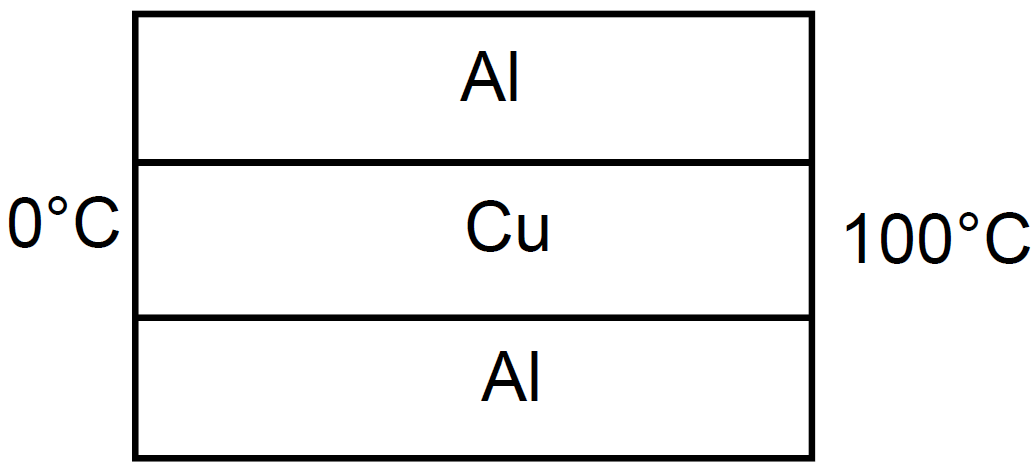
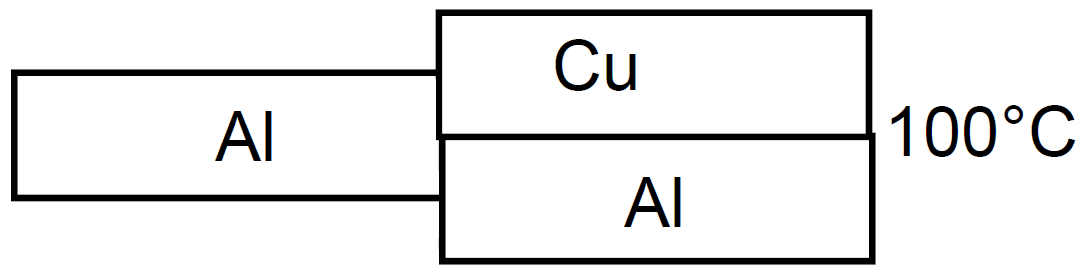
The three rods shown in figure, have identical geometrical dimensions. Heat flows from the hot end at a rate of 40 Win the arrangement (a) Find the rates of heat flow when the rods are joined as in arrangement (b) and in (c) Thermal conductivities of aluminium and copper are 200Wm-1°C-1 and 400Wm-1°C-1 respectively.

  1.  

  1.  

  1.  

A 4.0kg block is suspended from the ceiling of an elevator through a, string having a linear mass density of 19.2 × 10-3kg/m. Find the speed (with respect to the string) with which a wave pulse can proceed on the string if the elevator accelerates up at the rate of 2.0m/s2. Take g = 10m/s2.
The US athlete Florence Griffith-Joyner won the 100m sprint gold medal at Seol Olympic 1988 setting a new Olympic record of 10.54s. Assume that she achieved her maximum speed in a very short-time and then ran the race with that speed till she crossed the line. Take her mass to be 50kg.
  1. Calculate the kinetic energy of Griffith-Joyner at her full speed.
  2. Assuming that the track, the wind etc. offered an average resistance of one tenth of her weight, calculate the work done by the resistance during the run.
  3. What power GriffithJoyner had to exert to maintain uniform speed?
Certain collisions are referred to as elastic collisions. Elastic collisions are collisions in which both momentum and kinetic energy are conserved. The total system kinetic energy before the collision equals the total system kinetic energy after the collision. If total kinetic energy is not conserved, then the collision is referred to as an inelastic collision.
The coefficient of restitution, denoted by (e), is the measure of degree elasticity of collision. It is defined as the ratio of the final to inital relative speed between two objects after they collide. It normally ranges from 0 to 1 where 1 would be a perfectly elastic collision. A perfectly inelastic collision has a coefficient of 0 . In real life most of the collisions are neither perfectly elastic nor perfectly inealstic and $0< e <1$.

1. The following are the data of a collision between a truck and a car.
Mass of the car $=1000 kg$
Mass of the truck $=3000 kg$
Mass of the truck Before collision:
Speed of the car $=20 m / s$
Momentum of the car $=20000 kg m / s$
Speed of the truck $=20 m / s$
Momentum of the truck $=60000 kg m / s$
After collision:
Speed of the car $=40 m / s$ in the opposite direction
Momentum of the car $=40000 kg m / s$ in the opposite direction
Speed of the truck $=0$
Momentum of the truck $=0$
The collision is
(a) Both elastic since kinetic energy and momentum is conserved
(b) Elastic since momentum is conserved
(c) Inelastic since kinetic energy is conserved
(d) Elastic since kinetic energy is conserved
2. The coefficient of restitution is the measure of
(a) Malleability of a substance    (b) Conductivity of a substance
(c) degree of elasticity of collision    (d) Elasticity of a substance
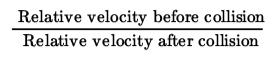
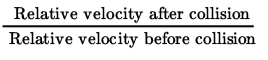
3. Coefficient of restitution is defined as
(a) 
Image
(b) Relative velocity after collision x relative velocity before collision
(c) Relative velocity after collision + relative velocity before collision
(d) 
Image
OR
In real life most of the collisions are
(a) Range of coefficient of restitution is 0 < e < 1
(b) both neither perfectly nor perfectly inelastic and range of coefficient of restitution is 0 < e < 1.
(c) neither perfectly elastic nor perfectly inelastic
(d) perfectly inelastic
4. For perfectly elastic and perfectly inelastic collision, the value of coefficient of restitution are respectively
(a) $+1,-1$    (b) 0,1    (c) $0,-1$    (d) 1,0
A body of mass 5 kg is acted upon by two perpendicular forces 8 N and 6 N. Give the magnitude and direction of the acceleration of the body.
In tug of war, the team that exerts a larger tangential force on the ground wins. Consider the period in which a team is dragging the opposite team by applying a larger tangential force on the ground. List which of the following works are positive, which are negative and which are zero?
  1. Work by the winning team on the losing team.
  2. Work by the losing team on the winning team.
  3. Work by the ground on the winning team.
  4. Work by the ground on the losing team.
  5. Total external work on the two teams.
Read the passage given below and answer the following questions from (i) to (v).
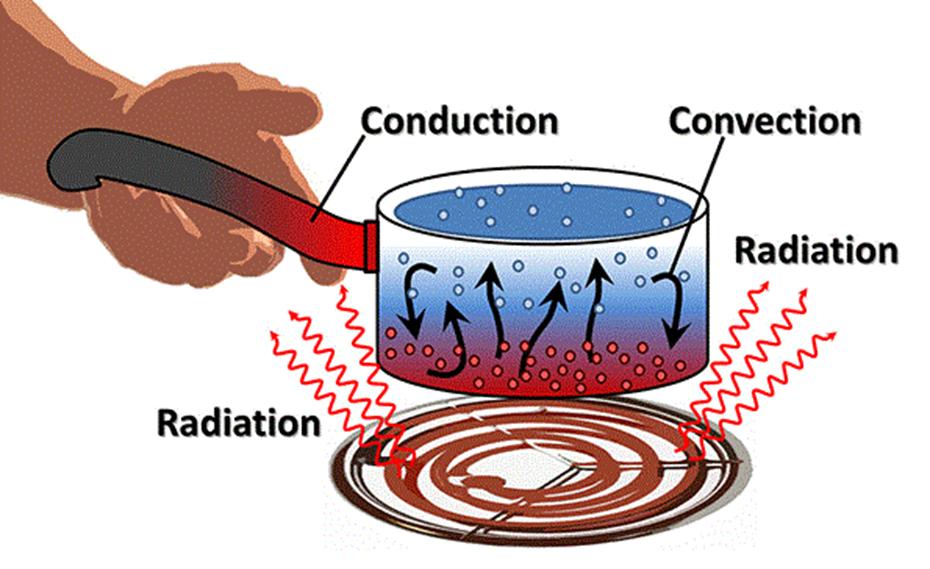
The figure shows the different modes of transfer of heat, heat transfer is defined as the movement of heat across the border of the system due to a difference in temperature between the system and its surroundings. The temperature difference exists between the two systems, heat will find a way to transfer from the higher to the lower system.

  1. The sea breeze is caused by:
    1. conduction
    2. convection
    3. radiation
    4. none of these
  2. At what factor heat absorbed on radiation by the body depends on?  
    1. distance between body
    2. source of heat
    3. its color
    4. all of the above
  3. When heat is transferred by molecular collision, it is referred to as heat transfer by:
    1. convection
    2. conduction
    3. radiation
    4. convection and radiation
  4. Thermal conductivity of air with rise in temperature:
    1. increase
    2. decrease
    3. constant
    4. none of these
  5. Mass transfer does not take place in:
    1. conduction
    2. convection
    3. radiation
    4. none of these
While watering a distant plant, a gardener partially water than in fresh closes the exit hole of the pipe by putting his finger on it. Explain why this results in the water stream goirig to a larger distance.
An isolated metal sphere is heated to a high temperature. Will it become positively charged due to thermionic emission?
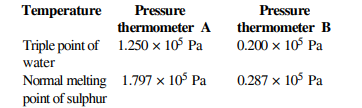
Two ideal gas thermometers A and B use oxygen and hydrogen respectively. The following observations are made :
Image
(a) What is the absolute temperature of normal melting point of sulphur as read by thermometers A and $B$ ?
(b) What do you think is the reason behind the slight difference in answers of thermometers A and B? (The thermometers are not faulty). What further procedure is needed in the experiment to reduce the discrepancy between the two readings?