Question types

PART - 1 CH - 7 Gravitation question types

83 questions across 9 question groups — pick any mix to generate a Physics paper with step-by-step answer keys.

83
Questions
9
Question groups
5
Question types
Sample Questions

PART - 1 CH - 7 Gravitation questions

One sample from each question group in this chapter. Select any group above to see the full set with answer keys.

What would be the reason for the absence of atmosphere on the Moon?
  • A
    The moon is quite light.
  • B
    The moon revolves around the Earth.
  • The value of root mean square velocity of gas molecules is more than the escape velocity.
  • D
    All of the above.

Answer: C.

View full solution
An object performs action due to force acting towards a point. The mgnitude of force is inversely proportional to the square of the distance. The path of the object will be:
  • Ellipse
  • B
    Hyperbola
  • C
    Circle
  • D
    Parabola

Answer: A.

View full solution
The intensity of the gravitational field at a distance $r$ from the center of a spherical shell of mass M and radius $R (r< R )$ will be :
  • A
    $E _g=\frac{- GM }{r^2}$
  • B
    $E _g=-\frac{ GM }{ R ^2}$
  • C
    $E _g=-\frac{ GM r}{ R ^3}$
  • Zero

Answer: D.

View full solution
Which of the following symptoms is likely to afflict an astronaut in space (a) swollen feet, (b) swollen face, (c) headache, (d) orientational problem.
View full solution
Choose the correct alternative :
(a) If the zero of potential energy is as infinity, the total energy of an orbiting satellite is negative of its kinetic/potential energy.
(b) The energy required to launch an orbiting satellite out of earth's gravitational influence is more/ less than the energy required to project a stationary object at the same height (as the satellite) out of earth's influence.
View full solution
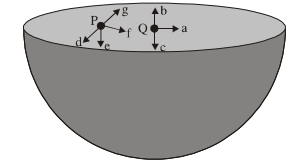
For the above problem, the direction of the gravitational intensity at an arbitrary point P is indicated by the arrow (i) d, (ii) e, (iii) f, (iv) g.
View full solution
The diameters of two planets are in the ratio $4: 1$ and the ratio of their density is $1: 2$. What will be the ratio of gravitational accelerations on the planets?
View full solution
At depth $x$ from the earth's surface the value of $g^{\prime}$ remains half of that of at the surface. What will be the value of $g ^{\prime}$ obtained at the same height.
View full solution
A satellite is moving in a circular orbit of radius $R$. If the radius is increased to $1.02 R$ then what will be the percentage change in its period?
View full solution
Q 243 Marks Question3 Marks
Does the escape speed of a body from the earth depend on (a) the mass of the body, (b) the location from where it is projected, (c) the direction of projection, (d) the height of the location from where the body is launched?
View full solution
Q 253 Marks Question3 Marks
Suppose there existed a planet that went around the Sun twice as fast as the earth. What would be its orbital size as compared to that of the earth?
View full solution
Q 263 Marks Question3 Marks
A satellite orbits the earth at a height of 400 km above the surface. How much energy must be expended to rocket the satellite out of the earth’s gravitational influence? Mass of the satellite = 200 kg ; mass of the earth $=6.0 \times 10^{24} kg$; radius of the earth $=6.4 \times 10^6 m ; G =6.67 \times 10^{-11} Nm ^2 kg^{-2}$.
View full solution
Q 273 Marks Question3 Marks
In the following two exercises, choose the correct answer from among the given ones : The gravitational intensity at the centre of a hemispherical shell of uniform mass density has the direction indicated by the arrow.
Image
View full solution
Q 283 Marks Question3 Marks
Answer the following :
(a) You can shield a charge from electrical forces by putting it inside a hollow conductor. Can you shield a body from the gravitational influence of nearby matter by putting it inside a hollow sphere or by some other
means?
(b) An astronaut inside a small space ship orbiting around the earth cannot detect gravity. If the space station orbiting around the earth has a large size, can he hope to detect gravity?
(c) If you compare the gravitational force on the earth due to the sun to that due to the moon, you would find that the Sun’s pull is greater than the moon’s pull. (you can check this yourself using the data available in the succeeding exercises). However, the tidal effect of the moon’s pull is greater than the tidal effect of sun.Why?
View full solution
Q 294 Marks Question4 Marks
A comet orbits the sun in a highly elliptical orbit. does the comet have a constant (a) linear speed, (b) angular speed, (c) angular momentum, (d) kinetic energy, (e) potential energy, (f) total energy throughout its orbit? Neglect any mass loss of the comet when it comes very close to the sun.
View full solution
Q 304 Marks Question4 Marks
Let us assume that our galaxy consists of $2.5 \times 10^{11}$ stars each of one solar mass. How long will a star at a distance of 50,000 ly from the galactic centre take to complete one revolution? Take the diameter of the Milky way to be $10^5 ly$.
View full solution
Q 314 Marks Question4 Marks
Two heavy spheres each of mass 100 kg and radius 0.10 m are placed 1.0m apart on a horizontal table. What is the gravitational force and potential at the mid point of the line joining the centres of the spheres? Is an object placed at that point in equilibrium? If so, is the equilibrium stable or unstable?
View full solution
Q 324 Marks Question4 Marks
Choose the correct alternative :
(a) Acceleration due to gravity increases/ decreases with increasing altitude.
(b) Acceleration due to gravity increases/ decreases with increasing depth (assume the earth to be a sphere of uniform density).
(c) Acceleration due to gravity is independent of mass of the earth/mass of the body.
(d) The formula - GMm $\left(1 / r_2-1 / r_1\right)$ is more/ less accurate than the formula $m g\left(r_2-r_1\right)$ for the difference of potential energy between two points $r_2$ and $r_1$ distance away from the centre of the earth.
View full solution
Q 334 Marks Question4 Marks
The escape speed of a projectile on the earth’s surface is 11.2 km s–1. A body is projected out with thrice this speed. What is the speed of the body far away from the earth ? Ignore the presence of the sun and other planets.
View full solution
Column – AColumn - B
1. Value of $\overrightarrow{ F }_{12}+\overrightarrow{ F }_{21}$ will be(A) Less
2. The gravitational force between two 1 kg balls can be expected because it is very_________ .(B) Towards the sun
3. Centripetal force is applied on the planets which has a direction(C) In the form of a hyperbola
4. There is a relationship between gravitational acceleration (g) and universal constant G(D) Zero
5. Potential energy changes(E) $g=\frac{4}{3} \pi R GP$
View full solution
Column - AColumn - B
1. Potential energy changes(A) $V _0=\sqrt{g R }$
2. The value of escape velocity (G) Zero for the Moon as compared to that of the Earth(B) $+\frac{ GM m}{2 r}$
3. The value of orbital velocity will be(C) $\frac{1}{5}$ times
4. The period of revolution of a satellite orbiting near the Earth is(D) In the form of a hyperbola
5. The value of binding energy will be(E) 84.6 minutes
View full solution
Io, one of the satellites of Jupiter, has an orbital period of 1.769 days and the radius of the orbit is $4.22 \times 10^8 m$. Show that the mass of Jupiter is about one-thousandth that of the sun.
View full solution
Two starts each of one solar mass (= 2 × 1030 kg) are approaching each other for a head on collision. When they are a distance 109 km, their speeds are negligible. What is the speed with which they collide? The radius of each start is 104 km. Assume the stars to remain undistorted until they collide. (Use the known value of G).
View full solution
A rocket is fired from the earth towards the sun. At what distance from the earth's centre is the gravitational force on the rocket zero? Mass of the sun $=2 \times 10^{30} kg$, mass of the earth $=6 \times 10^{24} kg$. Neglect the effect of other planets etc. (orbital radius $\left.=1.5 \times 10^{11} m\right)$.
View full solution
Establish a relation between gravitational acceleration and the radius of the Earth and the density of its medium.Or
Prove that gravitational acceleration on the surface of a planet of mass $M$, radius $R$ and density $\rho$ is$
g=\frac{4 \pi G R \rho }{3}
$
View full solution

Generate a PART - 1 CH - 7 Gravitation paper free

Pick question groups from the list above, set marks and difficulty, and export a branded PDF with step-by-step answer keys. First 3 chapters free — no signup.

Download App