The conduction current is the same as displacement current when the source is.
- AAC only
- BDC only
- Cboth AC and DC
- Dneither AC nor for DC
Explanation:
For a capacitor, we have:
Q = CV
If Q is changing, there will be a current in capacitor plates,
$\text{I}=\frac{\text{dQ}}{\text{dt}}=\frac{\text{CdV}}{\text{dt}}$when voltage across the capacitor is constant, $\frac{\text{dV}}{\text{dt}}=0$
therefore, I = 0
It implies that, for a DC (constant) voltage, the capacitor current is zero.
Hence, for a DC source the conduction current and displacement current (capacitor current) are not same.
Whereas, by Maxwell's equation for a time varying voltage (AC voltage), both conduction and displacement currents are same.
Generate a complete, print-ready paper with questions like this in minutes — across 16+ boards, with answer keys.
For a substance the average life for a-emission is 1620 years and for b emission is 405 years. After how much time the 1/4 of the material remains after a and b emission
|
(a) 1500 years |
(b) 300 years |
(c) 449 years |
(d) 810 years |
A potentiometer has uniform potential gradient across it. Two cells connected in series (i) to support each other and (ii) to oppose each other are balanced over 6m and 2m respectively on the potentiometer wire. The e.m.f.’s of the cells are in the ratio of
|
(a) 1 : 2 |
(b) 1 : 1 |
(c) 3 : 1 |
(d) 2 : 1 |
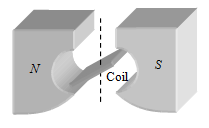
The figure below shows the north and south poles of a permanent magnet in which n turn coil of area of cross-section A is resting, such that for a current i passed through the coil, the plane of the coil makes an angle θ with respect to the direction of magnetic field B. If the plane of the magnetic field and the coil are horizontal and vertical respectively, the torque on the coil will be

|
(a) τ = niAB cosθ |
|
(b) τ = niAB sinθ |
|
(c) τ = niAB |
|
(d) None of the above, since the magnetic field is radial |
A person using a lens as a simple microscope sees an:
The phenomenon of interference is shown by
|
(a) Longitudinal mechanical waves only |
(b) Transverse mechanical waves only |
|
(c) Electromagnetic waves only |
(d) All the above types of waves |
Among the two interfering monochromatic sources A and B; A is ahead of B in phase by 66°. If the observation be taken from point P, such that PB – PA = l/4. Then the phase difference between the waves from A and B reaching P is
|
(a) 156° |
(b) 140° |
(c) 136° |
(d) 126° |