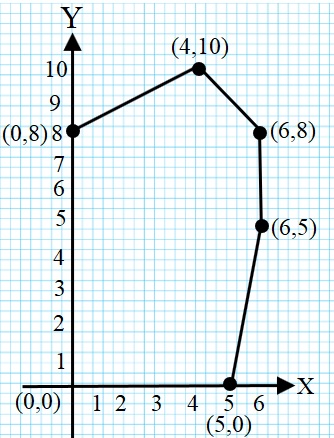
Question
Choose the correct answer from the given four options.
A and B are two students. Their chances of solving a problem correctly are $\frac{1}{3}$ and $\frac{1}{4},$respectively. If the probability of their making a common error is, $\frac{1}{20}$ and they obtain the same answer, then the probability of their answer to be correct is:
  1. $\frac{1}{12}$
  2. $\frac{1}{40}$
  3. $\frac{13}{120}$
  4. $\frac{10}{13}$

Answer

  1. $\frac{10}{13}$

Solution:

Let E= Event that both A and B solve the problem

$\therefore\text{P}(\text{E}_1)=\frac{1}{3}\times\frac{1}{4}=\frac{1}{12}$

Let E2 = Event that both A and B got incorrect solution of the problem

$\therefore\text{P}(\text{E}_2)=\frac{2}{3}\times\frac{3}{4}=\frac{1}{2}$

Here, $\text{P}\Big(\frac{\text{E}_1}{\text{E}}\Big)=1,\text{P}\Big(\frac{\text{E}}{\text{E}_2}\Big)=\frac{1}{20}$

 $\therefore\text{P}\Big(\frac{\text{E}_1}{\text{E}}\Big)=\frac{\text{P}(\text{E}_1\cap\text{E})}{\text{P}(\text{E})}=\frac{\text{P}(\text{E}_1)\cdot\text{P}\Big(\frac{\text{E}_1}{\text{E}}\Big)}{\text{P}(\text{E}_1)\cdot\text{P}\Big(\frac{\text{E}_1}{\text{E}}\Big)+\text{P}(\text{E}_2)\cdot\text{P}\Big(\frac{\text{E}_1}{\text{E}}\Big)} $

$=\frac{\frac{1}{12}\times1}{\frac{1}{12}\times1+\frac{1}{2}\times\frac{1}{20}}=\frac{10}{30}$

Need a full question paper?

Generate a complete, print-ready paper with questions like this in minutes — across 16+ boards, with answer keys.

Start Generating Free

Similar questions

The coordinates of the foot of the perpendicular drawn from the point $(0,1,2)$ on the $x$-axis are given by:
The feasible region for an LPP is shown below:

Let Z = 3x - 4y be the objective function. Minimum of Z occurs at

$\frac{\text{d}^{20}}{\text{dx}^{20}}(2\cos\text{x}\cos3\text{x})=$
  1. $2^{20}(\cos2\text{x}-2^{20}\cos4\text{x})$
  2. $2^{20}(\cos2\text{x}+2^{20}\cos4\text{x})$
  3. $2^{20}(\sin2\text{x}+2^{20}\sin4^\text{x})$
  4. $2^{20}(\sin2\text{x}-2^{20}\sin4^\text{x})$
${d \over {dx}}\,\,\left[ {{{\tan }^{ - 1}}\left( {{{\sqrt x (3 - x)} \over {1 - 3x}}} \right)} \right] =$
Let $\text{A}=\begin{vmatrix}1&\sin\theta&1\\-\sin\theta&1&\sin\theta\\-1&-\sin\theta&1\end{vmatrix},$ where $0\leq\theta\leq2\pi.$ Then:
  1. $\text{Det (A)}=0$
  2. $\text{Det (A)}\in(2,\infty)$
  3. $\text{Det (A)}\in(2,4)$
  4. $\text{Det (A)}\in[2,4]$
The differential coefficient of ${\cos ^{ - 1}}\left\{ {\sqrt {{{1 + x} \over 2}} } \right\}$ with respect to $x$ is
Let $N$ be the set of natural numbers. For $n \in N$, define $I_n=\int_0^\pi \frac{x \sin ^{2 n}(x)}{\sin ^{2 n}(x)+\cos ^{2 n}(x)} d x$. Then, for $m, n \in N$
The number of solutions of the equation $\sin ^{-1}\left[x^{2}+\frac{1}{3}\right]+\cos ^{-1}\left[x^{2}-\frac{2}{3}\right]=x^{2}$ for $x \in[-1,1],$ and $[x]$ denotes the greatest integer less than or equal to $x$, is ...... .
If $f(x) = \left| {\begin{array}{*{20}{c}}1&x&{x + 1}\\{2x}&{x(x - 1)}&{(x + 1)x}\\{3x(x - 1)}&{x(x - 1)(x - 2)}&{(x + 1)x(x - 1)}\end{array}} \right|$ then $f(100)$ is equal to
The equation x2 - x - 2 = 0 in three dimensional space is represented by: