Question
Let $\text{A}=\begin{vmatrix}1&\sin\theta&1\\-\sin\theta&1&\sin\theta\\-1&-\sin\theta&1\end{vmatrix},$ where $0\leq\theta\leq2\pi.$ Then:
  1. $\text{Det (A)}=0$
  2. $\text{Det (A)}\in(2,\infty)$
  3. $\text{Det (A)}\in(2,4)$
  4. $\text{Det (A)}\in[2,4]$

Answer

  1. $\text{Det (A)}\in[2,4]$

Solution:

$\begin{vmatrix}1&\sin\theta&1\\-\sin\theta&1&\sin\theta\\-1&-\sin\theta&1\end{vmatrix}$

$=\begin{vmatrix}1&\sin\theta&2\\-\sin\theta&1&\sin\theta\\-1&-\sin\theta&1\end{vmatrix}$ [Applying C3 → C3 + C1]

$=2\times\begin{vmatrix}-\sin\theta&1\\-1&-\sin\theta\end{vmatrix}$ [Expanding along C3]

$=2(\sin^2\theta+1)$

Given, $0\leq\theta\leq2\pi$

$-1\leq\sin\theta\leq1$

$0\leq\sin^2\theta\leq1$

$|\text{A}|=2(\sin^2\theta+1)$

$|\text{A}|=2\times1=2$ $[\theta=0]$

$|\text{A}|=2\times2=4$ $[\theta=2\pi]$

$\text{Det (A)}\in[2,4]$

Need a full question paper?

Generate a complete, print-ready paper with questions like this in minutes — across 16+ boards, with answer keys.

Start Generating Free

Similar questions

If $a,b,c$ be positive and not all equal, then the value of the determinant $\left| {\,\begin{array}{*{20}{c}}a&b&c\\b&c&a\\c&a&b\end{array}\,} \right|$ is
The eqution of the plane which cute equal intercepts of unit length on the coordinate axes is:
If $A$ is a square matrix of order 3 and $|A|=5$, then $|\operatorname{adj} A|=$
A parallelopiped is formed by planes drawn through the point (2, 3, 5) and (5, 9, 7) parallel to the coordinate planes. The length of a diagonal of the parallelopiped is:
  1. $7$
  2. $\sqrt{38}$
  3. $\sqrt{155}$
  4. $\text{none of these}$
Choose the correct answer from the given four options:
let $\text{P}(\text{A})=\frac{7}{13},\text{P}(\text{B})=\frac{9}{13}$ and $\text{P}(\text{A}\cup\text{B})=\frac{4}{13}.$ Then $\text{P}\Big(\frac{\text{A'}}{\text{B}}\Big)$ is equal to:
  1. $\frac{6}{13}$
  2. $\frac{4}{13}$
  3. $\frac{4}{9}$ 
  4. $\frac{5}{9}$
The area enclosed by the curves $y = x^2, y = x^3 , x = 0$ and $x = p,$ where $p > 1$ , is $1/6$. The $p$ equals
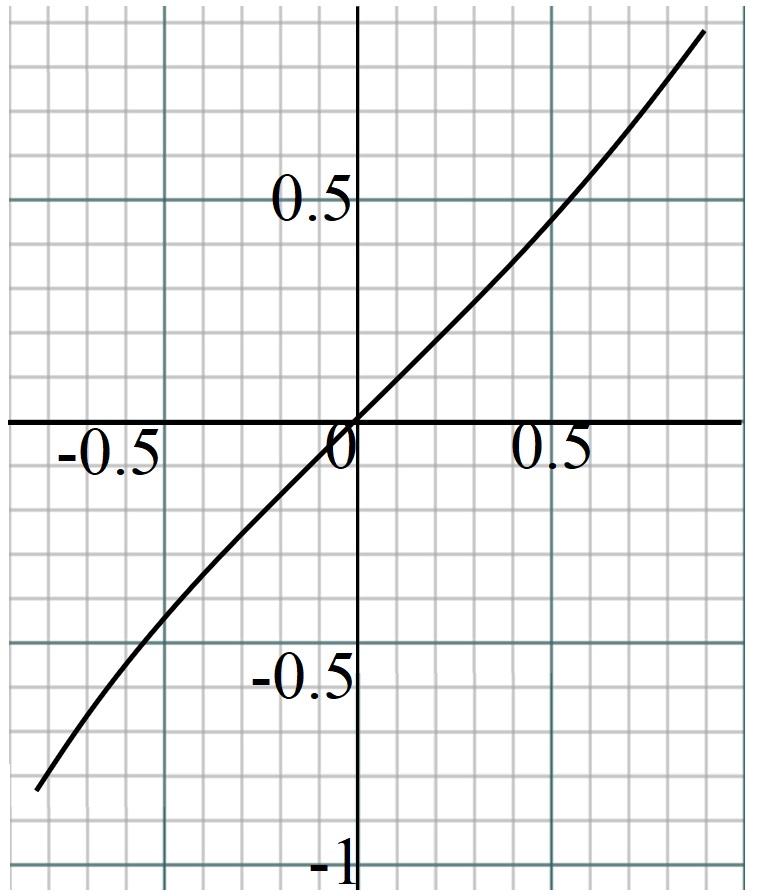
The given graph is for which equation?

  1. $\text{y}= \sin\text{x}$

  2. $\text{y} = \sin-1\text{x}$

  3. $\text{y} = \text{cosec }\text{x}$

  4. $\text{y} = \sec\text{x}$

The solution of $\frac{{dy}}{{dx}} + 2y\,\tan x = \sin x$, is
Let $f$ be function such that $f(x + y) = f(x) + f(y)$ for all $x$ and $y$ and $f(x) = (2x^2 + 3x)g(x)$ for all $x$; where $g(x)$ is continuous and $g(0) = 3.$ Then $f '(x)$ is equal to :-
A random variable has the following probability distribution:
X = xi 0 1 2 3 4 5 6 7
P(X = Xi) 0 2p 2p 3p p2 2p2 7p2 2p