MCQ
Choose the correct answer from the given four options:
A ladder, 5 meter long, standing on a horizontal floor, leans against a vertical wall. If the top of the ladder slides downwards at the rate of 10cm/ sec, then the rate at which the angle between the floor and the ladder is decreasing when lower end of ladder is 2 metres from the wall is:
  • A
    $\frac{1}{10}\text{radian/}\sec$
  • $\frac{1}{20}\text{radian/}\sec$
  • C
    $20\text{ radian/}\sec$
  • D
    $10\text{ radian/}\sec$

Answer

Correct option: B.
$\frac{1}{20}\text{radian/}\sec$
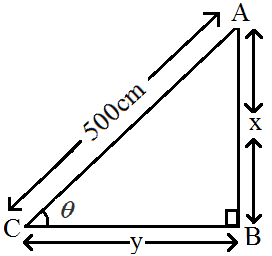
Let the angle between floor and the ladder be $\theta.$
Let at any time 't' AB = x cm and BC = y cm

$\therefore\ \sin\theta=\frac{\text{x}}{500}$ and $\cos\theta=\frac{\text{y}}{500}$
$\Rightarrow\ \text{x}=500\sin\theta$ and $\text{y}=500\cos\theta$
Also it is given that $\frac{\text{dx}}{\text{dt}}=10\text{cm/s}$
$\Rightarrow\ 500\cdot\cos\theta\cdot\frac{\text{d}\theta}{\text{dt}}=10\text{cm}/ \text{s}$
$\Rightarrow\ \frac{\text{d}\theta}{\text{dt}}=\frac{10}{500\cos\theta}=\frac{1}{50\cos\theta}$
For $\text{y}=2\text{m}=20\text{cm},$
$\frac{\text{d}\theta}{\text{dt}}=\frac{1}{50\cdot\frac{\text{y}}{500}}=\frac{10}{\text{y}}$ $=\frac{10}{200}=\frac{1}{20}\text{radian/}\sec$

Need a full question paper?

Generate a complete, print-ready paper with questions like this in minutes — across 16+ boards, with answer keys.

Start Generating Free

Similar questions

If the vectors, $\overrightarrow{\mathrm{p}}=(a+1) \hat{\mathrm{i}}+a \hat{\mathrm{j}}+a \hat{\mathrm{k}}$  ; $\overrightarrow{\mathrm{q}}=\mathrm{a} \hat{\mathrm{i}}+(\mathrm{a}+1) \hat{\mathrm{j}}+\mathrm{a} \hat{\mathrm{k}}$ and  $\overrightarrow{\mathrm{r}}=\mathrm{a} \hat{\mathrm{i}}+\mathrm{a} \hat{\mathrm{j}}+(\mathrm{a}+1) \hat{\mathrm{k}}(\mathrm{a} \in \mathrm{R})$ are coplanar and $3(\overrightarrow{\mathrm{p}} \cdot \overrightarrow{\mathrm{q}})^{2}-\lambda|\overrightarrow{\mathrm{r}} \times \overrightarrow{\mathrm{q}}|^{2}=0,$ then the value of $\lambda$ is
If $\tan^{-1}\Big(\frac{\text{x}-1}{\text{x}+2}\Big)+\tan^{-1}\Big(\frac{\text{x}+1}{\text{x}+2}\Big)=\frac{\pi}{4},$ then $x$ is equal to:
Maximum value of a second order determinant whose every element is either 0, 1 or 2 only is:
Let $a, b$ and $c$ be distinct positive numbers. If the vectors $a \hat{i}+a \hat{j}+c \hat{k}, \hat{i}+\hat{k}$ and $c \hat{i}+c \hat{j}+b \hat{k}$ are co-planar, then $\mathrm{c}$ is equal to:
If $y = a{e^x} + b{e^{ - x}} + c$ where $a,b,c$ are parameters then $y''' = $
The value of $\sin ^{ -1 }{ \left( \cos { \frac { 53\pi }{ 5 } } \right) }=\sin ^{ -1 }{ \left( \cos { \frac { 50\pi+3\pi }{ 5 } } \right) }:$
For the curve $\sqrt{\text{x}}+\sqrt{\text{y}}=1,\frac{\text{dy}}{\text{dx}}$ at $\Big(\frac{1}{4},\frac{1}{4}\Big)$ is:
The value of $\left| {\,\begin{array}{*{20}{c}}{441}&{442}&{443}\\{445}&{446}&{447}\\{449}&{450}&{451}\end{array}\,} \right|$ is
The solution of linear programming problem, maximize $\mathrm{Z}=3 x_{1}+5 x_{2}$ subject to $3 x_{1}+$ $2 x_{2} \leq 18, x_{1} \leq 4, x_{2} \leq 6, x_{1} \geq 0, x_{2} \geq 0$ is $.....$
Let $f(x) = \int {} {e^x}(x - 1)(x - 2)dx$. Then $f$ decreases in the interval