MCQ 11 Mark
Every invertible function is:
- ✓
- B
- C
- D
Not necessarily monotonic function.
AnswerWe know that "every invertible function is a monotonic function".
View full question & answer→MCQ 21 Mark
Choose the correct answer from the given four options$:\ f(x) = x^x$ has a stationary point at:
AnswerCorrect option: B. $\text{x}=\frac{1}{\text{e}}$
We have, $f(x) = x^x$
Let us suppose $y = x^x$
Taking logarithm on both sides, we get
$\log\text{y}=\text{x}\log\text{x}$
$\therefore\ \frac{1}{\text{y}}\cdot\frac{\text{dy}}{\text{dx}}=\text{x}\cdot\frac{1}{\text{x}}+\log\text{x}\cdot1$
$\big[\because(\text{fg})\ '=\text{fg}\ '+\text{gf}\ '\big]$
$\Rightarrow\ \frac{\text{dy}}{\text{dx}}=(1+\log\text{x})\cdot\text{x}^\text{x}$
Find the critical points by equating $\frac{\text{dy}}{\text{dx}}$ to $0.$
$\therefore\ \frac{\text{dy}}{\text{dx}}=0$
$\Rightarrow\ (1+\log\text{x})\text{x}^\text{x}=0$
$\Rightarrow\ \log\text{x}=-1$ as $\text{x}^\text{x}\neq0$
$\Rightarrow\ \log\text{x}=\log\text{e}^{-1}$
$\Rightarrow\ \text{x}=\text{e}^{-1}$
$\Rightarrow\ \text{x}=\frac{1}{\text{e}}$
Hence$, f(x)$ has a stationary point at $\text{x}=\frac{1}{\text{e}}.$
View full question & answer→MCQ 31 Mark
If $s = t^3- 4t^2+ 5$ describes the motion of a particle, then its velocity when the acceleration vanishes, is:
- A
$\frac{16}{2}\ \text{unit}/\text{sec}.$
- B
$\frac{\text{-32}}{3}\ \text{unit}/\text{sec}.$
- C
$\frac{4}{3}\ \text{unit}/\text{sec}.$
- ✓
$-\frac{16}{3}\ \text{unit}/\text{sec}.$
AnswerCorrect option: D. $-\frac{16}{3}\ \text{unit}/\text{sec}.$
According to the question,
$\text{s}=\text{t}^{3}-4\text{t}^{2}+5$
$\Rightarrow\frac{\text{ds}}{\text{dt}}=3\text{t}^{2}-8\text{t}$
$\Rightarrow\frac{\text{d}^{2}\text{s}}{\text{dt}^{2}}=6\text{t}-8$
$\Rightarrow6\text{t}-8=0$
$\Big[$As velocity diminish, then $\frac{\text{d}^{2}\text{s}}{\text{dt}^{2}}=0\Big]$
$\Rightarrow\text{t}=\frac{4}{3}$
Now, $\Big(\frac{\text{ds}}{\text{dt}}\Big)_{\text{t}=\frac{4}{3}}=3\Big(\frac{4}{3}\Big)^{2}-8\Big(\frac{4}{3}\Big)$
$\Rightarrow\frac{\text{ds}}{\text{dt}}=\frac{16}{3}-\frac{32}{3}$
$\Rightarrow\frac{\text{ds}}{\text{dt}}=-\frac{16}{3}\ \text{unit}/\text{sec}.$
View full question & answer→MCQ 41 Mark
If the function $\text{f}(\text{x})=\frac{-\text{x}}{2}+\sin\text{x}$ defined on $\Big[\frac{-\pi}{3},\frac{\pi}{3}\Big]$ is:
Answer$\text{f}(\text{x})=\frac{-\text{x}}{2}+\sin\text{x}$ defined on $\Big[\frac{-\pi}{3},\frac{\pi}{3}\Big]$
$\therefore\ \text{f}'(\text{x})=\frac{-1}{2}+\cos\text{x}$
$\Rightarrow\text{f}'(\text{x})\geq0,\forall\ \text{x}\in\Big[\frac{-\pi}{3},\frac{\pi}{3}\Big]$
$\Big[\because\ \text{for }\text{x}\in\Big[\frac{-\pi}{3},\frac{-\pi}{3}\Big],\cos\geq\frac{1}{2}\Big]$
Hence, the given function is increasing.
View full question & answer→MCQ 51 Mark
If $\text{f}(\text{x})=\frac{1}{4\text{x}^{2}+2\text{x}+1}$, then its maximum value is :
- ✓
$\frac{4}{3}$
- B
$\frac{2}{3}$
- C
$1$
- D
$\frac{3}{4}$
AnswerCorrect option: A. $\frac{4}{3}$
Maximum value of $\frac{1}{4\text{x}^{2}+2\text{x}+1}$ = Minimum value of $4\text{x}^{2}+2\text{x}+1$
Now, $\text{f}(\text{x})=\text4\text{x}^{2}+2\text{x}+1$
lmplies that $\text{f}'(\text{x})=8\text{x}+2$
For a local maxima or a local minima, We must have f'(x) = 0
lmplies that $8\text{x}+2 =0$
lmplies that $8\text{x}=-2$
lmplies that $\text{x}=-14$
Now, $\text{f}''(\text{x})=8$
lmplies that $\text{f}''(\text{1})=8 >0$
Therefore, $\text{x}=\frac{-1}{4}$ is a local minima.
Thus, $\frac{1}{4\text{x}^{2}+2\text{x}+1}$ is maximum at $\text{x}=\frac{-1}{4}$
lmplies that maximum value of $\frac{1}{4\text{x}^{2}+2\text{x}+1}=\frac{1}{4\Big(\frac{-1}{4}\Big)^{2}+2\Big(\frac{-1}{4}\Big)+1}$
$=\frac{16}{12}=\frac{4}{3}$
View full question & answer→MCQ 61 Mark
Choose the correct answer from the given four options : The points at which the tangents to the curve $y = x^3 - 12x + 18$ are parallel to $x-$ axis are : $z$
- A
$(2, -2), (-2, -34)$
- B
$(2, 34), (-2, 0)$
- C
$(0, 34), (-2, 0)$
- ✓
$(2, 2), (-2, 34)$
AnswerCorrect option: D. $(2, 2), (-2, 34)$
The given equation of curve is
$y = x^3 - 12x + 18$
$\therefore\ \frac{\text{dy}}{\text{dx}}=3\text{x}^2-12 [$on differenttiating $\text{ w.r.t. x}]$
So, the slope of line parallel to the $X-$ axis
$\therefore\ \Big(\frac{\text{dy}}{\text{dx}}\Big)=0$
$\Rightarrow\ 3\text{x}^2-12=0$
$\Rightarrow\ \text{x}^2=\frac{12}{3}=4$
$\therefore\ \text{x}=\pm2$
For $x = 2, y = 2^3 - 12 \times 2 + 18 = 2$
and for $x = -2, y = (-2)^3 -12(-2) + 18 = 34$
So, the points are $(2, 2)$ and $(-2, 34).$
View full question & answer→MCQ 71 Mark
The point on the curve $y^2 = x$ where tangent makes $45^\circ $ angle with $x-$axis is:
- A
$\Big(\frac{1}{2},\frac{1}{4}\Big)$
- ✓
$\Big(\frac{1}{4},\frac{1}{2}\Big)$
- C
$(4,2)$
- D
$(1,1)$
AnswerCorrect option: B. $\Big(\frac{1}{4},\frac{1}{2}\Big)$
Let the required point be $(x_1, y_1).$
The tangent makes an angle of $45^\circ $ with the $x-$axis,
$\therefore$ Slope of the tangen $= \tan 45^\circ = 1$
Since, the point lies on the curve.
Hence, $\text{y}^2=\text{x}_1$
Now, $\text{y}^2=\text{x}$
$\Rightarrow2\text{y}\frac{\text{dy}}{\text{dx}}=1$
$\frac{\text{dy}}{\text{dx}}=\frac{1}{2\text{y}}$
Slope of the tangent $=\Big(\frac{\text{dy}}{\text{dx}}\Big)_{(\text{x}_1,\text{y}_1)}=\frac{1}{2\text{y}_1}$
Given:
$\frac{1}{2\text{y}_1}=1$
$\Rightarrow2\text{y}_1=1$
$\Rightarrow\text{y}_1=\frac{1}{2}$
Now,
$\text{x}_1=\text{y}_1^2=\Big(\frac{1}{2}\Big)^2=\frac{1}{4}$
$\therefore(\text{x}_1,\text{y}^2_1)=\Big(\frac{1}{4},\frac{1}{2}\Big)$
View full question & answer→MCQ 81 Mark
A man of height 6ft walks at a uniform speed of 9ft/sec. from a lamp fixed at 15ft height. The length of his shadow is increasing at the rate of:
AnswerCorrect option: C. $6\text{ft}/\text{sec}.$
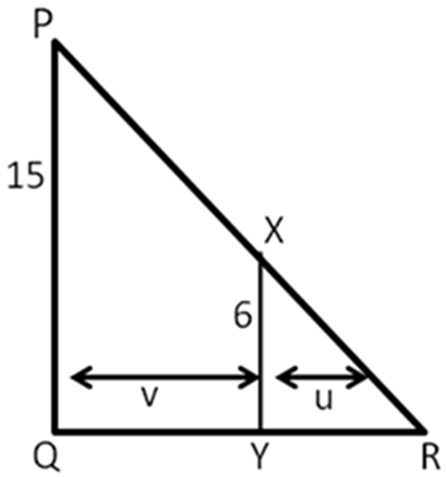
$\frac{15}{6}=\frac{\text{u+v}}{\text{u}}$
$\Rightarrow\frac{15}{6}=\frac{\text{v}}{\text{u}}+1$
$\Rightarrow\frac{\text{v}}{\text{u}}=\frac{3}{2}$
$\Rightarrow\text{u}=\frac{2\text{v}}{3}$
$\Rightarrow\frac{\text{du}}{\text{du}}=\frac{2}{3}\frac{\text{dv}}{\text{dt}}$
$\Rightarrow\frac{\text{du}}{\text{dt}}=\frac{2}{3}\times9$
$=6\text{ft}/\text{sec}.$ View full question & answer→MCQ 91 Mark
The point on the curve $y = x^2 - 3x + 2$ where tangent is perpendicular to $y = x$ is:
- A
$(0, 2)$
- ✓
$(1, 0)$
- C
$(-1, 6)$
- D
$(2, -2)$
AnswerCorrect option: B. $(1, 0)$
$\text{y}=\text{x}$
$\Rightarrow\frac{\text{dy}}{\text{dx}}=1$
Let $(x_2,y_2)$ be the required point.
Since, the point lies on the curve,
Hence, $\text{y}_1=\text{x}_1^2-3\text{x}_1+2$
Now, $\text{y}=\text{x}^2-3\text{x}+2$
$\therefore\frac{\text{dy}}{\text{dx}}=2\text{x}-3$
Slope of the perpendicular to this line.
$\therefore$ Slope of the tangent $=\frac{-1}{\text{slope of the line}}=\frac{-1}{1}=-1$
Now,
$2\text{x}_1-3=-1$
$\Rightarrow 2\text{x}_1=2$
$\Rightarrow\text{x}_1=2$
and
$\text{y}_1=\text{x}_1^2-3\text{x}_1+2=1-3+2=0 $
$\therefore(\text{x}_1,\text{y}_1)=(1,0)$
View full question & answer→MCQ 101 Mark
Choose the correct answer from the given four options:
A ladder, 5 meter long, standing on a horizontal floor, leans against a vertical wall. If the top of the ladder slides downwards at the rate of 10cm/ sec, then the rate at which the angle between the floor and the ladder is decreasing when lower end of ladder is 2 metres from the wall is:
AnswerCorrect option: B. $\frac{1}{20}\text{radian/}\sec$
Let the angle between floor and the ladder be $\theta.$
Let at any time 't' AB = x cm and BC = y cm
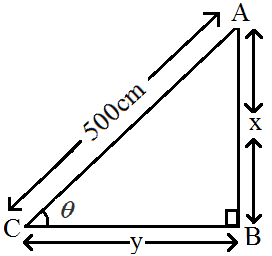
$\therefore\ \sin\theta=\frac{\text{x}}{500}$ and $\cos\theta=\frac{\text{y}}{500}$
$\Rightarrow\ \text{x}=500\sin\theta$ and $\text{y}=500\cos\theta$
Also it is given that $\frac{\text{dx}}{\text{dt}}=10\text{cm/s}$
$\Rightarrow\ 500\cdot\cos\theta\cdot\frac{\text{d}\theta}{\text{dt}}=10\text{cm}/ \text{s}$
$\Rightarrow\ \frac{\text{d}\theta}{\text{dt}}=\frac{10}{500\cos\theta}=\frac{1}{50\cos\theta}$
For $\text{y}=2\text{m}=20\text{cm},$
$\frac{\text{d}\theta}{\text{dt}}=\frac{1}{50\cdot\frac{\text{y}}{500}}=\frac{10}{\text{y}}$ $=\frac{10}{200}=\frac{1}{20}\text{radian/}\sec$ View full question & answer→MCQ 111 Mark
The radius of the base of a cone is increasing at the rate of 3cm/minute and the altitude is decreasing at the rate of 4cm/minute. The rate of change of lateral surface when the radius = 7cm and altitude 24cm is:
- ✓
$54\pi \text{cm}^{2}/\text{min}$
- B
$7\pi\text{cm}^{2}/\text{min}$
- C
$27\text{cm}^{2}/\text{min}$
- D
$\text{none of these }$
AnswerCorrect option: A. $54\pi \text{cm}^{2}/\text{min}$
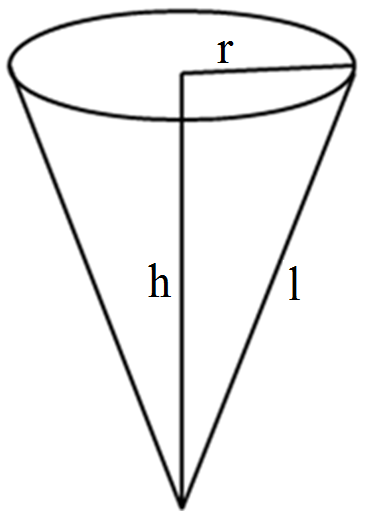
Given that $\frac{\text{dr}}{\text{dt}}=3\text{cm}/\text{min}, \frac{\text{dh}}{\text{dt}}=-4\text{cm}/\text{min}$
$\text{h}=24\text{cm}, \text{r}=7\text{cm}$
$\text{l}^{2}=\text{h}^{2}+\text{r}^{2}$
$\Rightarrow\text{l}^{2}=24^{2}+7^{2}$
$\Rightarrow\text{l}=25$
$\text{s}=\pi\text{r}\text{l}$
$\Rightarrow\text{s}^{2}=\pi\text{r}^{2}\text{l}^{2}$
$\Rightarrow\text{s}^{2}=\pi\text{r}^{2}(\text{h}^{2}+\text{r}^{2})$
$\Rightarrow\text{s}=\pi\text{r}^{2}\text{h}^{2}+\pi\text{r}^{4}$
$\Rightarrow2\text{s}\frac{\text{ds}}{\text{dt}}=2\pi^{2}\text{r}^{2}\text{h}\frac{\text{dh}}{\text{dt}}+2\pi^{2}\text{h}^{2}\text{r}\frac{\text{dr}}{\text{dt}}+4\pi^{2}\text{r}^{3}\frac{\text{dr}}{\text{dt}}$
$\Rightarrow2\pi\text{r}\text{l}\frac{\text{ds}}{\text{dt}}=2\pi^{2}\text{r}\text{h}\Bigg(\text{r}+\frac{\text{dh}}{\text{dt}}+\text{h}\frac{\text{dr}}{\text{dt}}+\frac{2\text{r}^{2}}{\text{h}}\frac{\text{dr}}{\text{dt}}\bigg)$
$\Rightarrow\pi\text{r}\text{l}\frac{\text{ds}}{\text{dt}}=\pi^{2}\text{r}\text{h}\Bigg(\text{r}+\frac{\text{dh}}{\text{dt}}+\text{h}\frac{\text{dr}}{\text{dt}}+\frac{2\text{r}^{2}}{\text{h}}\frac{\text{dr}}{\text{dt}}\Bigg)$
$\Rightarrow25\frac{\text{ds}}{\text{dt}}=\pi\text{r}\text{h}\Bigg(\text{r}+\frac{\text{dh}}{\text{dt}}+\text{h}\frac{\text{dr}}{\text{dt}}+\frac{2\text{r}^{2}}{\text{h}}\frac{\text{dr}}{\text{dt}}\Bigg)$
$\Rightarrow25\frac{\text{ds}}{\text{dt}}=\pi\text{h}\Bigg(\text{r}+\frac{\text{dh}}{\text{dt}}+\text{h}\frac{\text{dr}}{\text{dt}}+\frac{2\text{r}^{2}}{\text{h}}\frac{\text{dr}}{\text{dt}}\Bigg)$
$\Rightarrow25\frac{\text{ds}}{\text{dt}}=24\pi\Bigg(7\times(-4)+24\times3+\frac{2\times(7)^{2}}{24}\times3\bigg)$
$\Rightarrow\frac{\text{ds}}{\text{dt}}=54\pi\text{cm}^{2}/\text{sec}$ View full question & answer→MCQ 121 Mark
At what point the slope of the tangent to the curve $x^2 + y^2 - 2x - 3 = 0$ is zero:
- A
$(3, 0), (-1, 0)$
- B
$(3, 0), (1, 2)$
- C
$(-1, 0), (1, 2)$
- ✓
$(1, 2), (1, -2)$
AnswerCorrect option: D. $(1, 2), (1, -2)$
Let $(x_1, y_1)$ be the required point.
Since, the point lie on the curve.
Hence, $\text{x}^2_1+\text{y}_1^2-2\text{x}_1-3=0 \ ...(1)$
Now, $\text{x}^2+\text{y}^2-2\text{x}-3=0$
$\Rightarrow2\text{x}+2\text{y}\frac{\text{dy}}{\text{dx}}-2=0$
$\therefore\frac{\text{dy}}{\text{dx}}=\frac{2-2\text{x}}{2\text{y}}=\frac{1-\text{x}}{\text{y}}$
Now,
Slope of the tangent $=\Big(\frac{\text{dy}}{\text{dx}}\Big)_{(\text{x}_1,\text{y}_1)}=\frac{1-\text{x}_1}{\text{y}_1}$
Slope of tangent $= 0 ($Given$)$
$\therefore\frac{1-\text{x}_1}{\text{y}_1}=0$
$\Rightarrow1-\text{x}_1=0$
$\Rightarrow\text{x}_1=1$
From $(1),$ we get
$\text{x}_1^2+\text{y}_1^2-2\text{x}_1-3=0$
$\Rightarrow1+\text{y}_1^2-4=0$
$\Rightarrow\text{y}_1=\pm2$
So, the points are $(1, 2)$ and $(1, -2).$
View full question & answer→MCQ 131 Mark
If the function $\text{f}(\text{x})=\cos|\text{x}|-2\text{ax}+\text{b}$ increases along entire number scale, then:
AnswerCorrect option: C. $\text{a}\leq-\frac{1}{2}$
Given:
$\text{f}(\text{x})=\cos|\text{x}|-2\text{ax}+\text{b}$
Now, $|\text{x}|=\begin{cases}\text{x},&\text{x}\geq0\\-\text{x},&\text{x}<0\end{cases}$
And $\cos|\text{x}|=\begin{cases}\cos(\text{x}),&\text{x}\geq0\\\cos(-\text{x})=\cos(\text{x}),&\text{x}<0\end{cases}$
$\therefore\ \cos|\text{x}|=\cos\text{x},\forall\ \text{x}\in\text{R}$
$\therefore\ \text{f}(\text{x})=\cos\text{x}-2\text{ax}+\text{b}$
$\Rightarrow\text{f}'(\text{x})=-\sin\text{x}-2\text{a}$
It is given that f(x) is increasing.
$\Rightarrow\text{f}'(\text{x})\geq0$
$\Rightarrow-\sin\text{x}-2\text{a}\geq0$
$\Rightarrow\sin\text{x}+2\text{a}\leq0$
$\Rightarrow2\text{a}\leq-\sin\text{x}$
The least value of $-\sin\text{x}$ is -1.
$\Rightarrow2\text{a}\leq-1$
$\Rightarrow\text{a}\leq\frac{-1}{2}$
View full question & answer→MCQ 141 Mark
Side of an equilateral triangle expands at the rate of $2\text{cm}/ \text{sec}.$ The rate of increase of its area when each side is 10cm is:
AnswerCorrect option: B. $10\sqrt{3}\text{cm}^2/\sec.$
$\text{A}=\frac{\sqrt{3}}{4}\text{x}^2$
$\frac{\text{dA}}{\text{dt}}=\frac{\sqrt{3}}{2}\text{x}\frac{\text{dx}}{\text{dt}}$
$\Rightarrow\frac{\text{dA}}{\text{dt}}=\frac{\sqrt{3}}{2}\times2\times10=10\sqrt{3}\text{cm}^2/\sec.$
View full question & answer→MCQ 151 Mark
The sum of two non$-$zero number is $8,$ the minimum value of the sum of the reciprohcle is :
- A
$\frac{1}{4}$
- ✓
$\frac{1}{2}$
- C
$\frac{1}{8}$
- D
AnswerCorrect option: B. $\frac{1}{2}$
Let the two non$-$zero number be $x$ and $y.$ Then,
$x + y = 8$
$\Rightarrow y = 8 - x ...(i)$
Now, $\text{f}(\text{x})=\frac{1}{\text{x}}+\frac{1}{\text{y}}$
$\Rightarrow\text{f}(\text{x})=\frac{1}{\text{x}}+\frac{1}{8-\text{x}} [$from eq.$(i)]$
$\Rightarrow\text{f}\ '(\text{x})=\frac{1}{\text{x}}+\frac{1}{8-\text{x}^{2}}$
For a local minima or a local maxima, we must have $f\ '(x) = 0$
$\Rightarrow\frac{-1}{\text{x}^{2}}+\frac{1}{8-\text{x}^{2}}=0$
$\Rightarrow \frac{-(8-{\text{x}^{2}})+\text{x}^{2}}{(\text{x})^{2}(8-\text{x})^{2}}=0$
$\Rightarrow -64-\text{x}^{2}+16\text{x}+\text{x}^{2}=0$
$\Rightarrow 16\text{x}-64 =0$
$\Rightarrow \text{x}=4$
$ \text{f}\ ''(\text{x})=\frac{2}{\text{x}^{3}}-\frac{2}{(8-{\text{x}})^{3}}$
$ \Rightarrow\text{f}\ ''(\text{4})=\frac{2}{\text{x}^{3}}-\frac{2}{(8-{\text{4}})^{3}}$
$ \Rightarrow\text{f}\ ''(\text{4})=\frac{2}{\text{4}^{3}}-\frac{2}{(8-{\text{4}})^{3}}$
$ \Rightarrow\text{f}\ ''(\text{4})=\frac{2}{\text{64}}-\frac{2}{64}=0$
$\therefore$ minimum value $=\frac{1}{4}+\frac{1}{4}=\frac{1}{2}$
View full question & answer→MCQ 161 Mark
While measuring the side of an equilateral triangle an error of k % is made, the percentage error in its area is:
- A
- ✓
- C
$\frac{\text{K}}{2}\%$
- D
AnswerArea of equilateral triangle is,
$\text{A}=\frac{\sqrt{3}}{4}\text{a}^2$
Given that $\frac{\text{da}}{\text{a}}\times100=\text{k}$
and
$\frac{\text{dA}}{\text{da}}=\frac{\sqrt{3}}{2}\text{a}$
$\Rightarrow\frac{\triangle\text{A}}{\text{a}}=\frac{\frac{\sqrt{3}}{2}\text{da}}{\frac{\sqrt{3}}{4}\text{a}^2}$
$\Rightarrow\frac{\triangle\text{A}}{\text{A}}=\frac{2}{\text{a}}\times\frac{\text{Ka}}{100}=2\text{k}$
The error in the area of the triangle is 2K%
View full question & answer→MCQ 171 Mark
The interval in which $y = x^2 e^{-x}$ is increasing is:
- A
$(-\infty,\ \infty)$
- B
$( -2, 0)$
- C
$(2, \ \infty)$
- ✓
$(0, 2)$
AnswerCorrect option: D. $(0, 2)$
Given$:\ \text{f}\text{(x)} = [\text{y} = \text{x}^2 \text{e}^{-\text{x} }]$
$\Rightarrow \ \frac{\text{dy}}{\text{dx}}=\text{x}^2\frac{\text{d}}{\text{dx}}\text{e}^{-\text{x}}+\text{e}^{-\text{x}}\frac{\text{d}}{\text{dx}}\text{x}^2$
$=\text{x}^2e^{-\text{x}}(-1)+\text{e}^{-\text{x}}(2\text{x})$
$\Rightarrow\ \frac{\text{dy}}{\text{dx}}=-\text{x}^2\text{e}^{-\text{x}}+2\text{xe}^{-\text{x}}=\text{xe}^{-\text{x}}(-\text{x}+2)$
$\Rightarrow \ \frac{\text{dy}}{\text{dx}}=\frac{\text{x}(2-\text{x})}{\text{e}^\text{x}}$
In option $(D), \frac{\text{dy}}{\text{dx}} > 0$ for all $x$ in the interval $(0, 2).$
View full question & answer→MCQ 181 Mark
If the ratio of base radius and height of a cone is 1 : 2 and percentage error in radius is $\lambda\%,$ then the error in its volume is:
- A
$\lambda\%$
- B
$2\lambda\%$
- ✓
$3\lambda\%$
- D
$\text{None of these}$
AnswerCorrect option: C. $3\lambda\%$
Let x be the radius of the cone and V be the volume.
Given that $\frac{\triangle\text{r}}{\text{r}}\times100=\lambda$
$\text{V}=\frac{1}{3}\pi\text{r}^2\text{h}$
$\Rightarrow\text{V}=\frac{2}{3}\pi\text{r}^3$ $\Big(\because\frac{\text{r}}{\text{h}}=\frac{1}{2}\Rightarrow\text{h}=2\text{r}\Big)$
$\Rightarrow\frac{\text{dV}}{\text{dr}}=2\pi\text{r}^2$
$\Rightarrow\frac{\text{dV}}{\text{V}}=\frac{2\pi\text{r}^2}{\frac{2}{3}\pi\text{r}^3}\times\frac{\lambda\text{r}}{100}$
$\Rightarrow\frac{\text{dv}}{\text{V}}=3\lambda\%$
View full question & answer→MCQ 191 Mark
Choose the correct answer from the given four options:
The sides of an equilateral triangle are increasing at the rate of 2cm/ sec. The rate at which the area increases, when side is 10cm is:
- A
$10\text{cm}^2\text{/s}$
- B
$\sqrt{3}\text{cm}^2\text{/s}$
- ✓
$10\sqrt{3}\text{cm}^2\text{/s}$
- D
$\frac{10}{3}\text{cm}^2\text{/s}$
AnswerCorrect option: C. $10\sqrt{3}\text{cm}^2\text{/s}$
Let the side of an equilateral triangle be x cm,
$\therefore$ Area of equilateral triangle, $\text{A}=\frac{\sqrt{3}}{4}\text{x}^2\ \ \dots(\text{i})$
Also, $\frac{\text{dx}}{\text{dt}}=2\text{cm/s}$
On differentiating Eq. (i) w.r.t. t, we get
$\frac{\text{dA}}{\text{dt}}=\frac{\sqrt{3}}{2}\cdot2\text{x}\cdot\frac{\text{dx}}{\text{dt}}$
$=\frac{\sqrt{3}}{4}\cdot2\cdot10\cdot2$ $\Big[\because\ \text{x}=10\text{ and }\frac{\text{dx}}{\text{dt}}=2\Big]$
$=10\sqrt{3}\text{cm}^2\text{/s}$
View full question & answer→MCQ 201 Mark
The equation of motion of a particle is $\text{s} = \text{2t}^2 + \sin\text{2t,}$ where $s$ is in metres and $t$ is in seconds. The velocity of the particle when its acceleration is $2m/\sec^2$, is:
- A
$\pi+\sqrt{3}\text{m}/\text{sec}.$
- ✓
$\frac{\pi}{3}+\sqrt{3}\text{m}/\text{sec}.$
- C
$\frac{2\pi}{3}+\sqrt{3}\text{m}/\text{sec}.$
- D
$\frac{\pi}{3}+\frac{1}{\sqrt{3}}\text{m}/\text{sec}.$
AnswerCorrect option: B. $\frac{\pi}{3}+\sqrt{3}\text{m}/\text{sec}.$
$\text{s}=2\text{t}^{2}+\sin2\text{t}$
$\text{v}=\frac{\text{ds}}{\text{dt}}=4\text{t}+2\cos2\text{t}$
$\text{a}=\frac{\text{d}^{2}\text{s}}{\text{dt}^{2}}=4-4\sin2\text{t}$
Given that $\text{a}=2\text{m}/\text{sec}^{2}$
$\Rightarrow4-4\sin2\text{t}=2$
$\Rightarrow2-2\sin2\text{t}=1$
$\Rightarrow2\sin2\text{t}=1$
$\Rightarrow\sin2\text{t}=\frac{1}{2}$
$\Rightarrow2\text{t}=\frac{\pi}{6}$
$\Rightarrow\text{t}=\frac{\pi}{12}$
$\text{v}=4\text{t}+2\cos2\text{t}$ at $\text{t}=\frac{\pi}{12},$
$\text{v}=4\text{t}\times\frac{\pi}{12}+2\cos\frac{\pi}{6}=\frac{\pi}{3}+\sqrt{3}\text{m}/\text{sec}.$
View full question & answer→MCQ 211 Mark
Choose the correct answer The line $y = x + 1$ is a tangent to the curve $y^2 = 4x$ at the point:
- ✓
$(1, 2)$
- B
$(2, 1)$
- C
$(1, -2)$
- D
$(-1, 2)$
AnswerCorrect option: A. $(1, 2)$
The equation of the given curve is $y^2 = 4x.$
Differentiating with respect to $x,$ we have:
$2\text{y}\frac{\text{dy}}{\text{dx}}=4$
$\Rightarrow\ \frac{\text{dy}}{\text{dx}}=\frac{2}{\text{y}}$
Therefore, the slope of the tangent to the given curve at any point $(x, y)$ is given by,
$\frac{\text{dy}}{\text{dx}}=\frac{2}{\text{y}}$
The given line is $y = x + 1 ($which is of the form $y = m \ x + c)$
$\therefore$ Slope of the line $= 1$
The line $y = x + 1$ is a tangent to the given curve if the slope of the line is equal to the slope of the tangent.
Also, the line must intersect the curve,
Thus, we must have:
$\frac{2}{\text{y}} =1$
$\Rightarrow y = 2$
Now, $y = x + 1 $
$\Rightarrow x = y -1$
$ \Rightarrow x = 2 -1 = 1$
Hence, the line $y = x + 1$ is a tangent to the given curve at the point $(1, 2).$
View full question & answer→MCQ 221 Mark
The minimum value of $\frac{\text{x}}{\log_{\text{e}}\text{x}}$ is .
- ✓
$\text{e}$
- B
$\frac{1}{\text{e}}$
- C
$1$
- D
AnswerCorrect option: A. $\text{e}$
Given, $\text{f}(\text{x})=\frac{\text{x}}{\log_{\text{e}}\text{x}}$
$\Rightarrow \text{f}'(\text{x})=\frac{\log_{e}\text{x}-1}{(\log_{\text{e}}\text{x})^{2}}$
For a local maximum or a local minima, we must have $\text{f}'(\text{x})=0$
$\Rightarrow \frac{\log_{e}\text{x}-1}{(\log_{\text{e}}\text{x})^{2}}=0$
$\Rightarrow \log_{\text{e}}\text{x}-1=0$
$\Rightarrow \log_{\text{e}}\text{x}=1$
$\Rightarrow \text{x}=\text{e}$
Now, $\Rightarrow \text{f}''(\text{x})=\frac{-1}{\text{x}(\log_{\text{e}}\text{x})^{2}}+\frac{2}{\text{x}(\log_{\text{e}}\text{x})^{3}}$
$\Rightarrow \text{f}''(\text{e})=\frac{-1}{\text{e}}+\frac{2}{\text{e}}=\frac{1}{\text{e}}>0$
So, x = e is a local minima.
$\therefore$ minimum value of $\text{f}(\text{x})=\frac{\text{e}}{\log_{\text{e}}\text{e}}=\text{e}$
View full question & answer→MCQ 231 Mark
The circumference of a circle is measured as 28cm with an error of 0.01cm. The percentage error in the area is:
- ✓
$\frac{1}{14}$
- B
$0.01$
- C
$\frac{1}{7}$
- D
$\text{None of these}$
AnswerCorrect option: A. $\frac{1}{14}$
Let x be the radius of the circle and y be its circumference.
x = 28cm
$\triangle\text{x}=0.01\text{cm}$
$\text{x}=2\pi\text{r}$
$\text{y}=\pi\text{r}^2=\pi\times\frac{\text{x}^2}{4\pi^2}=\frac{\text{x}^2}{4\pi}$
$\Rightarrow\frac{\text{dy}}{\text{dx}}=\frac{\text{x}}{2\pi}$
$\Rightarrow\frac{\triangle\text{y}}{\text{y}}=\frac{\text{x}}{2\pi\text{y}}\text{dx}=\frac{2}{\text{x}}\times0.01$
$\Rightarrow\frac{\triangle\text{y}}{\text{y}}\times100=\frac{2}{\text{x}}=\frac{1}{14}$
Hence, the percentage error in the area is $\frac{1}{14}$
View full question & answer→MCQ 241 Mark
The function $\text{f}(\text{x})=\log_\text{e}\Big(\text{x}^3+\sqrt{\text{x}^6+1}\Big)$ is of the following type:
Answer$\text{f}(\text{x})=\log_\text{e}\Big(\text{x}^3+\sqrt{\text{x}^6+1}\Big)$
$\Rightarrow\text{f}(-\text{x})=\log_\text{e}\Big(-\text{x}^3+\sqrt{\text{x}^6+1}\Big)$
$=\log_\text{e}\Bigg\{\frac{\big(-\text{x}^3+\sqrt{\text{x}^6+1}\big)\big(\text{x}^3+\sqrt{\text{x}^6+1}\big)}{\text{x}^3+\sqrt{\text{x}^6+1}}\Bigg\}$
$=\log_\text{e}\Big(\frac{\text{x}^6+1-\text{x}^6}{\text{x}^3+\sqrt{\text{x}^6+1}}\Big)$
$=\log_\text{e}\Big(\frac{1}{\text{x}^3+\sqrt{\text{x}^6+1}}\Big)$
$=-\log_\text{e}\Big(\text{x}^3+\sqrt{\text{x}^6+1}\Big)$
$=-\text{f}(\text{x})$
Hence, f(-x) = -f(x)
Therefore, it is an odd function.
$\text{f}(\text{x})=\log_\text{e}\Big(\text{x}^3+\sqrt{\text{x}^6+1}\Big)$
$\frac{\text{d}}{\text{dx}}\{\text{f}(\text{x})\}=\Big(\frac{1}{\text{x}^3+\sqrt{\text{x}^6+1}}\Big)\times\Big(3\text{x}^2+\frac{1}{2\sqrt{\text{x}^6+1}}\times6\text{x}^5\Big)$
$=\Big(\frac{1}{\text{x}^3+\sqrt{\text{x}^6+1}}\Big)\times\bigg(\frac{6\text{x}^2\sqrt{\text{x}^6+1}+6\text{x}^5}{2\sqrt{\text{x}^6+1}}\bigg)$
$=\Big(\frac{1}{\text{x}^3+\sqrt{\text{x}^6+1}}\Big)\times\Bigg\{\frac{6\text{x}^2\big(\sqrt{\text{x}^6+1+\text{x}^3}\big)}{2\sqrt{\text{x}^6+1}}\Bigg\}$
$=\Big(\frac{6\text{x}^2}{2\sqrt{\text{x}^6+1}}\Big)>0$
Therefore the given function is an increasing function.
View full question & answer→MCQ 251 Mark
The normal at the point $(1, 1)$ on the curve $2y + x^2 = 3$ is:
- A
$x + y = 0$
- ✓
$x - y = 0$
- C
$x + y + 1 = 0$
- D
$x - y = 1$
AnswerCorrect option: B. $x - y = 0$
$2y + x^2 = 3$
$2\frac{\text{dy}}{\text{dx}}+2\text{x}=0$
$\frac{\text{dy}}{\text{dx}}=-\text{x}$
$\Big(\frac{\text{dy}}{\text{dx}}\Big)_{(1,1)}=-1$
Slope of the normal $= 1$
Equation of the normal
$y - 1 = x - 1$
$y = x$
$x - y = 0$
View full question & answer→MCQ 261 Mark
Any tangent to the curve $y = 2x^7 + 3x + 5$:
AnswerCorrect option: C. Makes an acute angle with $x-$axis.
We have, $y = 2x^7 + 3x + 5$
$\frac{\text{dy}}{\text{dx}}=14\text{x}^6+3$
$\Rightarrow\frac{\text{dy}}{\text{dx}}>3 (\because x^6$ is always positive for any real value of $x)$
$\Rightarrow\frac{\text{dy}}{\text{dx}}>0$
So, $\tan\theta>0$
Hence, $\theta$ lies in first quadrant.
Thus, the tangent to the curve makes an acute angle with $x-$axis.
View full question & answer→MCQ 271 Mark
if $\text{ax}+\frac{\text{b}}{\text{x}}\geq\text{c}$ for all positive x where a, b, > 0, then.
- A
$\text{ab} < \frac{\text{c}^{2}}{4}$
- ✓
$\text{ab} > \frac{\text{c}^{2}}{4}$
- C
$\text{ab} > \frac{\text{c}}{4}$
- D
$\text{None of these}$
AnswerCorrect option: B. $\text{ab} > \frac{\text{c}^{2}}{4}$
$=\text{f}(\text{x})=\text{ax}+\frac{\text{b}}{\text{x}}$
$\text{f}(\text{x})=0$
$\Rightarrow \text{a}-\frac{\text{b}}{\text{x}^{2}}=0$
$\Rightarrow\text{x}=\pm\sqrt{\frac{\text{b}}{\text{a}}}$
$\text{f}''(\text{x})=\frac{2\text{b}}{\text{x}^{3}}$
$\text{f}''\Big(\sqrt{\frac{\text{b}}{\text{a}}}\Big)=\frac{2\text{b}}{\Big(\sqrt{\frac{\text{b}}{\text{c}}}\Big)^{3}}>0$
$\Rightarrow\text{x}=\sqrt{\frac{\text{b}}{\text{a}}}$ has a minima.
$\text{f}''\Big(\sqrt{\frac{\text{b}}{\text{a}}}\Big)=2\sqrt{\text{ab}}\geq\text{c}$
$\frac{\text{c}}{2}\le\sqrt{\text{ab}}$
$\Rightarrow\frac{\text{c}}{4}\le{\text{ab}}$
View full question & answer→MCQ 281 Mark
The slope of the tangent to the curve $x = t^2 + 3 t - 8, y = 2t^2 - 2t - 5$ at point $(2, -1)$ is:
- A
$\frac{22}{7}$
- ✓
$\frac{6}{7}$
- C
$-6$
- D
AnswerCorrect option: B. $\frac{6}{7}$
$\text{x}=\text{t}^2+3\text{t}-$ and $\text{y}=2\text{t}^2-2\text{t}^2-2\text{t}-5$
$\frac{\text{dx}}{\text{dt}}=2\text{t}+3$ and $\frac{\text{dy}}{\text{dt}}=4\text{t}-2$
$\therefore\frac{\text{dy}}{\text{dx}}=\frac{\frac{\text{dy}}{\text{dt}}}{\frac{\text{dx}}{\text{dt}}}=\frac{4\text{t}-2}{2\text{t}+3}$
The given point is $(2, -1).$
$\therefore\text{x}=2$ and $\text{y=}-1$
Now,
$\text{t}^2+3\text{t}-8=2 $ and $2\text{t}^2-2\text{t}-5=-1$
Let $u$ solve one of these to get the value of $t.$
$\text{t}^2+3\text{t}-10=0$ and $2\text{t}^2-2\text{t}-4=0$
$\Rightarrow(\text{t}+5)(\text{t}-2)=0$ and $(2\text{t}-2)(\text{t}-2)=0$
$\Rightarrow\text{t}=-5$ or $\text{t}=2$
These two have $t = 2$ as a comman solution.
$\therefore$ Slope of the tangent $= \Big(\frac{\text{dy}}{\text{dx}}\Big)_{\text{t}=2}=\frac{8-2}{4+3}=\frac{6}{7}$
View full question & answer→MCQ 291 Mark
The function $f(x) = x^x$ decreases on the interval:
AnswerCorrect option: C. $\Big(0,\frac{1}{\text{e}}\Big)$
Given, $\text{f}(\text{x})=\text{x}^{\text{x}}$
Applying log with base $e$ on both sides, we get
$\log(\text{f}(\text{x}))=\text{x}\log_\text{e}\text{x}$
$\frac{\text{f}\ '(\text{x})}{\text{f}(\text{x})}=1+\log_{\text{e}}\text{x}$
$\text{f}'(\text{x})=\text{f}(\text{x})(1+\log_\text{e}\text{x})$
$=\text{x}^\text{x}(1+\log_\text{e}\text{x})$
For $f(x)$ to be decreasing, we must have
$\text{f}\ '(\text{x})<0$
$\Rightarrow\text{x}^\text{x}(1+\log_\text{e}\text{x})<0$
Here, logarithmic function is defined for positive values of $x.$
$\Rightarrow\text{x}^\text{x}>0$
$\Rightarrow1+\log_\text{e}\text{x}<0$
$[$Since $\text{x}^\text{x}(1+\log_\text{e}\text{x})<0\Rightarrow1+\log_\text{e}\text{x}<0]$
$\Rightarrow\log_\text{e}\text{x}<-1$
$\Rightarrow\text{x}<\text{e}^{-1}$ $\big[\because\ \log_\text{a}\text{x}<\text{N}\Rightarrow\text{a}^\text{N}$ for $\text{a}>1\big]$
Here,
$\text{e}>1$
$\Rightarrow\log_\text{e}\text{x}<-1$
$\Rightarrow\text{x}<\text{e}^{-1}$
$\Rightarrow\text{x}\in\big(0,\text{e}^{-1}\big)$
So$, f(x)$ is decreasing on $\Big(0,\frac{1}{\text{e}}\Big).$
View full question & answer→MCQ 301 Mark
In the interval (1, 2), function f(x) = 2|x - 1| + 3|x - 2| is:
Answerf(x) = 2|x - 1| + 3|x - 2|
In the interval (1, 2)
⇒ |x -1| = x - 1 and |x - 2| = -(x - 2)
⇒ f(x) = 2(x - 1) - 3(x - 2)
⇒ f(x) = -x + 4
⇒ f'(x) = -1
⇒ function is decreasing on (1, 2).
View full question & answer→MCQ 311 Mark
$\text{f}(\text{x})=\sin +\sqrt{3}\cos\text{x}$ is maximum when x =
- A
$\frac{\pi}{3}$
- B
$\frac{\pi}{4}$
- ✓
$\frac{\pi}{6}$
- D
$0$
AnswerCorrect option: C. $\frac{\pi}{6}$
$\text{f}(\text{x})=\sin +\sqrt{3}\cos\text{x}$
$\Rightarrow\text{f}'(\text{x})=\cos\text{x}-\sqrt{3}\sin\text{x}$
For maxima or maxima,
f'(x) = 0
$\cos\text{x}-\sqrt{3}\sin\text{x}=0$
$\Rightarrow\ \tan\text{x}=\frac{1}{\sqrt{3}}\Rightarrow\text{x}=\frac{\pi}{6}$
$\text{f}''\Big(\frac{\pi}{6}\Big)=-\sin\frac{\pi}{6}-\sqrt{3}\cos\frac{\pi}{6}=\frac{-1-\sqrt{3}}{2}<0$
function has local maima at $\text{x}=\frac{\pi}{6}$
View full question & answer→MCQ 321 Mark
The function $f(x) = x^9+ 3x^7 + 64$ is increasing on:
- ✓
$\text{R}$
- B
$(-\infty,0)$
- C
$(0,\infty)$
- D
$\text{R}_0$
AnswerCorrect option: A. $\text{R}$
$\text{f}(\text{x})=\text{x}^9+3\text{x}^7+64$
$\text{f}\ '(\text{x})=9\text{x}^8+21\text{x}^6>0,\forall\ \text{x}\in\text{R}$
So$, f(x)$ is increasing on $R.$
View full question & answer→MCQ 331 Mark
The radius of a circular plate is increasing at the rate of 0.01cm/sec. The rate of increase of its area when the radius is 12cm, is:
- A
$144\pi\text{cm}^{2}/\text{sec}.$
- B
$2.4\pi\text{cm}^{2}/\text{sec}.$
- ✓
$0.24\pi\text{cm}^{2}/\text{sec}.$
- D
$0.024\pi\text{cm}^{2}/\text{sec}.$
AnswerCorrect option: C. $0.24\pi\text{cm}^{2}/\text{sec}.$
$\text{A}=\pi\text{r}^{2}$
$\frac{\text{dA}}{\text{dt}}=2\pi\text{r}\frac{\text{dr}}{\text{dt}}$
$\Rightarrow\frac{\text{dA}}{\text{dt}}=2\pi\times12\times0.01$
$=0.24\pi\text{cm}^{2}/\text{sec}.$
View full question & answer→MCQ 341 Mark
The minimum value of $(\text{x}^{2}+\frac{250}{\text{x}})$ is:
Answer$\text{f}(\text{x})=\text{x}^{2}+\frac{250}{\text{x}}$
$\text{f}'(\text{x})=2\text{x}-\frac{250}{\text{x}^{2}}$
For the local minima a or maxima. We must have f'(x) = 0
$=2\text{x}-\frac{250}{\text{x}^{2}}=0$
⇒ x = 5
$=2\text{x}-\frac{250}{\text{x}^{2}}=0$
$\text{f}''(\text{x})=2+\frac{500}{\text{x}^{3}}$
$\text{f}''(\text{x})=2+\frac{500}{125}>0$
function has minima at x = 5
f(5) = 75.
View full question & answer→MCQ 351 Mark
If the rate of chage of volume of sphere is equal to the rate of change of its radius, then its radius is equal to:
- A
$1\ \text{unit}$
- B
$\sqrt{2\pi}\ \text{units}$
- C
$\sqrt{2\pi}\ \text{units}$
- ✓
$\frac{1}{2\sqrt{\pi}}\ \text{unit}$
AnswerCorrect option: D. $\frac{1}{2\sqrt{\pi}}\ \text{unit}$
Let r be the radius and V be the volume of the sphere at any time t. Then,$\text{v}=\frac{4}{3}\pi\text{r}^{3}$
$\Rightarrow\frac{\text{dv}}{\text{dt}}=\frac{4}{3}(3\pi\text{r}^{2})\frac{\text{dr}}{\text{dt}}$
$\Rightarrow\frac{\text{dv}}{\text{dt}}=4\pi\text{r}^{2}\frac{\text{dr}}{\text{dt}}$
$\Rightarrow4\pi\text{r}^{2}=1\ [\therefore\frac{\text{dv}}{\text{dt}}=\frac{\text{dr}}{\text{dt}}]$
$\Rightarrow\text{r}^{2}=\frac{1}{4\pi}$
$\Rightarrow\text{r}=\sqrt{\frac{1}{4\pi}}$
$\Rightarrow\text{r}=\frac{1}{2\sqrt{\pi}}\text{unit}$
View full question & answer→MCQ 361 Mark
Choose the correct answer from the given four options:
The curve $\text{y}=\text{x}^{\frac{1}{5}}$ has at (0, 0)
- ✓
A vertical tangent (parallel to y-axis).
- B
A horizontal tangent (parallel to x-axis).
- C
- D
AnswerCorrect option: A. A vertical tangent (parallel to y-axis).
We are given that $\text{y}=\text{x}^{\frac{1}{5}}$
$\Rightarrow\ \frac{\text{dy}}{\text{dx}}\Rightarrow\frac{\text{dy}}{\text{dx}}=\frac{1}{5}\text{x}^{\frac{1}{3}-1}$ $\Big[\because\frac{\text{d}}{\text{dx}}(\text{x}^\text{n})=\text{nx}^{\text{n}-1}\Big]$
$\Rightarrow\ \frac{\text{dy}}{\text{dx}}=\frac{1}{5}\text{x}^{\frac{-4}{5}}$
$\Rightarrow\ \frac{\text{dy}}{\text{dx}}=\frac{1}{5\text{x}^{\frac{4}{5}}}$
$\Rightarrow\ \Big(\frac{\text{dy}}{\text{dx}}\Big)_{(0,0)}=\frac{1}{5(0)^{\frac{4}{5}}}=\infty$
So, the curve $\text{y}=\text{x}^{\frac{1}{5}}$ has a vertical tangent at (0, 0), which is parallel to Y-axis.
View full question & answer→MCQ 371 Mark
The function $f(x) = 2x^3- 15x^2 + 36x + 4$ is maximum at $x =$
AnswerGiven, $f(x) = 2x^3- 15x^2 + 36x + 4$
lmplies that $f'(x) = 6x^2- 30x + 36$
For a local maxima or a local minima, we must have $f'(x) = 0$
lmplies that $6x^2 - 30x + 36 = 0$
lmplies that $x^2 - 5x + 6 = 0$
$(x - 2)(x - 3) = 0$
lmplies that $x = 2, 3$
Now, $f''(x) = 12x - 30$
lmplies that $f''(2) = 24 - 30 = 6 < 0$
Therefore, $x = 1$ is a local maxima.
Also, $f''(3) = 36 - 30 = 6 > 0$
Therefore, $x = 2$ is a local maxima.
View full question & answer→MCQ 381 Mark
Choose the correct answer The maximum value of $[\text{x(x}-1)+1]^\frac{1}{3},0\leq\text{x}\leq1]\text{is:}$
AnswerCorrect option: A. $\Big(\frac{1}{3}\Big)^{\frac{1}{3}}$
Let $\text{f}\text{(x)}=[\text{x(x}-1)+1]^{\frac{1}{3}}$ $=(\text{x}^2-\text{x}+1)^{\frac{1}{3}},0\leq\text{x}\leq1\ \dots\text{(i)}$
$\therefore\ \ \text{f}'\text{(x)}=\frac{1}{3}(\text{x}^2-\text{x}+1)^{\frac{-2}{3}}\frac{\text{d}}{\text{dx}}(\text{x}^2-\text{x}+1)$ $=\frac{(2\text{x}-1)}{3(\text{x}^2-\text{x}+1)^{\frac{2}{3}}}$
Now $\text{f}'\text{(x)}=0\ \Rightarrow\ \frac{(2\text{x}-1)}{3(\text{x}^2-\text{x}+1)^{\frac{2}{3}}}=0$ $\Rightarrow\ 2\text{x}-1=0$
$\Rightarrow\ \text{x}=\frac{1}{2}\ $[Turning point] and it belongs to the given enclosed interval $0\leq\text{x}\leq1$ i.e.,[0, 1].
$\text{At}\text{ x}=\frac{1}{2},\ \text{from eq.(i)},\ \text{f}\Big(\frac{1}{2}\Big)$ $=\Big(\frac{1}{4}-\frac{1}{2}+1\Big)^{\frac{1}{3}}$ $=\Big(\frac{1-2+4}{4}\Big)^{\frac{1}{3}}=\Big(\frac{3}{4}\Big)^{\frac{1}{3}}<1$
$\text{At}\text{ x}=0,\ \text{form eq.(i)},\ \text{f}(0)=(1)^{\frac{1}{3}}=1$
$\text{At}\text{ x}=1,\ \text{from eq.(i)},\ \text{f}(1)=(1-1+1)^{\frac{1}{3}}=(1)^{\frac{1}{3}}=1$
$\therefore\ $ Maximum value of f(x) is 1.
View full question & answer→MCQ 391 Mark
Choose the correct answer from the given four options:
The function $\text{f(x)}=\tan\text{x}-\text{x}$
- ✓
- B
- C
- D
Sometimes increases and sometimes decreases.
AnswerWe have, $\text{f(x)}=\tan\text{x}-\text{x}$
$\therefore\ \text{f}'(\text{x})=\sec^2\text{x}-1$
Since, $\text{f}'(\text{x})>0,\forall\text{ x}\in\text{R}$
Hence, f(x) always increases.
View full question & answer→MCQ 401 Mark
For the function $\text{f}(\text{x})=\text{x}+\frac{1}{\text{x}}$
- A
x = 1 is a point of maximum.
- B
x = -1 is a point of minimum.
- C
maximum value > minimum value.
- ✓
maximum value < minimum value.
AnswerCorrect option: D. maximum value < minimum value.
Given, $\text{f}(\text{x})=\text{x}+\frac{1}{\text{x}}$
lmplies that $\text{f}''(\text{x})=\text{x}-\frac{1}{\text{x}}$
For a local maxima or a local minima, we must have f'(x) = 0
lmplies that $1-\frac{1}{\text{x}^{2}}=0$
lmplies that $\text{x}^{2}-1=0$
lmplies that $\text{x}^{2}=0$
lmplies that $\text{x}=\pm1$
Now, $\text{f}'(\text{x})=\frac{2}{\text{x}^{3}}$
lmplie that $\text{f}'(\text{1})=\frac{2}{\text{1}}=2<0$
Threrefore, x = 1 is a local minima.
Also, f''(1) - 2 < 0
Threrefore, x = -1 is a local maxima.
The local minimum value is given by
f(1) = 2
The local maximum value is given by
f(-1) = -2
$\therefore$ maximum value < minimum value.
View full question & answer→MCQ 411 Mark
In the interval (1, 2), function f(x) = 2|x - 1| + 3|x - 2| is:
- A
Monotonically increasing.
- ✓
Monotonically decreasing.
- C
- D
AnswerCorrect option: B. Monotonically decreasing.
f(x) = 2|x - 1| + 3|x - 2|
$\text{x}\in(1,2)$
x > 1 and x < 2
⇒ x - 1 > 0 and x - 2 < 0
⇒ f(x) = 2|x - 1| + 3|x - 2|
⇒ f(x) = 2(x - 1) - 3(x - 2)
⇒ f(x) = 2x - 2 - 3x + 6
⇒ f(x) = -x + 4
⇒ f'(x) = -1
Hence, function is monotonically decreasing.
View full question & answer→MCQ 421 Mark
The minimum value of $f(x) = x^4 - x^2 - 2x + 6$ is.
AnswerGiven, $f(x) = x^4 - x^2 - 2x + 6$
$\Rightarrow f'(x) = 4x^3 - 2x - 2$
$\Rightarrow f'(x) = (x - 1)(4x^2 + 4x + 2)$
For a local maxima or a local minima, we must have $f'(x) = 0$
$\Rightarrow (x - 1)(4x^2 + 4x + 2) = 0$
$\Rightarrow (x - 1) = 0$
$\Rightarrow x = 1$
Now, $f''(x) = 12x^2 - 2$
$\Rightarrow f''(x) = 12 - 2 = 10 > 0$
So, $x = 1$ is a local minima.
The local minimum value is given by
$f(1) = 1 - 1 -2 + 6 = 4$
View full question & answer→MCQ 431 Mark
The minimum value of $\text{x}\log_{\text{e}}\text{x}$ is equal to :
- A
$\text{e}$
- B
$\frac{1}{\text{e}}$
- ✓
$\frac{-1}{\text{e}}$
- D
$\text{2}{\text{e}}$
AnswerCorrect option: C. $\frac{-1}{\text{e}}$
Here, $\text{f}(\text{x})=\text{x}\log_{\text{e}}\text{x}$
lmplies that $\text{f}'(\text{x})=\log_{\text{e}}\text{x}+1$
For a local maxima or a local minima, we must have f'(x) = 0
lmplies that $\log_{\text{e}}\text{x}+1=0$
lmplies that $\log_\text{e}\text{x}=-1$
lmplies that $\text{x}=\text{e}^{-1}$
Now, $\text{f}''(\text{x})=\frac{1}{\text{x}}$
lmplies that $\text{f}''(\text{e}^{-1})=\text{e}>0$
Threrfore, $\text{f}(\text{e}^{-1})$ is a local minima.
Hence, the minimum value of $\text{f}(\text{x})=\text{f}(\text{e}^{-1})$
lmplies that $\text{e}^{-1}\log_\text{e}(\text{e}^{-1})=-\text{e}^{-1}=\frac{-1}{\text{e}}$
View full question & answer→MCQ 441 Mark
The distance moved by a particle travelling in straight line in $t$ seconds is given by $s = 45t + 11t^2- t^3$. The time taken by the particle to come to rest is:
AnswerCorrect option: A. $9\ \text{sec}.$
$\text{s}=45\text{t}+11\text{t}^{2}-\text{t}^{3}$
$\frac{\text{ds}}{\text{dt}}=45+22\text{t}-3\text{t}^{2}$
Given that particle moves in a straight line.
$\Rightarrow\frac{\text{ds}}{\text{dt}}=0$
$\Rightarrow3\text{t}^{2}-22\text{t}-45=0$
$\Rightarrow\text{t}=9 \ \text{or}\ \text{t}\neq\frac{-5}{3}$
$\text{t}=9\ \text{sec}.$
View full question & answer→MCQ 451 Mark
Let $\phi(\text{x})=\text{f}(\text{x})+\text{f}(2\text{a}-\text{x})$ and f'(x) > 0 for all $\text{x}\in[0,\text{a}].$ Then, $\phi(\text{x}):$
Answer$\phi(\text{x})=\text{f}(\text{x})+\text{f}(2\text{a}-\text{x})$
$\phi'(\text{x})=\text{f}'(\text{x})-\text{f}'(2\text{a}-\text{x})$
$\text{f}''(\text{x})>0$ as $\text{f}'(\text{x})>0$
Considering $\text{x}\in[0,\text{a}]$
$\text{x}\leq2\text{a}-\text{x}$
$\text{f}'(\text{x})\leq\text{f}(2\text{a}-\text{x})$
Also, $\phi(\text{x})=\text{f}'(\text{x})-\text{f}'(2\text{a}-\text{x})$
$\phi(\text{x})$ is decreasing on [0, a]
View full question & answer→MCQ 461 Mark
Let $f(x) = 2x^3 - 3x^2 - 12x + 5$ on $[-2, 4]$. The relative maximum occurs at $x =$
AnswerGiven, $f(x) = 2x^3 - 3x^2 - 12x + 5$
$\Rightarrow f'(x) = 6x^2 - 6x - 12$
For a local maxima or a local minima, we must have $f'(x) = 0$
$\Rightarrow 6x^2 - 6x - 12 = 0$
$\Rightarrow x^2- x - 2 = 0$
$\Rightarrow (x - 2)(x + 1) = 0$
$\Rightarrow x = 2, -1$
Now, $f''(x) = 12x - 6$
$\Rightarrow f''(-1) = -12 - 6 = 18 > 0$
So, $x = 1$ is a local maxima.
Also, $f''(2) = 24 - 6 = 18 > 0$
So, $x = 2$ is a local minima.
View full question & answer→MCQ 471 Mark
Choose the correct answer from the given four options:If $y = x(x - 3)^2$ decreases for the values of $x$ given by:
- ✓
$1<\text{x}<3$
- B
$\text{x}<0$
- C
$\text{x}>0$
- D
$0<\text{x}<\frac{3}{2}$
AnswerCorrect option: A. $1<\text{x}<3$
We have$, y = x(x - 3)^2$
$\therefore\ \frac{\text{dy}}{\text{dx}} =2(x - 3).1 + (x - 3)^2.1$
$= 2x^2 - 6x + x^2 + 9 = 6x = 3x^2 - 12x + 9$
$= 3(x^2 - 3x - x + 3) = 3(x - 3)(x - 1)$
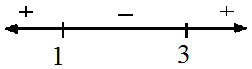
So, $y = x(x - 3)^2$ decreases for $(1, 3)$.
$[$since$, y\ ' < 0$ for all $x \in (1, 3),$ hence $y$ is decreasing on $(1, 3)]$ View full question & answer→MCQ 481 Mark
The volume of a sphere is increasing at $3\ cm^3/ sec$. The rate at which the radius increases when radius is $2\ cm$, is:
- A
$\frac{3}{32\pi}\text{ cm}/\text{sec}.$
- ✓
$\frac{3}{16\pi}\text{ cm}/\text{sec}.$
- C
$\frac{3}{48\pi}\text{ cm}/\text{sec}.$
- D
$\frac{1}{24\pi}\text{ cm}/\text{sec}.$
AnswerCorrect option: B. $\frac{3}{16\pi}\text{ cm}/\text{sec}.$
Let $r$ be the radius and $V$ be the volume of the sphere at any time $t.$
Then, $\text{v}=\frac{4}{3}\pi\text{r}^{3}$
$\Rightarrow\frac{\text{dv}}{\text{dt}}=4\pi\text{r}^{2}\frac{\text{dr}}{\text{dt}}$
$\Rightarrow\frac{\text{dr}}{\text{dt}}=\frac{1}{4\pi\text{r}^{2}}\frac{\text{dv}}{\text{dt}}$
$\Rightarrow\frac{\text{dr}}{\text{dt}}=\frac{3}{4\pi(2)^{2}}$
$\Rightarrow\frac{\text{dr}}{\text{dt}}=\frac{3}{16\pi}\text{ cm}/\text{sec}.$
View full question & answer→MCQ 491 Mark
Choose the correct answer:
The rate of change of the area of a circle with respect to its radius r at r = 6 cm is:
- A
$10\pi$
- ✓
$12\pi$
- C
$8\pi$
- D
$11\pi$
AnswerCorrect option: B. $12\pi$
Area of circle (A) $ $$=\pi \text{r}^{2}\ \Rightarrow \frac{\text{dA}}{\text{dr}}=2{\pi}\text{r}=2{\pi}\times6=12{\pi}$
Therefore, option (B) is correct.
View full question & answer→MCQ 501 Mark
The equation of the normal to the curve $3x^2 - y^2 = 8$ which is parallel to $x + 3y = 8$ is:
- A
$x + 3y = 8$
- B
$x + 3y + 8 = 0$
- ✓
$x + 3y ± 8 = 0$
- D
$x + 3y = 0$
AnswerCorrect option: C. $x + 3y ± 8 = 0$
Since the normal is parallel to the given line, the equation of normal will be of the given form.
$\text{x}+3\text{y}=\text{k}$
$3\text{x}^2-\text{y}^2=8$
Let $(x_1, y_1)$ be the point of intersection of the two curves.
Then,
$\text{x}_1+3\text{y}_1=\text{k} \ ...(1)$
$3\text{x}_1^2-\text{y}_1^2=8 \ ...(2)$
Now,
$3\text{x}^2-\text{y}^2=8$
On diffierentiating both sides $\text{w.r.t.x,}$ we get
$6\text{x}-2\text{y}\frac{\text{dy}}{\text{dx}}=0$
$\Rightarrow\frac{\text{dy}}{\text{dx}}=\frac{6\text{x}}{2\text{y}}=\frac{3\text{x}}{\text{y}}$
Slope of the normal, $=\Big(\frac{\text{dy}}{\text{dx}}\Big)_{(\text{x}_1,\text{y}_1)}=\frac{3\text{x}_1}{\text{y}_1}$
Slope of the normal, $\text{m}=\frac{-1}{\Big(\frac{3\text{x}}{\text{y}}\Big)}=\frac{-\text{y}_1}{3\text{x}_1}$
Given:
Slope of the normal $=$ Slope of the given line
$\Rightarrow\frac{-\text{y}_1}{3\text{x}_1}=\frac{-1}{3}$
$\Rightarrow\text{y}_1=\text{x}_1\ ...(3)$
From $(2)$, we get
$3\text{x}_1{^2}-\text{x}_1{^2}=8$
$\Rightarrow2\text{x}_1{^2}=8$
$\Rightarrow\text{x}_1{^2}=4$
$\Rightarrow\text{x}_1=\pm2$
Case $1$
when $\text{x}_1=2$
From $(3),$ we get
$\text{y}_1=\text{x}_1=2$
From $(3)$, we get
$2 + 3 (2) = k$
$\Rightarrow 2 + 6 = k$
$\Rightarrow k = 8$
$\therefore$ Equation of the normal from $(1)$
$\Rightarrow x + 3y = 8$
$\Rightarrow x + 3y - 8 = 0$
$\Rightarrow -2 - 6 = k$
$\Rightarrow k = -8$
$\therefore$ Equation of the normal from $(1)$
$\Rightarrow x + 3y = -8$
$\Rightarrow x + 3y - 8 = 0$
From both the case, we get the equation of the normal as:
$\text{x}+3\text{y}\pm8=0$
View full question & answer→