MCQ
Choose the correct answer from the given four options in the following questions : The zeroes of the quadratic polynomial $\text{x}^2+\text{kx}+\text{k},\text{ k}\neq0,$ :
  • Cannot both be positive.
  • B
    Cannot both be negative
  • C
    Are always unequal.
  • D
    Are always equal.

Answer

Correct option: A.
Cannot both be positive.
Let $p(x) =\text{x}^2+\text{kx}+\text{k},\text{ k}\neq0,$
On comparing $p(x)$ with $a x^2+b x+c$, we get
$a = 1, b = k$ and $c = k$
Now, $\text{x}=\frac{-\text{b}\pm\sqrt{\text{b}^2-4\text{ac}}}{2\text{a}} \ [$by quadratic formula$]$
$=\frac{-\text{k}\pm\sqrt{\text{k}^2-4\text{k}}}{2\times1}$
$=\frac{-\text{k}\pm\sqrt{\text{k}(\text{k}-4)}}{2},\text{k}\neq0$

Here, we see that
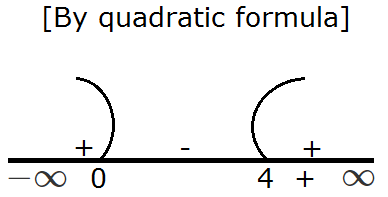
$k(k - 4) > 0$
$\Rightarrow\ \text{k }\in(-\infty,0)\text{ u }(4,\infty)$
Now, we know that
In quadratic Polynomial $a x^2+b x+c$
If $a > 0, b > 0, c > 0$ or $a < 0, b < 0, c < 0,$
Then the polynomial has always all negative zeroes.
and if $a > 0, c > 0 of a < 0, c > 0,$ then the ploynomial has always zeroes of opposite sing
Case $I:$
If $\text{k}\in(-\infty, 0)\text{ i.e., k}<0$
$\Rightarrow a = 1 > 0, b,c = k < 0$
So, both zeroes are of opposite sign.
Case $II:$
If $\text{k}\in(4,\infty)\text{ i.e., k}\leq4$
$\Rightarrow a = 1 > 0, b, c > 4$
So, both zeroes are negative,
Hence, in any case zeroes of the quadratic polynomial cannot both be positive.

Need a full question paper?

Generate a complete, print-ready paper with questions like this in minutes — across 16+ boards, with answer keys.

Start Generating Free