MCQ 11 Mark
In a family of $3$ children, the probability of having at least one boy is :
- ✓
$\frac{7}{8}$
- B
$\frac{1}{8}$
- C
$\frac{5}{8}$
- D
$\frac{3}{4}$
AnswerCorrect option: A. $\frac{7}{8}$
The probability that each child will be a boy is $\frac{1}{2.}$
The probability that each child will be a girl is $\frac{1}{2.}$
The probability of no boys $=\frac{1}{2}\times\frac{1}{2}\times\frac{1}{2}=\frac{1}{8}$
The probability of at least $1$ boy $= 1 -$ The probability of no boys.
$=1-\frac{1}{8}=\frac{7}{8}$
View full question & answer→MCQ 21 Mark
The probability that a number selected at random from the numbers $\{1, 2, 3, ..., 15\}$ is a multiple of $4,$ is
- A
$\frac{4}{15}$
- B
$\frac{2}{15}$
- ✓
$\frac{1}{5}$
- D
$\frac{1}{3}$
AnswerCorrect option: C. $\frac{1}{5}$
Total No. $= 15$
No. of multiples of $4$ between $1$ and $15 = 3$
$P($a number selected from the number $\{1, 2, 3, .... 15\}$ is a multiple of $4)$
$=\frac{3}{15}$
$=\frac{1}{5}$
View full question & answer→MCQ 31 Mark
The probability that a number selected at random from the numbers $\{1, 2, 3,..., 15\}$ is a multiple of $4,$ is :
- A
$\frac{4}{15}$
- B
$\frac{2}{15}$
- ✓
$\frac{1}{5}$
- D
$\frac{1}{3}$
AnswerCorrect option: C. $\frac{1}{5}$
Total No. $= 15$
No. of multiples of $4$ between $1$ and $15 = 3$
$P($a number selected from the number $\{1, 2, 3,....... 15\}$ is a multiple of $4)$
$=\frac{3}{15}$
$=\frac{1}{5}$
View full question & answer→MCQ 41 Mark
Cards bearing numbers $\{2, 3, 4, ...., 11\}$ are kept in a bag. A card is drawn at random from the bag. The probability of getting a card with a prime number is :
- ✓
$\frac{1}{2}$
- B
$\frac{2}{5}$
- C
$\frac{3}{10}$
- D
$\frac{5}{9}$
AnswerCorrect option: A. $\frac{1}{2}$
No. of prime cards $= 5$
Total numbers $= 10$
$\text{P}(\text{Prime})=\frac{\text{No. of prime cards}}{\text{Total no. of cards}}$
$=\frac{5}{10}=\frac{1}{2}=0.5$
$\therefore$ Probability of a card with prime number is $0.5.$
View full question & answer→MCQ 51 Mark
A card is drawn from a well $-$ shuffled deck of $52$ playing cards. The probability that the card will not be an ace is :
- A
$\frac{1}{13}$
- B
$\frac{1}{4}$
- ✓
$\frac{12}{13}$
- D
$\frac{3}{4}$
AnswerCorrect option: C. $\frac{12}{13}$
Total number of cards $= 52$
Number of non $-$ aces $= 52 – 4 = 48$
Probability $=\frac{48}{52}=\frac{12}{13}$
View full question & answer→MCQ 61 Mark
If two different dice are rolled together, the probability of getting an even number on both dice, is :
- A
$\frac{1}{36}$
- B
$\frac{1}{2}$
- C
$\frac{1}{6}$
- ✓
$\frac{1}{4}$
AnswerCorrect option: D. $\frac{1}{4}$
We toss dice twice,
So total no. of outcomes : $6 \times 6 = 36$
We need even numbers on both dice.
So possible numbers of arrangements are
$\{2, 4, 6 , x , 2, 4, 6\}$
$= 3 \times 3$
$= 9$ possible combination of even numbers.
Therefore required probability is : $\frac{9}{36}=\frac{1}{4}.$
View full question & answer→MCQ 71 Mark
A number is selected at random from the numbers $1$ to $30$. The probability that it is a prime number is :
- A
$\frac{2}{3}$
- B
$\frac{1}{6}$
- ✓
$\frac{1}{3}$
- D
$\frac{11}{30}$
AnswerCorrect option: C. $\frac{1}{3}$
Prime numbers between $1$ and $30$ are $\{2, 3, 5, 7, 11, 13, 17, 19, 23\},$ and $29.$
Total number of prime number $= 10$
The probability that the number chosen from $1$ to $30$ is a prime number $=\frac{10}{30}=\frac{1}{3}$
View full question & answer→MCQ 81 Mark
The probability of getting an even number, when a die is thrown once, is :
- ✓
$\frac{1}{2}$
- B
$\frac{1}{3}$
- C
$\frac{1}{6}$
- D
$\frac{5}{6}$
AnswerCorrect option: A. $\frac{1}{2}$
$S = \{1, 2, 3, 4, 5, 6\}$ there are $6$ possibilities in our set, each number has a probability of $\frac{1}{6}$
$S$ even $= \{2, 4, 6\}$
There are three sets of possibilities
$\text{Probability}=\frac{\text{event set}}{\text{total set}}$
Probability even $=\frac{3}{6}=\frac{1}{2}$
View full question & answer→MCQ 91 Mark
A box contains $90$ discs, numbered from $1$ to $90$. If one disc is drawn at random from the box, the probability that it bears a prime $-$ number less than $23,$ is :
- A
$\frac{7}{20}$
- B
$\frac{10}{90}$
- ✓
$\frac{4}{45}$
- D
$\frac{9}{89}$
AnswerCorrect option: C. $\frac{4}{45}$
Total number of possibility $= 90.$
Favorable condition possibility of a prime number less than $23 = \{2, 3, 5, 7, 11, 13, 17, 19\} = 8.$
Therefore probability of a prime number less than $23=\frac{8}{90}=\frac{4}{45}$
View full question & answer→MCQ 101 Mark
Two dice are thrown together. The probability of getting the same number on both dice is :
- A
$\frac{1}{2}$
- B
$\frac{1}{3}$
- ✓
$\frac{1}{6}$
- D
$\frac{1}{12}$
AnswerCorrect option: C. $\frac{1}{6}$
Total no. Of outcomes when $2$ dice are thrown $= 6 \times 6 = 36$
Favourable outcomes $(1, 1), (2, 2), (3, 3), (4, 4), (5, 5)$ and $(6, 6).$
No. Of favourable outcomes $= 6$
Probability $($same no. On both dice$) =\frac{\text{No. of favourable outcomes}}{\text{Total no. of outcomes}}$
Probability $($same no. On both dice$) =\frac{6}{36}=\frac{1}{6}$
Probability $($same no. On both dice$) =\frac{1}{6}$
View full question & answer→MCQ 111 Mark
Which of the following can not be the probability an event ?
- ✓
$1.5$
- B
$\frac{3}{5}$
- C
$25\%$
- D
$0.3$
Answer$0\leq\text{Probability of event E}\leq1$
Probability of an event $(E)$ is always greater than or equal to $0$.
Also, it is always less than or equal to one.
This implies that the probability of an event cannot be negative or greater than $1.$
Therefore, out of these alternatives, $1.5$ cannot be a probability of an event.
Hence $,(A)$.
View full question & answer→MCQ 121 Mark
A bag contains $3$ red $,5$ black and $7$ white balls. A ball is drawn from the bag at random. The probability that the ball drawn is not black, is :
- A
$\frac13$
- B
$\frac9{15}$
- C
$\frac5{10}$
- ✓
$\frac23$
AnswerCorrect option: D. $\frac23$
Favorable cases $($not black$) = (3 + 7) = 10$
$P($not black$) =\frac{\text{favourable outcomes}}{\text{total no. of outcomes}}$
So here $P($not black$) =\frac{10}{15}=\frac23$
Therefore the probability that the ball drawn is not black is $\frac23$
View full question & answer→MCQ 131 Mark
Two coins are tossed simultaneously. What is the probability of getting at most one head?
- A
$\frac{1}{4}$
- B
$\frac{1}{2}$
- C
$\frac{2}{3}$
- ✓
$\frac{3}{4}$
AnswerCorrect option: D. $\frac{3}{4}$
When two coins are tossed the simultanecusly the
outcomes are :
$\text{\{HH, HT, TH, TT}\}$
So, there are $4$ outcomes.
Getting atmost one head means the possible outcomes are :
$\text{\{HT, TH, TT\}}$
So, there are $3$ possible outcomes.
$P($getting atmost one head$)$
$=\frac{3}{4}$
View full question & answer→MCQ 141 Mark
From a well shuffled pack of $52$ cards, one card is drawn at random. The probability of getting a diamond is :
- A
$\frac{12}{52}$
- ✓
$\frac{1}{4}$
- C
$\frac{3}{4}$
- D
$\frac{1}{2}$
AnswerCorrect option: B. $\frac{1}{4}$
The probability of drawing a diamond $-$ faced card from a pack of $52$ playing cards is easy to determine.
Since there are $13$ diamond $-$ faced cards in the deck, the probability becomes $\frac{13}{52}=\frac{1}{4}$
View full question & answer→MCQ 151 Mark
Cards, each marked with one of the numbers $\{6, 7, 8, ..., 15\}$ are placed in a box and mixed thoroughly. One card is drawn at random from the box. What is the probability of getting a card with number less than $10?$
- A
$\frac{3}{5}$
- B
$\frac{1}{3}$
- C
$\frac{1}{2}$
- ✓
$\frac{2}{5}$
AnswerCorrect option: D. $\frac{2}{5}$
The total number of tickets $= 10$
The numbers less than $10$ are $6, 7, 8$ and $9.$
So, there are $4$ numbers.
$P($getting a number less than $10)$
$=\frac{4}{10}$
$=\frac{2}{5}$
View full question & answer→MCQ 161 Mark
The probability of an impossible event is :
- ✓
$0$
- B
$1$
- C
$\frac{1}{2}$
- D
Non $-$ existent.
AnswerProbability of an impossible event $= 0$
View full question & answer→MCQ 171 Mark
A die is thrown once. The probability of getting an odd number greater than $3$ is :
- A
$\frac{1}{3}$
- ✓
$\frac{1}{6}$
- C
$\frac{1}{2}$
- D
$0$
AnswerCorrect option: B. $\frac{1}{6}$
The number on a die are $\{1, 2, 3, 4, 5\}$ and $6.$
So, there are $6$ numbers in total.
The odd number on a die greater than $3$ is $5.$
So, there is only $1$ number.
$P($getting an odd number greater than $3)$
$=\frac{1}{6}$
View full question & answer→MCQ 181 Mark
The probability of throwing a number greater than $2$ with a fair die is :
- A
$\frac{2}{5}$
- B
$\frac{5}{6}$
- C
$\frac{1}{3}$
- ✓
$\frac{2}{3}$
AnswerCorrect option: D. $\frac{2}{3}$
The numbers on a fair die are $\{1, 2, 3, 4, 5\}$ and $6.$
So, there are $6$ numbers in total.
The number greater than $2$ are $3, 4, 5$ and $6.$
So, there are $4$ numbers.
$P($getting a number greater than $2)$
$=\frac{4}{6}$
$=\frac{2}{3}$
View full question & answer→MCQ 191 Mark
A bag contains cards numbered from $1$ to $25$. A card is drawn at random from the bag. The probability that the number on this card is divisible by both $2$ and $3$ is :
- A
$\frac{1}{5}$
- B
$\frac{3}{25}$
- ✓
$\frac{4}{25}$
- D
$\frac{2}{25}$
AnswerCorrect option: C. $\frac{4}{25}$
Total number of outcomes $= 25$
The number which is divisible by both $2$ and $3$ are $\{6, 12, 18, 24\}.$
Number of favourable outcomes $= 4$
Probability of number which is divisible by both $2$ and $3=\frac{4}{25}$
both $2$ and $3=\frac{4}{25}$
View full question & answer→MCQ 201 Mark
$3$ rotten eggs are mixed with $12$ good ones. One egg is chosen at random. The probability of choosing a rotten egg is :
- ✓
$\frac{1}{5}$
- B
$\frac{1}{15}$
- C
$\frac{2}{5}$
- D
$\frac{4}{5}$
AnswerCorrect option: A. $\frac{1}{5}$
Number of possible outcomes $= 3$
Number of Total outcomes $= 15$
$\therefore$ Required Probability $=\frac{3}{15}=\frac{1}{5}$
View full question & answer→MCQ 211 Mark
Choose the correct answer from the given four options: A girl calculates that the probability of her winning the first prize in a lottery is 0.08. If 6000 tickets are sold, how many tickets has she bought?
Answerc. 480
Solution:
Given, total number of sold tickets = 6000
Let she bought x tickets.
Then, probability of her winning the first prize $=\frac{\text{x}}{6000}=0.08$
$\Rightarrow\ \ \text{x}=0.08\times6000$
$\therefore\ \ \text{x}=480$
Hence, she bought 480 tickets.
View full question & answer→MCQ 221 Mark
One card is drawn at random from a well $- $ shuffled deck of $52$ cards. What is th probability of getting a face card?
- A
$\frac{1}{26}$
- B
$\frac{3}{26}$
- ✓
$\frac{3}{13}$
- D
$\frac{4}{13}$
AnswerCorrect option: C. $\frac{3}{13}$
The total number of cards $= 52$
The number of queens $= 12$
$P\ ($getting a face card$)$
$=\frac{12}{52}$
$=\frac{3}{13}$
View full question & answer→MCQ 231 Mark
Two dice are rolled simultaneously. The probability that they show different faces is :
- A
$\frac{2}{3}$
- B
$\frac{1}{6}$
- C
$\frac{1}{3}$
- ✓
$\frac{5}{6}$
AnswerCorrect option: D. $\frac{5}{6}$
Two dice are rolled simultaneously
$\therefore$ No. of total events $=6^2=36$
$\therefore$ No. of different face can be
$=36 - ($same faces$)$
Same face are $(1,1),(2,2),(3,3),(4,4),(5,5)$ and $(6,6)=6$
$\therefore 36-6=30$
$\therefore\ \text{Probability P (E)}=\frac{\text{m}}{\text{n}}=\frac{30}{36}=\frac{5}{6}$
View full question & answer→MCQ 241 Mark
A bag contains three green marbles, four blue marbles and two orange marbles. If a marble is picked at random, then the probability that it is not an orange marble is :
- A
$\frac{1}{4}$
- B
$\frac{1}{3}$
- C
$\frac{4}{9}$
- ✓
$\frac{7}{9}$
AnswerCorrect option: D. $\frac{7}{9}$
In a bag, there are $3$ green, $4$ blue and $2$ orange marbles
$\therefore$ Total marbles $(n) = 3 + 4 + 2 = 9$
No. of marbles which is not orange $= 3 + 4 = 7$
$\therefore m = 7$
$\therefore\ \text{Probability}=\frac{\text{m}}{\text{n}}=\frac{7}{9}$
View full question & answer→MCQ 251 Mark
The probability that a leap year will have $53$ Sundays or $53$ Mondays is :
- A
$\frac{2}{7}$
- B
$\frac{4}{7}$
- C
$\frac{1}{7}$
- ✓
$\frac{3}{7}$
AnswerCorrect option: D. $\frac{3}{7}$
Leap year contains $366$ days $= 52$ weeks $+\ 2$ days
$52$ weeks contain $52 $ Sundays and $52$ weeks contain $52$ Mondays
We will get $53$ Sundays or $53$ Mondays if one of the remaining two days is a Sunday or Monday,
Total possibilities for two days are :
$\text{(Sunday, Monday), (Monday, Tuesday), (Tuesday, Wednesday)} $
$\text{(Wednesday, Thursday), (Thursday, Friday), (Friday, Saturday), (Saturday, Sunday)}$
Number of Total possible outcomes $= 7$
Number of possible outcomes either Sunday or Monday or Both $= 3$
Required Probability $=\frac{3}{7}$
View full question & answer→MCQ 261 Mark
If $p$ is the probability of an event, then $p$ satisfies :
- ✓
$0 \leq p \leq 1$
- B
$0 \leq p < 1$
- C
$0 < p < 1$
- D
$0 < p \leq 1$
AnswerCorrect option: A. $0 \leq p \leq 1$
Probability of an event always lie between $0$ and $1.$
View full question & answer→MCQ 271 Mark
Cards marked with numbers $2$ to $101$ are placed in a box and mixed thoroughly. One card is drawn from the box. The probability that the number on the card is a prime number less than $20$ is :
- A
$\frac{12}{25 }$
- ✓
$\frac{2}{25}$
- C
$\frac{8}{25}$
- D
$\frac{4}{25}$
AnswerCorrect option: B. $\frac{2}{25}$
Prime numbers less than $20$ are $\{2, 3, 5, 7, 11, 13, 17, 19 = 8\}$
Number of possible outcomes $= 8$
Number of total outcomes $= 100$
$\therefore$ Required Probability $=\frac{8}{100}=\frac{2}{25}$
View full question & answer→MCQ 281 Mark
Choose the correct answer from the given four options in the following questions : The zeroes of the quadratic polynomial $\text{x}^2+\text{kx}+\text{k},\text{ k}\neq0,$ :
AnswerLet $p(x) =\text{x}^2+\text{kx}+\text{k},\text{ k}\neq0,$
On comparing $p(x)$ with $a x^2+b x+c$, we get
$a = 1, b = k$ and $c = k$
Now, $\text{x}=\frac{-\text{b}\pm\sqrt{\text{b}^2-4\text{ac}}}{2\text{a}} \ [$by quadratic formula$]$
$=\frac{-\text{k}\pm\sqrt{\text{k}^2-4\text{k}}}{2\times1}$
$=\frac{-\text{k}\pm\sqrt{\text{k}(\text{k}-4)}}{2},\text{k}\neq0$
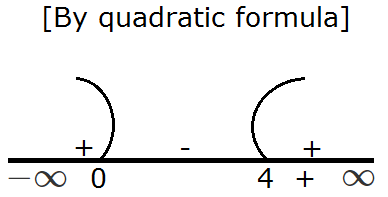
Here, we see that
$k(k - 4) > 0$
$\Rightarrow\ \text{k }\in(-\infty,0)\text{ u }(4,\infty)$
Now, we know that
In quadratic Polynomial $a x^2+b x+c$
If $a > 0, b > 0, c > 0$ or $a < 0, b < 0, c < 0,$
Then the polynomial has always all negative zeroes.
and if $a > 0, c > 0 of a < 0, c > 0,$ then the ploynomial has always zeroes of opposite sing
Case $I:$
If $\text{k}\in(-\infty, 0)\text{ i.e., k}<0$
$\Rightarrow a = 1 > 0, b,c = k < 0$
So, both zeroes are of opposite sign.
Case $II:$
If $\text{k}\in(4,\infty)\text{ i.e., k}\leq4$
$\Rightarrow a = 1 > 0, b, c > 4$
So, both zeroes are negative,
Hence, in any case zeroes of the quadratic polynomial cannot both be positive. View full question & answer→MCQ 291 Mark
A card is selected at random from a well shuffled deck of $52$ playing cards. The probability of its being a face card is :
- A
$\frac{4}{13}$
- B
$\frac{1}{26}$
- ✓
$\frac{3}{13}$
- D
$\frac{3}{26}$
AnswerCorrect option: C. $\frac{3}{13}$
Face Cards are $= 4$ kings $+\ 4$ queens $+\ 4$ jacks $= 12$
Number of possible outcomes $= 12$
Number of Total outcomes $= 52$
$\therefore$ Required Probability $=\frac{12}{52}=\frac{3}{13}$
View full question & answer→MCQ 301 Mark
In a single throw of a die, the probability of getting a multiple of $3$ is :
- A
$\frac{1}{2}$
- ✓
$\frac{1}{3}$
- C
$\frac{1}{6}$
- D
$\frac{2}{3}$
AnswerCorrect option: B. $\frac{1}{3}$
A die is thrown, the possible number of events $(n) = 6$
Now multiple of $3$ are $3, 6$ which are $2$
$\therefore m = 2$
$\therefore\ \text{Probability}=\frac{\text{m}}{\text{n}}=\frac{2}{6}=\frac{1}{3}$
View full question & answer→MCQ 311 Mark
Choose the correct answer from the given four options : An event is very unlikely to happen. Its probability is closest to :
- ✓
$0.0001$
- B
$0.001$
- C
$0.01$
- D
$0.1$
AnswerCorrect option: A. $0.0001$
The probability of an event which is very unlikely to happen is closest to zero and from the given options $0.0001$ is closest to zero.
View full question & answer→MCQ 321 Mark
A card is drawn at random from a well $-$ shuffled deck of $52$ cards. The probability that it will be a spade or a king is :
- A
$\frac{6}{13}$
- B
$\frac{10}{13}$
- ✓
$\frac{4}{13}$
- D
$\frac{8}{13}$
AnswerCorrect option: C. $\frac{4}{13}$
Number of spades $= 13$
Number of kings $= 3\ ($one spade king is counted in No. of spades$)$
Number of possible outcomes $= 13 + 3 = 16$
Number of Total outcomes $= 52$
Required Probability $=\frac{16}{52}=\frac{4}{13}$
View full question & answer→MCQ 331 Mark
A card is drawn at random from a well $-$ shuffled deck of $52$ cards. What is the probability of getting a black king?
- A
$\frac{1}{13}$
- ✓
$\frac{1}{26}$
- C
$\frac{2}{39}$
- D
$\text{None of these}$
AnswerCorrect option: B. $\frac{1}{26}$
The total number of cards $= 52$
The number of black kings $= 2$
$P\ ($getting a black king$)$
$=\frac{2}{52}$
$=\frac{1}{26}$
View full question & answer→MCQ 341 Mark
Which of the following cannot be the probability of occurrence of an event?
AnswerProbability of an event occurrence can not be $= 1.6$
View full question & answer→MCQ 351 Mark
The probability that it will rain on a particular day is $0.76$. The probability that it will not rain on that day is :
AnswerCorrect option: D. $0.24$
Given : $P ($It will rain on a particular day$) = 0.76$
$\therefore P ($It will not rain on a particular day$) = 1 - P\ ($It will rain particular day$)$
$= 1 - 0.76 = 0.24$
View full question & answer→MCQ 361 Mark
Two dice are rolled simultaneously. The probability that the sum of the numbers on the faces is $9$ is :
- A
$\frac{5}{9}$
- ✓
$\frac{1}{9}$
- C
$\frac{4}{9}$
- D
$\frac{2}{9}$
AnswerCorrect option: B. $\frac{1}{9}$
Number of possible outcomes $= \{(3, 6), (5, 4), (4, 5), (6, 3)\} = 4$
Number of Total outcomes $= 6 \times 6 = 36$
$\therefore$ Required Probability $=\frac{4}{36}=\frac{1}{9}$
View full question & answer→MCQ 371 Mark
A card is accidently dropped from a pack of $52$ playing cards. The probability that it is an ace is :
- A
$\frac{1}{4}$
- ✓
$\frac{1}{13}$
- C
$\frac{1}{52}$
- D
$\frac{12}{13}$
AnswerCorrect option: B. $\frac{1}{13}$
No. of card in a pack $(n) = 52$
A card is drawn at random
$\therefore$ No. of ace $(m) = 4$
$\therefore$ Probability of an ace $=\frac{\text{m}}{\text{n}}=\frac{4}{52}=\frac{1}{13}$
View full question & answer→MCQ 381 Mark
A box contains $90$ discs, numbered from $1$ to $90$. If one disc is drawn at random from the box, the probability that it bears a prime number less than $23,$ is :
- A
$\frac{7}{90}$
- B
$\frac{10}{90}$
- ✓
$\frac{4}{45}$
- D
$\frac{9}{89}$
AnswerCorrect option: C. $\frac{4}{45}$
Number of discs in a box $= 90$
Numbered on it are $1$ to $90$
Prime numbers less than $23$ are $= \{2, 3, 5, 7, 11, 13, 17, 19\} = 8$
Probability of a number being a prime less than $23=\frac{8}{90}=\frac{4}{45}$
View full question & answer→MCQ 391 Mark
An unbiased die is thrown once. The probability of getting a number between $2$ and $6$ is :
- A
$\frac{2}{3}$
- ✓
$\frac{1}{2}$
- C
$\frac{1}{3}$
- D
$\frac{2}{5}$
AnswerCorrect option: B. $\frac{1}{2}$
Number of numbers between $2$ and $6$ on a dice $= \{3, 4, 5\}, = 3$
Number of possible outcomes $= 3$
Number of Total outcomes $= 6$
$\therefore$ Required Probability $=\frac{3}{6}=\frac{1}{2}$
View full question & answer→MCQ 401 Mark
An unbiased die is thrown once. The probability of getting a prime or composite number is :
- A
$\frac{1}{2}$
- ✓
$\frac{5}{6}$
- C
$\frac{1}{6}$
- D
$1$
AnswerCorrect option: B. $\frac{5}{6}$
prime numbers on a die are $2, 3, 5$
composite numbers on a die are $ 4, 6$
Prime and Composite numbers on a die $= 2, 3, 4, 5, 6$
Number of possible outcomes $= 5$
Number of Total outcomes $= 6$
Required Probability$=\frac{5}{6}$
View full question & answer→MCQ 411 Mark
If $S$ is the sample space of a random experiment, then $P(S) =$
- A
$\frac{1}{4}$
- ✓
$1$
- C
$0$
- D
$\frac{1}{8}$
AnswerIf $S$ is the sample space of a random experiment, then $P(S) = 1$
View full question & answer→MCQ 421 Mark
The probability that a leap year selected at random will have $53$ Fridays is :
- ✓
$\frac{2}{7}$
- B
$\frac{6}{7}$
- C
$\frac{4}{7}$
- D
$\frac{1}{7}$
AnswerCorrect option: A. $\frac{2}{7}$
Leap year contains $366$ days $= 364$ days $+\ 2$ days $= 364/73$ weeks $+\ 2$ additional days $= 52$ weeks $+\ 2$ additional days
$52$ weeks contain $52$ Fridays
We will get $53$ Fridays if one of the remaining two additional days is a Friday
These additional days can be :
$\text{(Sunday, Monday), (Monday, Tuesday), (Tuesday, Wednesday)}$
$\text{(Wednesday, Thursday), (Thursday, Friday), (Friday, Saturday), (Saturday, Sunday)}$
Number of total outcomes $= 7$
Number of possible outcomes $= 2$
$\therefore$ Required Probabillity of the event $=\frac{\text{Number of possible outcomes}}{\text{Number of total outcomes }}=\frac{2}{7}$
View full question & answer→MCQ 431 Mark
If $P(E) = 0.05,$ then $P($not $E) =$
- A
$-0.5$
- B
$0.5$
- C
$0.9$
- ✓
$0.95$
AnswerCorrect option: D. $0.95$
$P(E) = 0.05$
$\because P(E) + P($not $E) = 1$
$\therefore P($not $E) = 1 - P(E) $
$= 1 - 0.05 = 0.95$
View full question & answer→MCQ 441 Mark
An unbiased die is thrown once. The probability of getting a prime number is :
- A
$\frac{1}{4}$
- ✓
$\frac{1}{2}$
- C
$\frac{1}{3}$
- D
$\frac{1}{5}$
AnswerCorrect option: B. $\frac{1}{2}$
Number of possible outcomes $= \{2, 3, 5\} = 3$
Number of Total outcomes $= 6$
$\therefore$ Probability of getting a prime number $= \frac{3}{6} =\frac{1}{2}$
View full question & answer→MCQ 451 Mark
One card is drawn from a well shuffled pack of $52$ cards. The probability of getting an ace is :
- A
$\frac{2}{13}$
- B
$\frac{4}{13}$
- C
$\frac{1}{52}$
- ✓
$\frac{1}{13}$
AnswerCorrect option: D. $\frac{1}{13}$
Number of possible outcomes $= 4$
Number of Total outcomes $= 52$
$\therefore$ Probability of getting an ace $=\frac{4}{52}=\frac{1}{13}$
View full question & answer→MCQ 461 Mark
The probability of throwing a number greater than $2$ with a fair dice is :
- A
$\frac{3}{5}$
- B
$\frac{2}{5}$
- ✓
$\frac{2}{3}$
- D
$\frac{1}{3}$
AnswerCorrect option: C. $\frac{2}{3}$
Given : A dice is thrown once
To Find : Probability of getting a number greater than $2$.
Total number on a dice is $6.$
Number greater than $2$ is $3, 4, 5$ and $6$
Total number greater than $2$ is $4$
We know that $\text{Probability}=\frac{\text{Number of favourable event}}{\text{Total number of event}}$
Hence probability of getting a number greater than $2$ is equal to $\frac{4}{6}=\frac{2}{3}$
Hence the correct option is $c.$
View full question & answer→MCQ 471 Mark
Choose the correct answer from the given four options : When a die is thrown, the probability of getting an odd number less than $3$ is :
- ✓
$\frac{1}{6}$
- B
$\frac{1}{3}$
- C
$\frac{1}{2}$
- D
$0$
AnswerCorrect option: A. $\frac{1}{6}$
When a die $-$ is thrown, then total number of outcomes $= 6$ Odd number less than $3$ is $1$ only.
Number of possible outcomes $= 1$
$\therefore\ \text{Required probability}=\frac{1}{6}$
View full question & answer→MCQ 481 Mark
If a number $x$ is chosen from the numbers $1, 2, 3,$ and a number $y$ is selected from the numbers $1, 4, 9.$ Then $, P(xy < 9)$
- A
$\frac{7}{9}$
- ✓
$\frac{5}{9}$
- C
$\frac{2}{3}$
- D
$\frac{1}{9}$
AnswerCorrect option: B. $\frac{5}{9}$
Given : $x$ is chosen from the numbers $1, 2, 3$ and $y$ is chosen from the numbers $1, 4, 9$
To Find : Probability of getting $P(xy) < 9$
We will make multiplication table for $x$ and $y$ such tha $(xy) < 9xy = 1 \times 1 = 1= 1 \times 4 = 4= 1 \times 9 = 9= 2 \times 1 = 2= 2 \times 4 $
$= 8= 2 \times 9 = 18= 3 \times 1 = 3= 3 \times 4 = 12= 3 \times 9 = 27$
So the numbers such that $(xy) < 9$ is $5$
We know that $\text{Probability}=\frac{\text{Number of favourable event}}{\text{Total number of event}}$
Hence $\text{P}(\text{xy}<9)=\frac{5}{9}$
Hecne the correct option is $b$.
View full question & answer→MCQ 491 Mark
If two different dice are rolled together, the probability of getting an even number :
- A
$\frac{1}{36}$
- B
$\frac{1}{2}$
- C
$\frac{1}{6}$
- ✓
$\frac{1}{4}$
AnswerCorrect option: D. $\frac{1}{4}$
Rolling two different dice,
Number of total events $= 6 \times 6 = 36$
Number of even number on both dice are $\{(2, 2), (2, 4), (2, 6), (4, 2), (4, 4), (4, 6), (6, 2), (6, 4), (6, 6)\} = 9$
$\therefore\ \text{Probability}=\frac{9}{36}=\frac{1}{4}$
View full question & answer→MCQ 501 Mark
What is the probability that a leap year has $52$ Mondays ?
- A
$\frac{2}{7}$
- B
$\frac{4}{7}$
- ✓
$\frac{5}{7}$
- D
$\frac{6}{7}$
AnswerCorrect option: C. $\frac{5}{7}$
Given : A leap year
To Find : Probability that a leap year has $52$ Mondays.
Total number of days in leap year is $366$ days
Hence number of weeks in a leap year is $\frac{366}{7}=52$ weeks and $2$ day
In a leap year we have $52$ complete weeks and $2$ day which can be any pair of the day of the week i.e.
$($Sunday, Monday$)$
$($Monday, Tuesday$)$
$($Tuesday, Wednesday$)$
$($Wednesday, Thursday$)$
$($Thursday, Friday$)$
$($Friday, Saturday$)$
$($Saturday, Sunday$)$
To make $52$ Mondays the additional days should not include Monday
Hence total number of pairs of days is $7$
Favorable day i.e. in which Mondays is not there is $5$
We know that $\text{Probability}=\frac{\text{Number of favourable event}}{\text{Total number of event}}$
Hence probability that a leap year has $52$ Mondays is equal to $\frac{5}{7}$
Hence the correct option is $c$.
View full question & answer→