MCQ
Choose the correct answer from the given four options.
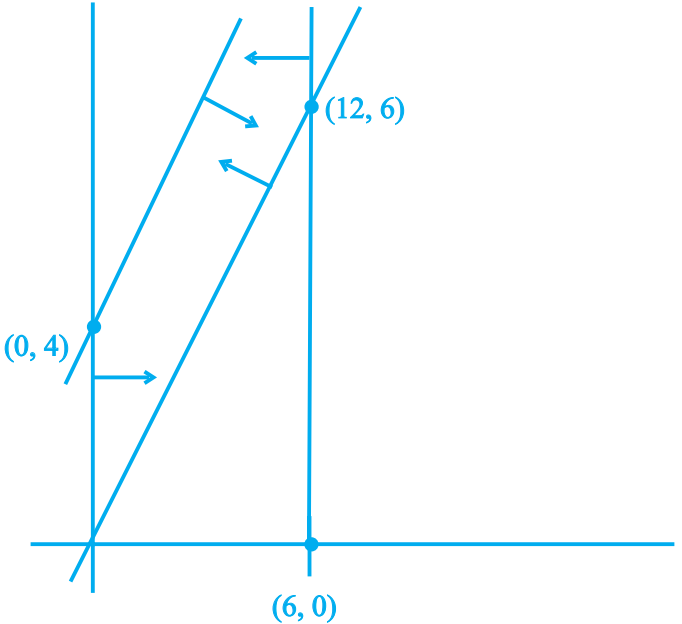
Let F = 3x - 4y be the objective function. Maximum value of F is:
  • A
    0.
  • B
    8.
  • 12.
  • D
    -18.

Answer

Correct option: C.
12.
The feasible region as shown in the figure, has objective function F = 3x - 4y
Corner points
Corresponding value of Z = 3x - 4y
(0, 0)
(12, 6)
(0, 4)
0
12 (maximum)
-16 (minimum)
Hence, the maximum value of F is 12.

Need a full question paper?

Generate a complete, print-ready paper with questions like this in minutes — across 16+ boards, with answer keys.

Start Generating Free

Similar questions

If $\tan (x + y) + \tan (x - y) = 1,$ then ${{dy} \over {dx}} = $
Choose the correct answer from the given four options:
let $\text{P}(\text{A})=\frac{7}{13},\text{P}(\text{B})=\frac{9}{13}$ and $\text{P}(\text{A}\cup\text{B})=\frac{4}{13}.$ Then $\text{P}\Big(\frac{\text{A'}}{\text{B}}\Big)$ is equal to:
If $\text{f(x)}=\begin{cases}\text{ax}^2+\text{b},&0\leq\text{x} < 1\\4,&\text{x}=1\\\text{x}+3,&1<\text{x}\leq2\end{cases}$ then the value of $(a, b)$ for which $f(x)$ cannot be continuous at $x = 1,$ is :
If $P(\operatorname{Not} A)=3 / 5$, then the value of $P(A)$ will be
If $a = 2i + 4j + 2k$ and $b = 8i - 3j + \lambda k$ and $a\, \bot \,b,$ then value of $\lambda $ will be
The distance moved by the particle in time t is given by $x = t^3- 12t^2 + 6t + 8.$ At the instant when its acceleration is zero, the velocity is:
If $\text{A}=\begin{bmatrix} \text{a} & 0 & 0 \\ 0 & \text{a} & 0 \\ 0 & 0 &\text{a} \end{bmatrix},$ then the value of $|\text{adj A}|$ is:
If $|\vec{\text{a}}|=\big|\vec{\text{b}}\big|,$ then $\big(\vec{\text{a}}+\vec{\text{b}}\big).\big(\vec{\text{a}}-\vec{\text{b}}\big)=$
If in a binomial distribution $\text{n}=4,\text{P(X}=0)=\frac{16}{81},$ then $\text{P(X}=4)$ equals:
Suppose $\left| {\begin{array}{*{20}{c}}
  {f'\left( x \right)}&{f\left( x \right)} \\ 
  {f''\left( x \right)}&{f'\left( x \right)} 
\end{array}} \right| = 0$ where $f(x)$ is continuously differentiable function with $f'(x) \ne  0$ and satisfy $f(0) = 1$ and $f'(0) = 2$ , then the number of solution $(s)$ of equation $f(x) = x^2$ is equal to