Question
Choose the correct answer from the given four options. The feasible solution for a LPP is shown in. Let Z = 3x - 4y be the objective function.
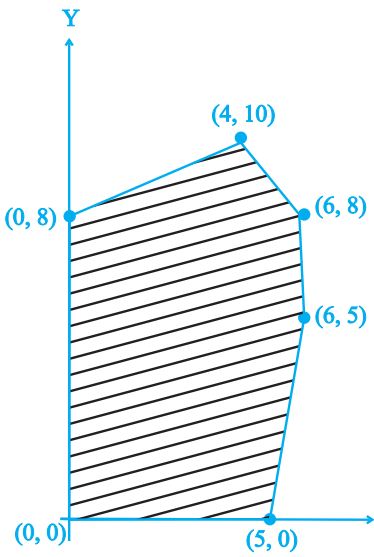
Maximum of Z occurs at:

Answer

  1. (5, 0)
Solution:
Corner points
Corresponding value of Z = 3x - 4y
(0, 0)
(5, 0)
(6, 5)
(6, 8)
(4, 10)
(0, 8)
0
15 (Maxmimum)
-2
-14
-28
-32
Hence, maximum of Z occurs at (5, 0) and its maximum value is 27.

Need a full question paper?

Generate a complete, print-ready paper with questions like this in minutes — across 16+ boards, with answer keys.

Start Generating Free

Similar questions

A rectangular parallelopiped is formed by planes drawn through the point (5, 7, 9) and (2, 3, 7) parallel to the coordinate planes. The length of an edge of this rectangular parallelopiped is:
  1. 2
  2. 3
  3. 4
  4. all of these
The solution of the differential equation $\frac{\text{dy}}{\text{dx}}=1+\text{x}+\text{y}^{2}+\text{xy}^{2}, \text{y}=(0)$ is: 
  1. $\text{y}^{2}=\text{exp}\big(\text{x}+\frac{\text{x}^{2}}{2}-1\big)$
  2. $\text{y}^{2}=1+\text{C}\ \text{exp}\Big(\text{x}+\frac{\text{x}^{2}}{2}\Big)$
  3. $\text{y}=\tan (\text{C}+\text{x}+\text{x}^{2})$
  4. $\text{y}=\tan\Big(\text{x}+\frac{\text{x}^{2}}{2}\Big)$
The solution set of the inequation 3x + 2y > 3 is:
  1. Half plane not containing the origin
  2. Half plane containing the origin
  3. The point being on the line 3x + 2y = 3
  4. None of these
If $A=\left[\begin{array}{ll}x & 0 \\ 1 & 1\end{array}\right]$ and $B=\left[\begin{array}{cc}4 & 0 \\ -1 & 1\end{array}\right]$, then value of $x$ for which $A^2=B$ is
$\text{Area}\text{ of}\text{ ellips}\frac{\text{x}^2}{\text{a}^2}+\frac{\text{y}^2}{\text{b}^2}=1\text{ is:}$
  1. $4\pi\text{ ab}\text{ sq.}\text{ units}$
  2. $2\pi\text{ ab}\text{ sq.}\text{ units}$
  3. $\pi\text{ ab}\text{ sq.}\text{ units}$
  4. $\frac{\pi\text{ab}}{2}\text{ sq.}\text{ units}$
If $A=\left[a_{i j}\right]$ be a $3 \times 3$ matrix, where $a_{i j}=i-3 j$, then which of the following is false?
The solution of the equation $\frac{d y}{d x}=e^{x-y}$ is :
The function $\text{f(x)}=\frac{\sin(\text{x}|\text{x}-\pi|)}{4+|\text{x}|^2},$ where[.] denotes the greatest integer function, is:
  1. Continuous as well as differentiable for all $\text{x}\in\text{R}$
  2. Continuous for all x but differentiable at some x
  3. Differentiable for all x but not continuous at some x
  4. None of these.
The binary operation * defined on N by a * b = a + b + ab for all a, b ∈ N is:
  1. Commutative only.
  2. Associative only.
  3. Commutative and associative both.
  4. None of these.
Area bounded by parabola $y^2 = x$ and straight line $2y = x$ is: