Question
The solution of the equation $\frac{d y}{d x}=e^{x-y}$ is :

Answer

$\frac{d y}{d x}=e^{x-y}$
$=e^x \times e^{-y}$
$\Rightarrow \frac{d y}{e^{-y}}=e^x d x$
$\Rightarrow e^y d y=e^x d x$
So  $\int e^y d y=\int e^x d x$
$\Rightarrow e^y=e^x+c$

Need a full question paper?

Generate a complete, print-ready paper with questions like this in minutes — across 16+ boards, with answer keys.
Start Generating Free

Similar questions

$A$ and $B$ are two students. Their chances of solving a problem correctly are $\frac{1}{3}$ and $\frac{1}{4}$ respectively. If the probability of their making common error is $\frac{1}{20}$ and they obtain the same answer, then the probability of their answer to be correct is.
The area bounded by the curve $x^2 = 4y + 4$ and line $3x + 4y = 0$ is$:$
Which of the following holds true for a vector quantity:
  1. It has only magnitude
  2. It has only direction
  3. A vector has both direction and magnitude
  4. A vector can never be negative
If $\vec{\text{a}}+\vec{\text{b}}+\vec{\text{c}}=\vec{0},|\vec{\text{a}}|=3,\big|\vec{\text{b}}\big|=5,|\vec{\text{c}}|=7,$then the angle between $\vec{\text{a}}$ and $\vec{\text{b}}$ is:
  1. $\frac{\pi}{6}$
  2. $\frac{2\pi}{3}$
  3. $\frac{5\pi}{3}$
  4. $\frac{\pi}{3}$
The Function $\text{f}(\text{x})=\frac{\lambda+\sin\text{x}+2\cos\text{x}}{\sin\text{x}+\cos\text{x}}$ is increasing, if:
  1. $\lambda<1$
  2. $\lambda>1$
  3. $\lambda<2$
  4. $\lambda>2$
Let L denote the set of all straight lines in a plane. Let a relation R be defined by lRm if l is perpendicular to m for all l, m ∈ L. Then, R is:
  1. Reflexive.
  2. Symmetric.
  3. Transitive.
  4. None of these.
Let f : [0, $\infty$) → [0, 2] be defined by $\text{f(x)}=\frac{2\text{x}}{1+\text{x}},$ then f is:
  1. One-one but not onto.
  2. Onto but not one-one.
  3. Both one-one and onto.
  4. Neither one-one nor onto.
Choose the correct answer from given four options in each of the Exercise: The area of a triangle with vertices $(-3, 0), (3, 0)$ and $(0, k)$ is $9$ sq. units. The value of k will be:
Choose the correct answer from given four options in each of the Exercise:
Let $\text{f}(\text{t})=\begin{vmatrix}\cos\text{t}&\text{t}&1\\2\sin\text{t}&\text{t}&2\text{t}\\\sin\text{t}&\text{t}&\text{t}\end{vmatrix} ,$ then $\lim\limits_{\text{t}\rightarrow0}\frac{\text{f(t)}}{\text{t}^2}$ is equal to:
  1. 0
  2. -1
  3. 2
  4. 3
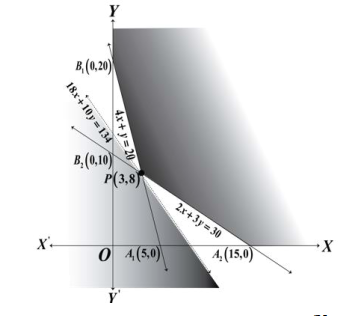
A linear programming problem (LPP) along eith the graph of its constraints is shown below.The correspondig objective function is :Z = 18x + 10y which has to be minimized. The smallest value of the objective function Z is 134 and is obtained at the corner point (3,8).
Image
The optimal solution of the above linear programming problem_______________.